

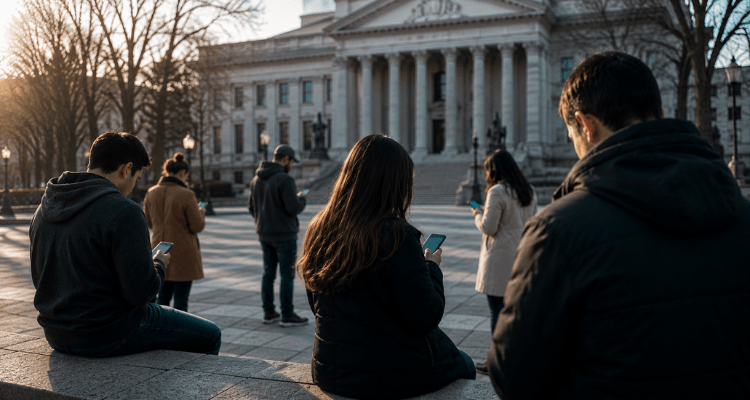
A murder trial was still months away. But in the community where the jury would come from, the case had already started.
Not in a courtroom.
On Facebook.
In a county of fewer than 50,000 residents, one local social media group connected to the community had more than 41,000 members. Posts about the case generated thousands of reactions, comments, and shares.
The question facing the defense team was no longer just about the evidence in the courtroom.
And that raised the question every defense attorney fears: Could their client still get a fair trial?
How Social Media Can Impact Criminal Cases Before Trial Begins
Pretrial publicity is not a new challenge. High-profile cases have always attracted public attention. But social media has made it much easier for opinions to form quickly and spread widely.
In a big city, online talk about a case might reach only a small part of the potential jury pool. In a small community, things can be very different.
In a county with fewer than 50,000 people, those reading and reacting to social media posts might be the same people who end up on the jury. This overlap is important. The real challenge is proving this connection.
A defense team cannot just go to court and say, “Everyone is talking about this online.” The court needs more solid proof.
This is why collecting digital evidence properly is so important.
Documenting the Online Conversation
Our role was not to determine guilt or innocence.
Our job was to preserve what was happening online and turn a rapidly changing digital conversation into something attorneys could actually use. We analyzed public social media posts about the case and recorded the volume of discussion and the nature of the conversations taking place. We documented publicly available content, preserved source information, captured relevant metadata, tracked engagement activity, and created a defensible record of what existed at the time of collection.
How much discussion was happening?
How far was it spreading?
What kinds of opinions and statements were being shared?
These details were important because they gave a clearer view of what was happening around the case.
But gathering this information was just one step.
Making sure it was preserved properly was just as important.
Are Screenshots of Social Media Posts Enough Evidence for Court?
Sometimes screenshots help document what was seen, but they often fail to preserve the information needed to authenticate and defend digital evidence later. Many people assume that taking screenshots of online activity preserves evidence. In fact, screenshots can cause problems.
Screenshots often miss key details, such as where the content came from, when it was collected, whether the page changed, and whether the way it was captured can be verified later.
In litigation, the question is not just: “Did you find something important?” The question is: “Can you prove where it came from and defend how you collected it?”
This means you need a reliable method, the right tools to preserve evidence, and someone who can explain the process if needed.
From Online Conversations to Courtroom Evidence
After the social media activity was collected and preserved, we prepared an affidavit explaining our findings. The goal was to give the legal team a clear and solid view of how much people were talking online, how far the posts spread, and what kinds of conversations were happening in the community.
What we found showed exactly why preservation mattered. The online conversation was not limited to a handful of isolated comments. It represented widespread community discussion involving thousands of interactions across posts, comments, reactions, and shares.
The findings helped demonstrate the scope of public exposure surrounding the case.
That information supported a motion for a change of venue.
The motion was granted, and the case was transferred to another venue.
Following the trial, the defendant was ultimately acquitted.
But the purpose of digital evidence preservation is not to influence the facts of a case. It is to ensure decisions are based on the evidence presented in court—not on the opinions circulating outside it.
The Takeaway for Attorneys Handling High-Profile Cases
Social media can influence how people see a case long before it goes to trial.
Sometimes those conversations fade away. Sometimes posts are deleted. Sometimes the online environment changes so much that it is impossible to piece it back together months later.
If pretrial publicity could affect your case, it is important to save that information as early as possible.
When the issue comes up in court, just knowing what people said is not enough.
You need to be able to show, preserve, and defend that information.