International Due Diligence – Investigative Due Diligence – Hedge Fund Due Diligence

The decision to make a $50 million investment in a company demands rigorous due diligence. The company’s press releases look polished. Its filings appear routine. The registered address is properly listed. But an unannounced visit tells a different story. The company’s “office” is a rusty mailbox bolted to a wall.

There are no employees. There is no signage. The listed phone number routes to an automated voice and an endless hold. This situation sounds theatrical, and watching it unfold demonstrates that this can be a real risk for investors.

Lessons From Sweetpea And Kwabena

In a recent episode of HBO’s Industry, Sweetpea Golightly and Kwabena Bannerman, hedge fund analysts, travel to Accra, Ghana, to conduct a site visit, which involves visiting the locations associated with a business to see whether it actually conducts business at its registered addresses.

In Accra, Sweetpea goes to the registered address of a Tender subsidiary (a payment processing company) and asks the security guard for the location of the company’s office. The guard points to a mailbox. When she asks the guard for a phone number, he eventually provides it, which connects to an automated voice and a never-ending hold.

Her colleague, Kwabena, luckily knows someone who was affiliated with Tender’s subsidiary, who, during a conversation, admitted that Tender paid less than the $50 million it claimed in a news article. This source also provided the subsidiary’s actual office address.

This human-source interview yielded two helpful leads. First, we learn that what Tender publicly reported about the acquisition of the subsidiary was untruthful, according to this source. Second, the interviewee provided a physical address to allow for a second site visit.

Sweetpea and Kwabena traveled to the address the source provided, arriving at a warehouse that appeared abandoned. They went to the subsidiary company’s floor and found a mostly abandoned office space. Two security guards sat behind a desk in the middle of one of the rooms, monitoring video feeds to ensure there were no squatters. Sweetpea again called the number the guard provided her from the first site visit. The phone on the guards’ desk rang; one guard picked it up, then hung up immediately, and the automated voice began speaking. Sweetpea and Kwabena called their superiors to inform them that this operation appeared to be a fraud.

Real-World Takeaways

When conducting an enhanced due diligence investigation, research is essential to uncover new findings for the client and verify previously reported information about the subject (a company or person). The value of having someone complete a background check questionnaire (also called a due diligence questionnaire) is that it allows the subject to be transparent with both its business partner (our client) and the investigator who verifies this information (us).

While it would be alarming to discover that EU entities sanctioned a potential business partner or that a potential investor has declared bankruptcy multiple times, it would be even more disturbing if this entity claimed to have never been sanctioned or involved in legal proceedings, including bankruptcies. Being sanctioned and filing for bankruptcy multiple times are significant red flags. Blatantly lying about these matters is another one.

While this was an extreme case suited for television, this site visit and the interview with the human source were instrumental in helping these analysts conduct their due diligence. Many investigations rely solely on open-source intelligence, often conducted behind a desk. Site visits and human-source interviews can provide information that desk research cannot. Even if Sweetpea and Kwabena had the addresses for both the mailbox and the warehouse, they could have used an online map service to view the locations from the outside. If they had only done this, they would not have discovered that no company was conducting business behind these doors.

Since the human source and the news article provided different answers regarding the price Tender paid for its subsidiary, analysts would conduct additional research, attempting to verify these claims. Some sources are more trustworthy than others. In this case, a human source close to the subsidiary’s owners would likely provide more reliable information than a company’s online claims.

Business intelligence analysts, along with their clients, define the scope of the investigation, but a client’s budget and appetite for risk carry more weight. Human-source interviews and site visits are more costly because they are more time and labor intensive. They can even require working with partner investigations firms, often when the subject is located on a different continent (Sweetpea and Kwabena reside in London). Having to pay for higher-fee due diligence investigations can be a deterrent for clients, as many businesses view them as box-checking exercises. Ultimately, the client determines the scope of an investigation. A smaller scope and budget, while economical, could leave crucial findings uncovered.

Due Diligence Is Cheaper Than Damage Control

Site visits and human sources cost more, take longer, and may involve uncomfortable questions. However, it would be even more uncomfortable to explain to your board that you authorized the transfer of $50 million to a mailbox or to security guards monitoring an abandoned building.

Enjoyed What You Read?

Join 2,000+ others to get insider tips and tricks delivered to your inbox from what has been voted the best blog in the investigative industry!

In today’s world, one wrong headline, viral post, or sketchy association can unravel years of credibility.

A resurfaced tweet. A sealed court record. A “business partner” with an inflated resume. These aren’t rare cases; they’re reality.

We’ve seen celebrities lose endorsements, companies tank mergers, and high-profile professionals get blindsided, all because someone didn’t do their homework.

That’s where background investigations come in. Done right, they don’t just protect you; they help you make smarter, safer decisions. Whether you’re exploring a partnership, fighting some legal claims, or just putting suspicions to rest, real due diligence gives you peace of mind and evidence-based knowledge.

Ethical Background Checks: Using OSINT the Right Way

We lead with ethics—always. Every investigation we conduct is grounded in strict legal and ethical standards, respecting both privacy and the law at every step.

While there are plenty of ways to dig up information, we stick to public, open-source intelligence and official records.

Why?

Because transparency, accuracy, and trust matter more than ever.

The wild part? Most folks don’t realize just how much of their life is floating around online, buried in court filings, tucked into tax rolls, or hiding in a forgotten Facebook post from 2009. Today’s data-rich world means public information is everywhere; you just have to know where—and how—to look. Using OSINT, we comb through massive volumes of public data, connect the dots, and deliver clear, unbiased reports that help you make confident decisions.

We use no hacking and no shady tactics, just intelligence and the effective use of ethically sourced public data.

Not Sure Where to Start? Ask Yourself the Whys

Every productive investigation begins with a purpose.

Maybe you’re worried about whom you can trust. Maybe someone’s story doesn’t quite add up. Or maybe you just want to be sure before you sign that contract, make that hire, or put your name on the line.

Ask yourself:

  • What do I need to know that I don’t already know?
  • What’s the worst-case scenario I’m trying to avoid?
  • Am I looking to relieve a gut feeling or clear up a blind spot?

Clarity matters here.

Without a clear why, investigations can become aimless and expectations can be shattered. With a clear goal, there are no questions of whether you did this or you looked there.

Here’s the thing: Most red flags aren’t hidden behind passwords. They’re sitting in plain sight in public records, social media, or official databases. The key is knowing what to look for, why it matters, and what to do with the findings.

Whether your goal is to verify, uncover, prevent, or protect, we align every part of our investigation with that north star. It keeps the research tight, relevant, and impactful.

Because when the stakes are high, the worst thing you can do is not ask the right questions.

Prefer to Start on Your Own?

At the most basic level, you can take the do-it-yourself approach. Not all investigations need to go full Sherlock Holmes mode off the jump.

Depending on what you’re trying to verify, sometimes you just want to take the first few steps yourself. And honestly, that’s not a bad move, because doing something is better than doing nothing.

Simple background checks can start with a well-crafted Google search. Social media profiles, news mentions, and even court records in some states are easily searchable online. Dozens of low-cost background check services can pull basic details like addresses, phone numbers, names of relatives, and criminal records.

Just keep in mind that these tools often provide surface-level or outdated info, and they don’t distinguish between someone with the same name in another state and your subject. We’ve seen automated reports miss glaring red flags or, worse, flag the wrong person entirely.

If you’re starting there, great. But if the results raise more questions than answers or if what’s at stake is worth taking seriously, it might be time to dig deeper with professional help.

When to Bring in the Pros

If you need real answers quickly and have a minimal budget, our Red Flag Background Investigation is often the best place to start.

It’s far more thorough than any generic online background check. We don’t rely on automated reports or surface-level snapshots. Instead, we methodically review the past 10 years of court filings, criminal records, professional licenses, and online behavior, looking for signs of deception, instability, or patterns that warrant concern.

This level of research is ideal when you need to confirm that someone’s clean or to know for sure if they’re not. We’re often brought in to vet potential investors, business partners, or plaintiffs in legal disputes before the pen hits paper. Think of it as your due diligence firewall—focused, fast, and able to catch what surface tools miss.

Here’s what that looks like in practice:

  • A healthcare investor we work with acquires small medical clinics across the U.S. These aren’t massive deals, but they’re still high-risk matters in a highly regulated industry. A $20,000 investigation wouldn’t make sense, but neither would a quick Google search. That’s where we come in. We analyze court records, licensing boards, and social media to flag anything that might signal trouble. It’s just the right overview level to protect the deal without overextending the budget.

Red Flag Background Investigations are designed to surface the truths that change outcomes quietly, efficiently, and without breaking the budget—and before it’s too late.

Need a Deep-Dive Background Investigation?

When the stakes are higher—eight-figure investments, complex litigation, high-profile partnerships—you can’t afford to make assumptions. You need the whole picture.

Our Deep-Dive Background Investigation goes far beyond basic checks. We reach back 25 to 30 years or more, connecting the dots across assets, legal entanglements, business ties, behavioral patterns, and hidden risks. It’s not just about what someone has done—it’s about how their past could impact your future with them.

Here’s what that looks like in the real world:

  • A global conglomerate asked us to vet the leadership team of a public company they were planning to acquire. The CEO looked perfect—until minor inconsistencies in his biographies led us to dig deeper. Yearbooks didn’t list him. Graduation records were missing. The truth? He never attended the school he claimed to have graduated from. That lie broke his credibility and the entire deal.

Unlike a Red Flag Background Investigation, a Deep-Dive Investigation goes that extra step to ensure no stone is left unturned and your concerns are turned into answers.

Let’s Start Digging

Public records are out there, but finding them is only half the battle. The real challenge? Knowing how to dig, verify, and understand court filings, property records, voter rolls, political donations, and business documents.

Official records like DMV data, degree verifications, or licensing checks are foundational. These concrete pieces of information add validity to data that may seem insignificant in the bigger picture, but if they’re incorrect, they can change an entire investigation.

To put it into perspective, a simple court record search for “John Smith” in New York can return hundreds of results. Using verified information and sorting through that noise take time, training, and a sharp eye.

Social media, meanwhile, gives us a candid window into someone’s life and relationships, affiliations, behaviors, and values. We’ve traced business investors back to high school friend groups, exposed lifestyle contradictions, and surfaced patterns no public record would reveal.

And increasingly, breach data has become a powerful investigative tool. When email addresses or usernames appear in data leaks—from forums, financial platforms, dating sites, or even adult websites—it can reveal associations most people would never disclose. These details can provide crucial links to hidden assets, business activity, or behavioral patterns.

If we feel our resources have been exhausted, another step we can take is to go directly to the source. Interviews are a powerful method of data collection that can confirm, challenge, or expand on what we’ve already uncovered, adding context, nuance, and occasionally the missing link that ties everything together.

Our comprehensive approach to investigations combines various tools and proven methods for cross-referencing records, spotting inconsistencies, and confirming identities.

The bottom line? Anyone can search, but making sense of what you find is where we come in.

Why Even the Best Background Checks Have Limits

Even the most rigorous background investigation isn’t a crystal ball.

You can dig deep into someone’s past and find a manicured lawn, a picket fence, and a picture-perfect appearance but still end up blindsided. A clean record doesn’t mean clean behavior forever. It just means nothing’s happened … yet.

We’ve seen people with spotless records spiral six months into a business deal. We’ve watched clients get burned by folks who “checked every box” on paper but whose judgment unraveled under pressure.

Even the most prestigious executives have made headlines after appearing on the jumbotron at a Coldplay concert, revealing their personal affairs. You can’t make this stuff up. Sometimes there were no warning signs.

The truth is due diligence is about reducing risk, not removing it. It gives you the best possible information today so you can make smart decisions tomorrow. But humans are unpredictable. That’s why context and patterns matter as much as data points.

Better Safe Than Sorry: Why This Work Pays Off

The truth is that most people aren’t hiding anything. But the ones who are often slip through the cracks simply because no one checked.

A thorough background investigation isn’t just smart; it’s often the difference between a smooth partnership and a PR nightmare.

We’re here to help you avoid that.

Let’s dig deeper, ask the right questions, and keep your reputation clean before it ever gets tested.

Enjoyed What You Read?

Join 2,000+ others to get insider tips and tricks delivered to your inbox from what has been voted the best blog in the investigative industry!

The risks associated with identifying a business’s ultimate beneficial owner (UBO) have become more complex now that sanctions are being used for untraditional purposes. The business intelligence sector helps firms maintain compliance with sanctions and the Federal Corrupt Practices Act (FCPA). To avoid violating sanctions or the FCPA, these analysts are tasked with identifying and researching companies’ decision-makers (or UBOs) on behalf of their clients. Businesses should consider risks beyond sanctions or the FCPA to avoid fines or other penalties, as emerging and more abstract risks pose a new threat.

Sanctions and the FCPA

Sanctions are regulated by the U.S. Treasury Department, specifically the Office of Foreign Assets Control (OFAC). On its website, OFAC states that sanctions are used “to accomplish foreign policy and national security goals.” For example, in December 2014, sanctions were imposed on Venezuelan security forces due to violence against student protestors. To avoid fines, business intelligence investigators are tasked with ensuring a client’s business and business partners and its principals (the UBOs of a company) are not sanctioned. However, in 2024, U.S.-based entities were fined around $48 million due to conducting business with a sanctioned entity, which can be a person, company or country.

Besides sanctions, firms can face financial penalties if they violate the FCPA. The FCPA of 1977 seeks to prevent U.S.-based companies from engaging in corruption or using financial incentives paid to foreign government officials to benefit the company’s business operations. The Department of Justice and the Securities and Exchange Commission (SEC), which oversee FCPA enforcement, received nearly $1.3 billion in fines in 2024. While the White House is not enforcing the FCPA at this time, it can be enforced against companies in the future due to the five-year statute of limitations. While harder to identify than sanctions busting, investigators leverage open- and human-source intelligence to evaluate a business’s operations to ensure compliance with the FCPA.

Emerging Risks in Brazil and India

Currently, there are heightened geopolitical risks in multiple jurisdictions, such as Brazil and India. Therefore, solely conducting sanctions and FCPA research is insufficient, and greater analysis of UBOs is needed.

In Brazil, a Supreme Federal Court justice was sanctioned in July. In August, tariffs on Brazilian imports followed due to the White House’s opposition to charges against President Jair Bolsonaro. As U.S.-based companies do business in Brazil, they will likely want to assess risks associated with companies or their UBOs who support the charges against the former president. While this is not a typical risk for business, it is a reality of the present moment. As business intelligence firms research Brazil-based entities, assessing political views should be a part of their overall analysis. Businesses may be associated with greater risk if the company or its UBOs have public opinions that directly contradict the views of the White House.

India, too, is facing U.S. tariffs due to its government’s decision to continue purchasing Russian oil. This will likely create risks when engaging with Indian companies. First, Indian goods will become more expensive. Second, the White House may seek to take additional punitive steps if the 50% tariff rate does not result in the change it seeks. These could be sanctions against Indian companies or UBOs directly involved in purchasing Russian oil. In the alternative, the White House could fine U.S.-based companies that are working with Indian companies that are involved in the purchase or transfer of Russian oil. Assessing these risks will require in-depth analysis of these supply chains.

Beyond Compliance: Why Emerging Political Risks Demand Proactive Analysis

While these emerging risks have yet to materialize into fines or penalties for U.S.-based firms, the risks remain elevated as the White House takes untraditional steps to pursue its policy goals. While U.S. companies can still do business in Brazil, India and other nations with certain geopolitical risks, business intelligence analysts should consider these emerging risks to assist their clients in operating efficiently and free of regulatory obstacles.

Enjoyed What You Read?

Join 2,000+ others to get insider tips and tricks delivered to your inbox from what has been voted the best blog in the investigative industry!

Recently, we have been working with two business owners regarding what they believed were sealed or expunged criminal records.

These cases had very different outcomes.

In the first scenario, a financial institution scrutinized a business owner when he applied for a significant loan. A background check was conducted as part of the evaluation process, and it revealed a felony record for dealing in stolen goods. The business owner, believing that his record had been expunged, was taken aback by this revelation and questioned the result.

In the second case, a man was selling his business and was subject to a background check as part of that process. The businessman believed that an old criminal case from his college days had been sealed, but he wanted to double-check. The client ran a TruthFinder search on himself and didn’t find the record. This was not terribly surprising, given our previous testing of TruthFinder. Not only did we find the criminal record, but we also found a second criminal case against him that he had completely forgotten about. Neither of the cases were sealed, and both were open to the public.

Neither of these situations was as straightforward as they seemed.

In the first scenario, the business owner had gone through the entire process of sealing and removing his record from the public realm. So, if anyone ever went to the court and searched the official records, the result would come back with no records.

However, we found the record in numerous investigative databases, and it turns out that the financial institution had also found the record in one of those databases. There is a dirty little secret in the world of public records: many of these local jurisdictions sell these records to various database aggregators, so once they are out in the wild, so to speak, it’s difficult to rein them back in. So, in this case, the record had been sealed many years after it was filed, so while it was removed from the official records, the record remained in the reports that could be obtained from dozens (if not hundreds) of various database providers that maintain these records.

The client is now going through the resource-intensive process of removing the record from these various database providers.

In the second scenario, the client was adamant that the case he was aware of was sealed. After all, he didn’t find it on TruthFinder. But as we have found before, TruthFinder’s criminal record repository can give you a false sense of security. So we dug our heels in, thinking that we were going to have to get creative about finding any record of the case, like by contacting the police or checking old police blotters.

So we were surprised when it came up in a few databases and even more surprised when a second case came up. The court where the offense took place also confirmed the records and sent us copies of the cases. Both of the cases were really old and, frankly, not particularly meaningful given that the client hadn’t been in any trouble for 20+ years, save for a few minor run-ins with the police in college. Nevertheless, they were pretty serious offenses, and their discovery could jeopardize the entire deal.

What are the takeaways from these two scenarios?

  • If you are a businessperson and subject to potential scrutiny, you should conduct your own due diligence to ensure that any purportedly sealed or expunged records are not out there. Don’t just assume that nobody will be able to find these records once they’re sealed. Nothing could potentially kill a deal faster than lying on a background investigation questionnaire.
  • Even in cases where a record is officially sealed with the court, it may exist in perpetuity in various other investigative databases because many counties and courts sell their information to third parties. Removing the records from the various databases is relatively straightforward, but it’s a time-consuming process. Intel Techniques’ Data Removal Guide is a good place to start.
  • For any motivated party, there are still many other ways to find criminal offenses, including calls for service records through local law enforcement.
  • The various online database “background check” providers can give you a false sense of security. If you’re seeking an affordable method to uncover some personal but incomplete information, TruthFinder might be a viable option. However, if your goal is to obtain reliable and comprehensive information more than half the time from reputable sources, it may be better to consult a professional.

Enjoyed What You Read?

Join 2,000+ others to get insider tips and tricks delivered to your inbox from what has been voted the best blog in the investigative industry!

I can’t seem to wrap my head around a bizarre phenomenon in the due diligence background investigation space: lying or omitting information on a background check questionnaire.

So, let me lay out a scenario for you.

The Scenario

A private equity firm is considering making a multimillion-dollar investment into a company. The private equity firm will do its due diligence on the company’s financials, reputation and legal issues. Before the deal is completed, one of the final pieces of due diligence is for the private equity firm to do a background investigation on some of the company’s key principals. The firm likes the business and is ready to make the deal but wants to be sure that the executive team members do not have any significant issues that the purchaser should be aware of. After all, the firm isn’t just buying the company, it is also acquiring a group of executives to run it. The private equity firm has an obligation to its investors not to employ a bunch of felons.

As part of that process, the private equity firm typically retains a third-party investigative firm to conduct some due diligence background investigation on the company’s principals in which it is investing.

As part of that process, the company may provide some forms for the principals to fill out, like an authorization to release information and a background investigation form. The authorization helps with things like employment history and education history. Or, if a credit report is part of the process, which is usually reserved for those in a financial capacity, the release is also necessary.

The background investigation questionnaire asks the executives for some personal information (full name, date of birth, etc.) and information on their personal and professional history, such as names of employers and schools attended. The questionnaire may also ask whether the person has been involved in any civil litigation or bankruptcy cases or has a criminal history.

In any case, the background investigation questionnaire has a dual purpose. The first is to create a concise document with all personal details, and the second is to allow the person filling out the questionnaire to self-reveal certain pieces of information, like a previous DWI, divorce or landlord-tenant case.

Usually, these are solid executives with pristine backgrounds from big-name schools and some high-end professional jobs. These executives have been part of this process before, having worked for some prestigious employers or been the subject of due diligence from other banks or financial firms that have been scrutinized. More often than not, these executives know what to expect.

In other cases, companies have grown over the years from small mom-and-pop shops to small-to-mid-sized businesses, and these professionals have never really been questioned about their background nor been scrutinized by investors or banks.

It’s usually with this latter group that I have seen issues pop up.

Over the years, I have personally seen hundreds of instances where executives have omitted, falsified or misrepresented information. I guess I shouldn’t be surprised, but this is what boggles my mind.

These executives, who have obviously been pretty successful businesspeople, think it would be smart to omit, falsify or misrepresent information on their background check questionnaire submitted to a private investigator.

Mind blown. 🤯

So let’s play this out. When filling out these forms, these executives have two options:

Full Disclosure

So what if you decide to fully disclose whatever your past issues were? I imagine that these executives might be thinking, “What if I reveal personal information that could not be known unless I revealed it to them?”

No matter how bad it is and how much you hope nobody will ever find out, it will probably come up anyway. And if it doesn’t come up, at least you were upfront and honest about it, allowing the executive to get in front of the narrative to explain the situation.

Jason Feifer recently wrote about an employee revealing his past conviction history on his blog. The employee could have told his manager about his background or waited for his manager to discover the news. He chose to disclose the information. The employee owned the information. This way, he could explain it himself and humanize the situation. And he got the job.

Disclose Nothing

On the opposite end of the spectrum, the executive may choose not to disclose anything.

Say the executive has some minor, not-so-significant criminal history or a legal fight with a former business partner or possibly a more serious battle with a former spouse that they don’t want to disclose (maybe their employer doesn’t know about it).

Instead of fully disclosing the information, the executive rolls the dice and hopes nothing is found. Or maybe they think the forms and background check are all pomp and circumstance and aren’t really searching for anything. Or maybe they think the old criminal record was expunged from their record long ago and can’t be found.

So maybe the investigator doesn’t find anything, and the coast is clear.

But more often than not, these issues arise, and now the private equity firm is questioning everything. Now, it’s a matter of trust.

Why would they hide this?

Did they think we wouldn’t find out?

Seeds of Doubt

Just in the past few years, I have seen falsified degrees, unreported disciplinary actions, undisclosed business disputes with allegations of stealing, lengthy criminal sentences with jail time and executives who had been charged with possession of child pornography.

All of these have led to some serious questions about trust.

Sometimes, it is more nuanced, like fudging dates of employment to hide an undisclosed position they were fired from or a period of unemployment or listing professional organizations that they weren’t really a part of. Maybe a military history wasn’t quite what they disclosed.

While these are a bit more nuanced, all the scenarios create a seed of doubt. They create suspicion, leading the private equity firm or investors to question or doubt something previously believed or accepted without hesitation. Skepticism or uncertainty arises in the trust, belief or confidence in a particular situation or individual.

And sometimes, it can lead to a deal falling apart.

Conclusion

As the saying goes, one lie is enough to question all truths.

The most epic example of this is George Santos, who started with misrepresentations and half-truths that eventually led to outright lies, a full-blown criminal investigation and an ouster from Congress.

My suggestion, 100-times-out-of-100, is to be upfront and honest.

Dishonesty, whether small or significant, can plant seeds of doubt that undermine trust.

In business and life, everything starts with trust.

Enjoyed What You Read?

Join 2,000+ others to get insider tips and tricks delivered to your inbox from what has been voted the best blog in the investigative industry!

Newly elected congressman George Santos is probably the biggest public-facing background investigation failure that the world has seen, and it’s a good reminder for the private equity community about investment due diligence and background investigations.

In case you don’t know the whole story, George Santos was elected to Congress from his district on Long Island back in November 2022. He ran as a “seasoned Wall Street financier and investor” who had worked for the likes of Goldman Sachs and Citigroup and owned a real estate portfolio of 13 properties. Santos purportedly received an undergraduate degree from Baruch College and at one point claimed to have received a degree from NYU as well. His firm, Devolder, was reportedly his “family’s firm” that managed $80 million in assets, including multiple properties.

After his election, the New York Times revealed that much of his personal and professional history was a figment of his imagination:

  • Baruch College had no record of Santos’s attendance or degree.
  • NYU had no record of Santos’s attendance or degree. Interestingly, it appears that he stuck with his story of graduating from Baruch, save for one instance where he indicated that he also went to NYU.
  • Citigroup had no record of Santos working for them.
  • Goldman Sachs had no record of Santos working for them.
  • Santos was evicted twice for a few thousand dollars in rent, despite being a “seasoned Wall Street financier.”
  • His “$80 million” family firm had no “public-facing assets.”

Oh, and to top it off, Santos also had a pending criminal case in Brazil for check fraud!

Subsequently, other questions have been raised about his Jewish heritage and sexual orientation, and he even lied about the death of his own mother.

Frankly, the question is whether or not he has been truthful about anything. But I digress.

Nevertheless, Santos ultimately confessed that he “never worked directly” with Goldman Sachs and Citigroup, stating a “poor choice of words.” He also never graduated from any “institution of higher learning” despite claiming to do so in multiple places. 

It’s rare to see such a pathological liar to be uncovered in such a public forum. Especially with politicians, in part because there is so much at stake in politics and ridiculous amounts of money involved, so there is plenty of motivation for various parties to dig up dirt on the opposing side and feed that information to the media.

But something clearly was amiss here.

How did everyone miss this? After all, the opposition had published an 87-page report on Santos. 

Could this have happened in a private equity investment? After closing on a transaction, would it be possible that the head of the new company was an outright liar?

Probably not. There are quite a number of protections in place during the due diligence process to not let that happen.

But there are certainly a few lessons that one can extract from this epic failure. 

Avoid Your Biases

I think it’s relatively safe to say that if any of these various embellishments, outright lies or criminal activity had come up prior to the election, it probably would have changed the outcome.

At least I hope so.

And if this had come up during the due diligence process in a private equity transaction, one would hope that it would have at least altered the deal, or possibly have killed the deal altogether. I mean, imagine if the new CEO of the company that a private equity firm was purchasing for millions of dollars was an outright liar?

Of course, if zero background investigation occurred, maybe it would have been missed. But let’s just assume that some background investigation would have been conducted.

In my experience, I have seen plenty of deals go through because of what I will call conservatism bias.

Conservatism bias is the process in which people maintain their past views at the cost of recognizing new information. In the case of private equity transactions, conducting a background investigation on the key principals is typically one of the final pieces of the due diligence process. By that time, the firm has invested months of time and tons of resources into their due diligence and investment decision process.

For example, suppose in the final weeks of a lengthy due diligence process a background investigation reveals that the founder and key future employee has a history of serious financial issues, misrepresented some details of their life and has had a bit of a messy personal life. But because the firm is so invested in the process and doesn’t want to rock the boat, they cling to their prior views that the founder is a good person, so they don’t address the issues and instead continue with the investment.

I’ve seen it happen dozens of times, where firms either ignore some pretty significant red flags or underreact to the new information, all for the sake of getting the deal done.

Sometimes it works out, but sometimes it doesn’t.

Gather Data => Summarize into Intelligence => Act on Intelligence

In the case of George Santos, the Democrats had done quite a bit of opposition research.

It wasn’t for lack of information. The Democrats had published an 87-page report on Santos. For the two people that had actually read the lengthy document, there were hordes of information on his political views, and it did reference the evictions, but it didn’t get into his degree (or lack thereof), his work history, the lack of assets for his family’s firm or his criminal history in Brazil. And someone clearly spent dozens of hours scouring through every tweet he has ever made.

But there were a couple of major failures here.

Anyone can gather data, but that data does no good if it’s not turned into succinct intelligence that is acted upon.

Clearly, few people read the 87-page report in much detail, or even the 10-page-long executive summary, which included minute details such as “Santos’s [sic] website had an issues page as of January 2021, but it was later taken down” and “Santos filed a Personal Financial Disclosure covering calendar year 2020.”

It’s just too much information, if you ask me.

How about if the first few lines of the executive summary read:

  • Santos claims to have worked for Goldman Sachs and Citigroup, but we have found no information to suggest that he has ever worked at either company. Similarly, we have been unable to find any information to support his degree at Baruch College or New York University, and we have found conflicting self-reported biographies about his attendance at the schools. We have been unable to verify his degree without a signed consent form.
  • Despite running his family firm with more than $80 million in assets, including multiple properties, property record databases have not shown any documents or deeds associated with him, immediate family members or his “family run” company, the Devolder Organization.
  • In 2015 and 2017, Santos was the subject of two eviction proceedings in Queens County for a few thousand dollars, yet over the last few years he appears to have run into significant wealth, reportedly earning $750,000 a year from his company along with dividends in the $1 million to $5 million range, according to financial disclosures. 

Would that have caught someone’s attention? My guess is probably yes.

So the first failure was the inability to succinctly turn that data into intelligence.

And the second failure was the failure to act on the data.

This happens in the investment space pretty often.

A few years back, we worked with a small family office on an investment opportunity. Concerned about their reputation, the family office told us that we should contact them immediately on the first sight of any possible issues.

So when we found some criminal issues, some pretty significant professional history discrepancies and some politically sensitive social media posts, we thought the deal would be over.

But it wasn’t.

We never got any insight into why the deal ultimately went through, and we are not privy to every conversation that happens. But if I were a betting man, I would guess that this deal will eventually go sideways.

Get Permission, Obtain Forms and Address Issues Head-On

In a private equity transaction, almost certainly a situation like George Santos could have been avoided with a simple signed release and a background investigation form requiring an individual to disclose their personal and professional history and any known civil litigation and criminal history.

Not all firms require this, which in my belief is a major oversight (and a topic for another day).

In the case of Santos, he claimed to have worked for Goldman Sachs and Citigroup, and at points that he had graduated from Baruch College and New York University, although he reportedly never furnished any dates to substantiate the claims of his professional and educational history. (The missing dates should have been a clue!)

The New York Times was able to determine that Santos never went to Baruch College or New York University and never worked at Goldman Sachs or Citigroup by reaching out to the schools and companies to seek comment.

Sidebar: Most schools won’t publicly verify degree information without a signed release, but I suspect the reporter was able to get the school to comment due to the weight of the New York Times and the story. Technically, degree details are considered directory information and are available publicly. But you can only access the information through National Student Clearinghouse, which has a monopoly on this information; the website requires permission from the student. I’ve vehemently argued with the schools and National Student Clearinghouse about this topic, and it enrages me that we can no longer get this information! (This too is a topic for another day.)

The 87-page report relied on Santos’ public statements in referencing his professional work history; they didn’t even bother trying to verify this information. They obviously didn’t have his permission, but even without his permission, a little digging in regulatory filings would have probably raised a red flag.

In the background investigation process for a private equity transaction, there are certain crucial steps, one of which is verifying that the person is who they say they are. Some basic steps in this process are things like verifying their name, date of birth and Social Security number and that they are, in fact, an actual human being.

Among those steps would be to verify work and education history. It can be a pretty simple, straightforward way of determining if the person is actually who they say they are. Like, did the incoming CFO really go to that Ivy League school and work for one of the Big 4 accounting firms?

To verify employment and education history, you need a list of the person’s professional and education history. In most cases, however, verifying employment and education requires a signed release.

Best practices call for getting a signed authorization and a good background investigation disclosure form, which can gather all the relevant details in one place.

And while you are at it, it’s also a good practice to have the person self-disclose any criminal history, litigation history or other history that you might be interested in knowing more about. It gives them an opportunity to openly disclose the issues. You might be surprised by how many people don’t self-disclose information, which, in my view, can be pretty revealing about a person’s character.

And to further avoid any issues, a good practice is to address the issues head-on with the subject of the background investigation.

So, for example, if they failed to disclose certain issues, misrepresented themselves or have a history of litigiousness that needs some additional color, talk it through with the person.

Was it an oversight? A misunderstanding? Or did some additional context clarify things?

Or is there something more nefarious going on? A lack of clarity, deflection of blame or outright denial may lead you down a different path. 

In Conclusion

On the biggest public stage, George Santos, with everyone watching and an enormous amount at stake, was able to literally make up his entire life and get voted into Congress. The greatest trick he pulled was to convince the world that George Santos was someone that he wasn’t.

Even in this age of information, with so much available at our fingertips, don’t think for a second that there isn’t another George Santos out there, trying to convince the world he is someone he isn’t.

Enjoyed What You Read?

Join 2,000+ others to get insider tips and tricks delivered to your inbox from what has been voted the best blog in the investigative industry!

Recently, I was having a discussion with a fellow private investigator about a background investigation report that was produced by another private investigation firm. The report has some glaring holes and a lack of depth, and the vast majority of the report was a cut-and-paste job from various investigative databases.

Some of these so-called holes and what I consider big issues may have an explanation, but the background investigation report was on THE key witness in a case with major implications and a lot of money at stake. I understand that there are times when you need to cut some corners, but this was not one of them.

This happens quite often in our line of business. I’ve seen private investigators send a $15 “comprehensive report” from the investigative database provider TLOxp (owned by Transunion) to an attorney, charge them $500, and call it a background investigation.

Note to anyone who does that: attorneys can get access to TLO too.

I am here to tell you that sending a comprehensive database report to an attorney and charging them multiple times what the report actually costs is not a background investigation. It’s doing no service to anyone.

Raw data + zero analysis = no value-add.

So, here are what I see as some glaring holes in background investigations.

1) Relying on Databases With Limited Access

Background investigations rely on both public and private databases for information. These databases get information from a variety of public data (e.g., criminal records, property records, voter registration records) as well as private data (e.g., phone information, credit header information). But a database is only as good as the information contained in the database itself.

So, for example, each database has its own set of phone information, driver’s license records and criminal records, some of which are more complete than others.

But NONE of them covers everything. ALL criminal record databases have major holes; even the FBI’s national criminal database (NCIC) has some huge holes.

2) Failing to Note the Limitations

Digging deep into someone’s background takes time and effort. Sometimes clients just don’t want to pay for that time and effort, which is understandable. A client may not want to spend thousands of dollars in order to learn “everything” about someone.

If you need to go back only five or 10 years in criminal history searches because you didn’t have the budget to do criminal history searches in 14 jurisdictions, say that in your report.

If you were only looking for derogatory or controversial social media posts because you didn’t have the time to analyze 82,000 tweets, say that. 

Just please don’t say, “We searched his criminal history and found nothing.”

Because that literally means nothing.

3) Not Multisourcing

As stated earlier, databases are only as good as the information that they contain. Each database provider offers different sources of information. Some are good for some things, while others are better than others. Any good background investigation will search multiple sources of information even if they overlap. For example, PACER is a great tool for federal, civil, criminal and bankruptcy cases. But its search capabilities are absolutely archaic. And PACER will only search for plaintiffs and defendants. That’s it.

Free services like RECAP or paid services like Bloomberg Law, Westlaw and Lexis Nexis allow you to use more advanced searches to find name variations and also includes searches of the docket sheets, which can show you if someone has filed an affidavit, testified or been a witness in a case. And the paid services allow you to search the actual court filings, so you may be able to find a hidden gem of when someone was involved in a case but not named as a party.

4) Cutting and Pasting

Just the other day, a new client reached out looking for some information on her daughter’s ex-husband. The potential client told me that the last investigator had been a waste of money because that investigator had “merely cut and pasted information from PACER.”

In the age of the internet, potential clients are smart and savvy.

Don’t cut and paste information from sources that can be easily found via a few Google searches.

Leave the cutting and pasting for the kids.

5) Not Vetting Information Through Reliable Sources

I’ve spent a good portion of this post talking about investigative databases. The ones private investigators use include TracersInfo, TLOxp, DelvePoint, IDI and Accurint. In vetting other public records and news sources, sites like Westlaw, Factiva, ProQuest, LexisNexis and Bloomberg Law are extraordinarily valuable as well.

All these services have their benefits, but the one limitation that they all have is that they rely on information from elsewhere. So, for example, one of these services may report some criminal history, but in order to rely on the information, getting the information from the actual source or local court is critical. Databases get information wrong, so vetting the information from the original source is critical. 

And before you ask, all of these databases have their benefits, but none of them is the “best.”

6) Lacking Analysis

I often see background investigation reports regurgitating database information with a lack of analysis. The prime example of that would be bankruptcy and litigation records. It’s obviously useful to know that a bankruptcy is filed, but an analysis of the bankruptcy petition, which lists assets, loans, income, retirement, children, corporation interests and other valuable information would be a bit more telling. Did the person have hundreds of thousands of dollars in credit card debt? Or did they get laid off and fall on hard times?

Litigation documents can be telling as well. Do the records suggest that it’s more of a course-of-business collection case, or is there some deeper issue of abuse, threats or harassment?

Similarly, knowing that a criminal case exists is one thing, but knowing the intimate details of the filings is another.

All of this adds some contextual information, not just a data dump.

7) Including Opinions

I read a background investigation report produced where the investigator wrote that they were “very moved by his social media presence,” he appeared to be an “encourager and uplifter,” and it was “evident by his presence that he had worked very hard to reform his life and become a shining example for men like him.”

I’m not making this up.

There are so many things wrong with this I don’t know where to even start.

But, clearly, this investigator never watched “Dragnet.”

Just. The. Facts.

8) Not Researching Name Variations

One of the first steps I teach investigators is to confirm a person’s name. Seems silly, but it’s a critical piece.

Why? Well did you know that the actor John Wayne was born Marion Robert Morrison? Or that Michael Keaton is really Michael John Douglas? Or Brad Pitt is William Bradley Pitt?

Researching records on these guys would be a nightmare. Think of all the name variations that you would need to conduct searches under. Remember, computers aren’t smart enough to know that Brad Pitt and William Pitt are the same person. For example, most court records or official documents would include the real full name, while references in other places might include their stage name.

There are also married names to contend with. Like actress Jada Pinkett Smith, wife of Will Smith. She might have records under Jada Pinkett, Jada Smith, Jada Pinkett Smith or Jada Pinkett-Smith.

Conducting a background investigation under name variations is critical to providing a complete, accurate background investigation.

9) Lacking Clarity

Last, but not least, the biggest mistake I see is that a private investigator lacks the clarity of what the client is looking for.

A few months ago, I was speaking with an attorney who wanted to find “anything and everything” on several individuals involved in a multimillion-dollar lawsuit. When it came down to it, however, the client was convinced these guys were lifelong fraudsters and was really only trying to see whether they had any significant issues in their past to confirm suspicions.

Those are two very different things.

So, does your client want to make sure that the person is not a convicted felon, wanted by the FBI and on the terrorist watch list?

Is the client on a dirt-digging exercise to find “anything” that may impugn a person’s character?

Are you trying to find holes in a person’s history to challenge their credibility?

Or are you working for an investment firm that just wants to check a box to make sure that the person is legitimate?

Each of these requires a whole different approach.

Enjoyed What You Read?

Join 2,000+ others to get insider tips and tricks delivered to your inbox from what has been voted the best blog in the investigative industry!

Henk van Ess has been on my radar for the past few years. He’s a former investigative journalist who’s morphed himself into a social media investigative guru. He’s done work with a bunch of major media outlets and worked as a trainer and contributor to Bellingcat (a group of open source journalist nerds), but these days, he mostly does workshops, which included a whirlwind January tour with media outlets including ProPublica, NBC News and the Wall Street Journal.

For me, Henk came into the spotlight in June 2019, when he became the de facto spokesman for the investigative community when he was quoted in several publications regarding Facebook Graph Search changes, which effectively killed the wealth of public information that Facebook could provide to investigators. Since that time, investigators around the world have been scrambling to find a fix.

In the world of open source investigation and techniques, there are a few people who are at the forefront — Michael Bazzell of Intel Techniques and Henk van Ess are two of them — and I listen to whatever they have to say. So any chance I have to meet one of them or learn from them, I am on it.

While most of Henk’s workshops are closed to the public, the last stop on his monthlong tour was an open event in New York City, hosted and sponsored by SkopeNow. I recently had considered flying to Amsterdam to take one of his courses, so this was a pleasant surprise and an easy choice, being right in my backyard.

According to Henk, I was literally the first person to sign up!

In short, the workshop was extraordinarily informative, and I got to meet some really interesting people. When you are learning from somebody who literally trains the most powerful investigative news reporters in the world and has done some really interesting work himself, you listen.

For me, part of this was a validation of things that I already knew. Some of it was an important reminder of how to think. And some of it was brand new.

Becoming a web search expert is no easy task; the landscape is constantly changing.

Although we were packed in like sardines, the interactive nature of the class was difficult with the large class, and teaching a diverse group at different investigative levels was a challenge, all of this got me really excited.

So, here are some fun tips, tricks and quotes I picked up over the two-day course.

If you are interested in getting some training yourself, Henk does private internal training, but he also has a course in March in Amsterdam and is doing a course in Washington, D.C., in June 2020 that you should be on the lookout for.

(You can follow him on Twitter, Facebook or LinkedIn to get some news on that.)

Investigative Techniques

Think Like a Child

Funny that Henk mentioned this, because this is something I have written about before; it’s one of the favorite blog posts I have ever written. One of our tasks was to identify the location of a photo that contained a partial sign from a park. One of the keys to finding the sign was to type in the color of the sign. Almost nobody in the class thought to do that because it was so obvious and simple.

Behave Like a Computer

Computers are not human. So if you are looking for a map of something, most “maps” don’t have the word map on them. Computers rely on rules; humans use rules too but can infer from experience as well.

Google Triple Search

Henk coined the term “Google triple search,” which effectively looks for three separate terms, for example: “brian” “willingham” “diligentia”

Using Google triple search will help eliminate false positives. So in this case, using the triple search will identify postings relating only to me, as there are a number of other Brian Willinghams out there, including a former police officer and a California real estate agent.

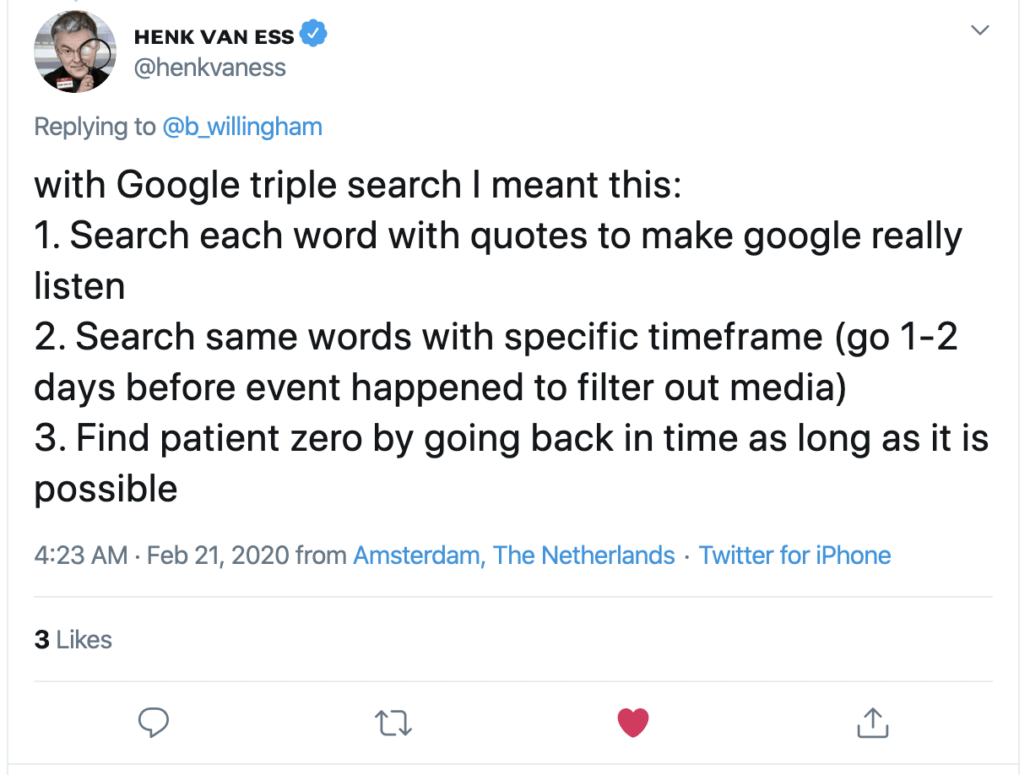
UPDATE: Turns out I had the “Google triple search” all wrong, as Henk later clarified on Twitter:

Falsification

The principle of falsification is trying to disprove a theory or information. So, for example, we went through an exercise of trying to show that a profile photo for a purported Russian spy was not, in fact, taken on the day it was purported to have been taken. In this case, we had to prove only that something was untrue.

Quotes

“For any serious research, I don’t use Google Chrome anymore.” In short, Henk says that Google Chrome skews your results too much; he prefers Firefox.

”It’s important to know that you don’t know everything.”

“To be a great investigator, you need to hop from data to data like Spiderman.”

“Most investigators don’t have time to research research.” So unbelievably true.

“The biggest problem is that you are too experienced. The problem with knowing too much is it’s difficult to detach you from what you already know.”

Tools

I’ve been talking about this for a few years, but Yandex has an unbelievable facial recognition engine. While it sounds like Google has all the technology to do the same, they have to worry about privacy and things like the EUs GDPR (General Data Protection Regulation). Yandex “doesn’t give a shit about GDPR.” Totally makes sense, given that they are based in Russia.

Lots of investigators have talked about Pipl; frankly, they’re mainly international investigators who don’t have access to the kinds of databases we have here in the U.S. But maybe it’s time for another look.

A lot of investigators have been raving about Maltego for quite some time, and I think it’s time to jump on the bandwagon.

4K Stogram downloads Instagram videos and stories.

Video Downloader professional is a Chrome extension that lets you save any online video from any website.

Image Composite Editor creates “stitched” panoramic photos from a video to create a single photo that you can more easily analyze.

Tricks

Trying to find a witness or whistleblower on Twitter or other social media platforms? First of all, “Real witnesses don’t use hashtags; they are too busy being a witness,” says Henk. No person will use the word “witness,” but about 75% of them will use personal pronouns like  “I” or “my” or “me.”

Most people know that searching the local country-specific Google website will get you more local results. In times past, you would have to go to, for example, Google.fr (Google France) or sign in through a virtual private network from the specific country to get those results. Now you just need to change the region in the search settings.

Quotation marks have a completely different meaning now. While in the past, you were telling Google to “shut up and listen” and only give results based on what’s in the quotes, now Google likes to think it knows what you want.

If you are looking for witnesses/whistleblowers, there are six times more employers on Facebook than there are on LinkedIn.

Magical formula to find interviews: “said Warren Buffett” OR “Buffett says.”

So You Think You Can Google

I once heard an attorney describe a private investigator as an “expensive Google search.” But I am pretty sure that attorney doesn’t know a fraction of the “ninja” Google stuff that can be done.

The term “Google dorks” refers to specific search queries that use Google’s search operators to find specific information. There are dozens of advanced operators and searches you can try, and there are endless combinations of possibilities. 

For example, as I mentioned on LinkedIn last week, if you want to do a quick, down and dirty negative internet string on someone, one of my favorite tricks to see if there is any low-hanging fruit is to run this Google query:

“{person or business name}” (arrest OR assault OR attack OR bribe OR corruption OR criminal OR defraud OR fraud OR illegal OR indict OR investigation OR launder OR misconduct OR misrepresent OR negligence OR violation OR sanction OR terror).

Or if you want to get even nerdier:

“{person or business name}” AROUND(20) (arrest OR assault OR attack OR bribe OR corruption OR criminal OR defraud OR fraud OR illegal OR indict OR investigation OR launder OR misconduct OR misrepresent OR negligence OR violation OR sanction OR terror).

The AROUND(20) represents that the “person or business name” needs to be within 20 characters of the remaining terms. The AROUND must be in capital letters and the 20 can be changed to whatever number you want.

Henk went over a number of really interesting Google dorks; in particular, he showed some interesting ways to use a combination of these tricks. For example, we were looking for the name of a river in Phoenix, Arizona, but when typing “River in Phoenix” in Google you get results for the actor River Phoenix.

But you will get the name of the Salt River if you type: River phoenix -“river phoenix”

When doing research on people, there are at least six ways that you will have to search in order to be thorough: “John Doe” or “John” “Doe” or “Doe, John” or “J. Doe” or “Doe, J.” or “John * Doe” (in case there is a middle name or middle initial)

Skopenow

Last, I would be remiss if I didn’t discuss Skopenow. Although the vast majority of people in attendance were Skopenow attendees, I was not. Nevertheless, they were extremely gracious hosts and kind enough (with a little pressure) to invite me to the group dinner.

Skopenow’s platform is really interesting, focusing on social media intelligence in combination with data from data providers like TLO. It’s a pretty powerful set of tools that is not well covered in other databases that I use.

I have always seen this tool as a way to quickly capture lots of data points, social media profiles and links. For example, I would use it for making a quick assessment of somebody or if you were an insurance firm and need to cull through thousands of social media posts or are doing a risk assessment on a number of people.

Given that much of my work is really manual, deeper and thorough because I am interested in every word, like and link, I haven’t seen a huge need for it. In a typical case, I will spend hours looking through one person’s social media, so having a tool that can cull lots of stuff is an interesting but not necessarily indispensable tool for my work.

But I am interested in giving it a shot to see how it fits into my processes.

Enjoyed What You Read?

Join 2,000+ others to get insider tips and tricks delivered to your inbox from what has been voted the best blog in the investigative industry!