
Litigation Support – White Collar Fraud Investigation – Corporate Fraud Investigation

Have you ever tried to find somebody on Facebook and couldn’t? One would think that finding somebody on Facebook would be a relatively straightforward process, but with a vast array of privacy settings, it’s not as straightforward as you may think.

Social media is playing an increasingly larger role for private investigators, and there is no bigger game in town than Facebook. With 800 million active Facebook users, it’s more common for someone to be on Facebook than not. Social media sites such as Facebook offer an unbelievably rich source of information that might be relevant to any investigation including an asset investigation, an executive background check or to find someone on the Internet.

One of the initial challenges to finding somebody on Facebook is the vast array of privacy settings that users have implemented so that people like you (or us) can’t find them. But there are ways around that, which we will go into below.

Here are four ways to find somebody on Facebook:

Facebook Search

What better place to start than Facebook’s own search feature. Here you can search by the person’s name, school or company. You must have an active account in order to access this feature. In order to find the person on Facebook, that “somebody” whom you are looking for must have privacy settings turned off so that the person can be looked up by name or contact info.

Email Address

For most social networks, Facebook included, you can find somebody by typing in an email address. So even if a user profile has been set up under a completely fake name, you can still find the person by typing his or her email address into the Facebook search box.

Site Operator

Even if a person turns on every Facebook privacy setting in the world, when he or she comments on a public page, it’s “public.” One way to find if the person has commented on any public pages is to use the “site” operator in Google, which searches all pages that have been indexed by Google. So, for example, if you were looking for the Boogie Man, you would type “site:www.facebook.com Boogie Man.”

Search Friends, Family and Colleagues

You can control your own privacy settings, but you can’t control everyone else’s. Facebook even has its own family search, where you can search by family last name. If friends, family or colleagues don’t change certain privacy settings, you may be able to find the person by looking through the friend lists of friends, colleagues, family and coworkers.

What Next?

If you have found the person’s profile, congratulations. While you may have found the person you are looking for, depending on the privacy settings, you may not be able to access the person’s wall or photos; but we have found that people often leave their friend lists open, which can be a rich source of information.

Enjoyed What You Read?

Join 2,000+ others to get insider tips and tricks delivered to your inbox from what has been voted the best blog in the investigative industry!

“We are only investigative superheroes; we’re not demigods.” ~VP

As private investigators, we wish we had superhero powers; sadly, we don’t.  We rely on some tools, certain databases, instinct and know-how to find information about someone.

They certainly do not involve magic, but here are 10 places private investigators go to find information about someone (in no particular order).

1Investigative Database

Investigators have access to professional-grade investigative databases that compile public records, credit header information, telephone information, social network information and other information about people and businesses. There are a number of high-quality databases – available only to licensed private investigators – including Accurint and TLO that compile information from wide variety of sources.

2Court Records

Current and historical court records provide an array of information about a person’s or even a business’ past. While criminal records might be the holy grail of relevant information, don’t overlook the value of civil lawsuits. Disputes with employees, litigiousness and sexual harassment allegations can tell a lot about a person’s character.

3Public Records

In addition to court records, a vast amount of public information is widely available in the U.S., including records relating to property transactions, corporation records and various government records. The problem is that the information is fractured and not quick and easy to search and review. That is why investigators use services such as LexisNexis and Westlaw, which gather millions of public records into searchable databases.

4Social Networks

Whether you like them or not, social networks are gaining popularity every day. There are more than 1.6 billion active users daily on Facebook and 126 million active users on Twitter. In addition to the most popular social networks, there are hundreds of other niche social networks. Although users of social networks are becoming increasingly cautious about the information they post, social networks continue to be a treasure trove of information.

5News Archives

Despite what people think, most historical news coverage is not available on the Internet without paying a hefty fee. Millions of current and historical news items are available through services like LexisNexis, Factiva and Proquest, each of which has a vast array of news publications not widely available on the Internet or through Google.

6Government Repositories

Military records, state government records, lobbyists’ records, Securities and Exchange Commission records and federal government contract information are just a sampling of the types of records available through various state and federal government agencies. And if the information is not immediately available online, there is a good chance you can request it under the federal Freedom of Information Act or similar state legislation.

7Garbage

Did you know that, in most states, your garbage is no longer considered your personal property once you bring it out to the curb for disposal? Consider what you don’t shred when you throw out your garbage: medical records, credit card bills, telephone bills, etc.  (If you don’t have a shredder, maybe you should buy one.)

8Human Intelligence

What we like to describe as human intelligence comes in various forms, including surveillance; contacting sources; or interviews with a person’s neighbors, colleagues or former friends. You might be surprised by what people will say.

9The Internet

With more than 1,300,000 domains and bajillions of pages, the Internet is filled with information about people, businesses and topics of interest. The difficult part is harnessing the information and weeding through the bajillions of pages of information to find credible and reliable information.

10Motor Vehicle

The state motor vehicle department not only provides details about a person’s traffic infractions, a person’s date of birth, and details such as a person’s height and weight, but in many states it’s the only place to determine if a person has ever been charged with a DWI (driving while intoxicated) offense (some states consider driving while intoxicated a criminal offense). Additionally, in some states, such as New York, you can discover if a person’s license has been suspended for failure to pay child support.

Enjoyed What You Read?

Join 2,000+ others to get insider tips and tricks delivered to your inbox from what has been voted the best blog in the investigative industry!

Below, we have put together a short list of things a private investigator can do.

The fact of the matter is that each case we get is different and needs to be approached differently, so it’s difficult to describe what a private investigator can do in a short sentence.

Ultimately, what we find is “information” or “facts” but that’s not nearly as entertaining as #101 on our list; “We will tell you what those bastards are up to!”

101 Things a Private Investigator Can Do

    1. Find a current address
    2. Find historical addresses
    3. Find a date of birth
    4. Identify known aliases
    5. Identify and/or confirm a Social Security number
    6. Locate birth records
    7. Locate death records
    8. Locate marriage records
    9. Locate divorce filings
    10. Dig through someone’s trash
    11. Locate a beneficiary for a probate proceeding
    12. Research current and / or historical property holdings
    13. Identify mortgage information
    14. Identify secured lenders
    15. Identify related party property transactions
    16. Determine current market value of real property
    17. Locate bankruptcy filings
    18. Retrieve and analyze bankruptcy records
    19. Uncover improper relationships
    20. Locate federal civil lawsuits
    21. Locate federal criminal records
    22. Retrieve and analyze federal civil and criminal records
    23. Retrieve mug shots from arrest records
    24. Provide independent analysis
    25. Locate state and local criminal arrest records
    26. Retrieve and analyze review criminal records
    27. Provide peace of mind
    28. Locate home phone numbers
    29. Locate cell phone numbers
    30. Identify owner of home or cell phone number
    31. Determine owners of corporation
    32. Retrieve and analyze corporate records
    33. Locate current or former executives
    34. Interview current or former executives
    35. Find and retrieve judgment and lien filings
    36. Research familial history
    37. Connect the dots
    38. Locate witnesses for a civil or criminal lawsuit
    39. Interview witnesses for a civil or criminal lawsuit
    40. Find assets
    41. Find current or historical boat registrations
    42. Find current or historical aircraft registrations
    43. Search for hidden assets
    44. Conduct business intelligence
    45. Discreet intelligence gathering
    46. Determine connections between parties
    47. Locate bank account information
    48. Locate current or former employees of a company
    49. Interview current or former employees of a company
    50. Locate significant inheritances
    51. Show you the big picture
    52. Identify a will for an estate
    53. Locate probate records
    54. Identify foreign assets
    55. Locate regulatory records
    56. Identify regulatory actions
    57. Identify professional licenses
    58. Determine prior disciplinary records for professional licenses
    59. Analyze state and federal political contributions
    60. Analyze state lobbyist records
    61. Analyze federal lobbyist records
    62. Identify potential whistleblowers
    63. Vet expert witnesses
    64. Interview industry sources
    65. Gather competitive intelligence
    66. Identify related party business transactions
    67. Retrieve and analyze non-profit financial filings
    68. Knock on doors
    69. Obtain and analyze Department of Labor Form 5500 Filings
    70. Submit FOIA / FOIL requests to government agencies
    71. Obtain driving record history (in applicable states)
    72. Find current vehicle registrations
    73. Find historical vehicle registrations
    74. Make you look brilliant
    75. Determine current market value of motor vehicles
    76. Assist with jury selection
    77. Background checks on prospective jurors
    78. Analyze documents for potential fraud
    79. Identify Risks
    80. Identifying corporate relationships
    81. Give you a competitive advantage
    82. Identify Uniform Commercial Code filings
    83. Foreign corporation research
    84. Help you manage sensitive situations
    85. Overseas litigation research
    86. Identify stock ownership
    87. Find facts
    88. Locate online resume
    89. Identify online networking profiles
    90. Locate historical video or news footage
    91. Conduct historical newspaper research
    92. Conduct mobile or stationary surveillance
    93. Perform clandestine operations
    94. Find undisclosed ties
    95. Identify and retrieve U.S. Tax Court cases
    96. Locate a missing person
    97. Identify and confirm education history
    98. Identify and confirm previous employment history
    99. Scour the Internet
    100. Research presence on social networks or message boards
    101. We will tell you what those bastards are up to!

Guide to Hiring a Private Investigator

Enjoyed What You Read?

Join 2,000+ others to get insider tips and tricks delivered to your inbox from what has been voted the best blog in the investigative industry!

Diligentia Group was retained by a law firm who wanted to conduct an asset investigation on an individual (“debtor”) that owed their client more than $1 million dollars.

The law firms client had settled litigation with the debtor more than five years ago which called for a balloon payment of more than $1 million in 2010.  When the time came to pay the $1 balloon payment, the debtor wouldn’t respond to phone calls, emails or letters from the law firm.  Prior to filing litigation, the law firm suggested conducting an asset investigation to determine if the debtor was in a position to make the debts whole.

[Note to reader: obtaining banking or financial details without specific authority is against federal and state statutes, unless, of course, you can find it in the public record.  Read more – Can a Private Investigator get Bank Records or Account Information?]

Our initial investigation identified a number of significant judgments against the debtor totaling approximately $1 million over the last several years. While our initial research did not look promising for the ultimate client, we were able to determine that all of the judgments had been satisfied, which showed that the debtor had the ability to satisfy more $1 million in payments.

Additional investigation identified a number of corporations that the debtor was involved with, a $900,000 residential property and at two watercraft’s worth an estimated $200,000. But the most significant piece of information was disclosed in records retrieved from a divorce filing.

Research disclosed that the debtor was in the process of divorcing his second wife.  A review of the divorce filings disclosed three separate bank accounts that the debtor had recently transferred more than $1 million to his soon to be x-wife. Additionally, the divorce filings identified 14 previously unknown partnership interests that the debtor had investments with and a significant fine art collection.

Armed with the information and in a favorable negotiation position, the law firm proceeded with the litigation and the client ultimately prevailed in recovering his money.

This case study is based on an actual asset investigation conducted by Diligentia Group.  Some of the details have been altered.

Enjoyed What You Read?

Join 2,000+ others to get insider tips and tricks delivered to your inbox from what has been voted the best blog in the investigative industry!

If you are looking for investigative services, one of the burning questions is “How much are private investigator fees?” The answer is not so simple.

In general, private investigators typically charge fees at an hourly rate. While some firms may offer flat-fee packages for a background check or surveillance matter, for the most part every case is different, and it’s difficult to put a standard flat fee on anything.

Like any other line of business, the hourly rate differs, based on various factors. Below, we have outlined below some important factors that determine private investigator fees.

Complexity

Just like any professional service firms, the rates of different investigative firms will vary depending on the complexity of the matter.

A private investigator retained for a complex legal matter with hundreds of thousands of dollars at stake will cost you more than finding an address for a long-lost friend.

Objective

Are you trying to find out if an individual has a criminal record, or is there something in a person’s past that could potentially discredit that person?

Logically speaking, if you are seeking any piece of information to discredit someone, you may have to dig deep. Needless to say, the deeper you want to go, the more expensive it will get.

Location

Rates vary depending on specific area of expertise and the jurisdiction in which the case is being worked.

For example, a surveillance investigator in “Anywhere, U.S.A.” may charge half the rate of a metro New York-based surveillance investigator who is conducting exactly the same investigation but charging upwards of $150 per hour for each investigator.

Skill

Investigators who are trained to conduct a complex asset investigation will demand higher fees than investigators those who conduct surveillance.

The most prominent New York investigative firms charge more than $500 per hour.

Closing

Rates for private investigators vary widely, from less than $75 per hour to more than $500 per hour.

The old adage “You get what you pay for” applies to the investigative business, just as it does to almost anything else.

Ultimately, private investigators are hired to find information to help you make more informed decisions and need to be comfortable with the information you are getting and the people with whom you are dealing, regardless of what fees they are charging you.

[Want to find out more about our fees?]

Other Resources:

Guide to Hiring a Private Investigator

Enjoyed What You Read?

Join 2,000+ others to get insider tips and tricks delivered to your inbox from what has been voted the best blog in the investigative industry!

We are frequently asked if it is legal to record a phone call or conversation. The answer is not as simple as you may think.

There are various state and federal statutes that apply to the legality of recording a conversation. The information below is by no means comprehensive. If you are contemplating recording a phone call or conversation, you should seek advice from a legal professional.

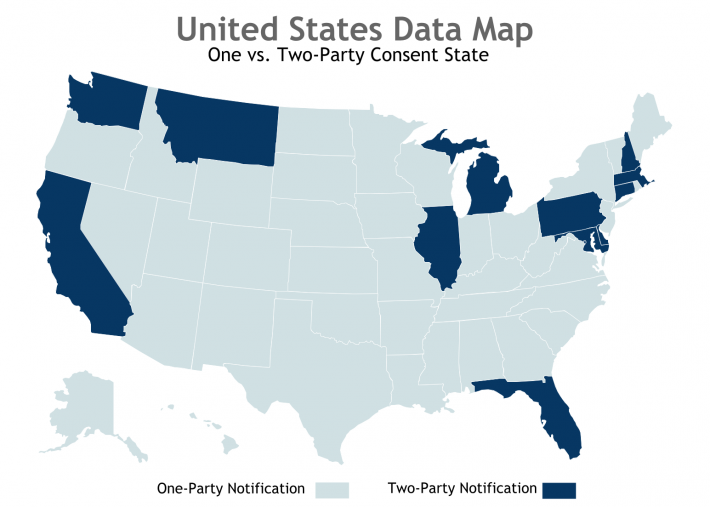
The Basics: “One-Party Consent” vs. “Two-Party Consent”

The District of Columbia and 39 states are one-party consent, and 11 states are two-party consent (see table below). A one-party consent state permits individuals to record conversations to which they are a party without informing the other parties that they are doing so. In other words, one-party states allow recording of phone calls with the consent of only one of the parties to the conversation.

Based on the name, you would think that a two-party state would require consent of two parties; however, under most circumstances, all of the parties must provide consent.

Legal to record conversationWhere One-Party Notification Is Required

Alabama Louisiana Oregon
Alaska Maine Ohio
Arizona Minnesota Rhode Island
Arkansas Mississippi South Carolina
Colorado Missouri South Dakota
District of Columbia Nebraska Tennessee
Georgia Nevada Texas
Hawaii New Jeresey Utah
Idaho New Mexico Vermont
Indiana New York Virginia
Iowa North Carolina West Virginia
Kansas North Dakota Wisconsin
Kentucky Oklahoma Wyoming

Where Two-Party Notification is Required 

California Illinois Montana
Connecticut Massachusetts New Hampshire
Delaware Maryland Pennsylvania
Florida Michigan Washington

In-Person Conversation vs. Phone Call Recording

This information generally applies to recording a conversation in person. If you are in a one-party state and need to record a conversation in person with another person, you must follow the applicable laws of the state that you are in. Likewise with a two-party state.

(If you are looking for a digital voice recorder [affiliate link], Amazon has number of high quality voice recorders starting at around $25.)

However, what if you are recording a phone conversation taking place between two different states that have two different consent requirements? For example, if you are making a phone call from New York (a one-party state) to California (a two-party state), what do you do?

The general rule of thumb is that you should abide by the law of the state with the most strict statute, which in this case would be California.

(If you want to record a conversation through your computer, Pamela for Skype [affiliate link] is a great tool that we have been using for years with great success.)

Other Things to Know

Generally, it is almost always illegal to record a phone call or conversation to which you are not a party. Every state except Vermont has criminal penalties for unlawful recording.

Final Thought

Whether it is legal to record a phone call or conversation is more complicated than you may think.

We hope this information will serve as a general guide, and is not intended to substitute for expert legal counsel. It is always best to talk with an attorney if you have questions about the legal implications of recording calls in your state. 

Additional Resources:

Enjoyed What You Read?

Join 2,000+ others to get insider tips and tricks delivered to your inbox from what has been voted the best blog in the investigative industry!

The trial for Samuel “Mouli” Cohen, which was scheduled to begin on September 19, 2011, is now set to begin on October 17, 2011.  Jury selection will begin on October 13, 2011. The trial will be held in San Francisco before Judge Charles R. Breyer.

As previously reported, in August 2010, federal prosecutors in California unsealed a criminal indictment charging Samuel “Mouli” Cohen of 19 counts of wire fraud and 13 counts of  “engaging in Monetary Transactions in Criminally Derived Property.”  The charges stem from allegations that Cohen defrauded over 55 investors, including actor Danny Glover, out of more than $30 million with claims that his company was about to be acquired by Microsoft Corp.

In August 2011, federal prosecutors added three counts of tax evasion for signing “false and fraudulent U.S. Individual Tax Return(s)” for the years 2005, 2006 and 2007 (see Mouli Cohen’s Superseding Indictment).

The government has filed a list of 34 witnesses that could be called to trial, many of which appear to be victims of Cohen’s scheme.  Prosecutors have also supplied a  list of more than 170 exhibits that could be brought into evidence at the the trial which include bank account records, tax records and emails.

According to information on the Federal Bureau of Prisons website, Cohen is currently being held at the Metropolitan Detention Center in Los Angeles, however, on August 26, 2011 Judge Breyer signed an order setting bail at $10 million and setting certain conditions upon release.  Update: Cohen met the conditions of his bail and was released on Tuesday, September, 20, 2011.

Cohen, who is required to have armed security guards throughout the period of his release, had to advance $80,000 to the security guard company to provide 24 hour security from the time of release through the end of October.

Cohen is required to wear a GPS device, is not allowed any communication except through a land-line phone and is bound to his wife’s residence at all times except to travel to the offices of his attorney or to Court.

As previously reported on this website, there were numerous “red flags” in Cohen’s background that should have been cause for concern for any investor prior to his arrest in August 2010.

Previous Posts on Samuel “Mouli” Cohen:

Enjoyed What You Read?

Join 2,000+ others to get insider tips and tricks delivered to your inbox from what has been voted the best blog in the investigative industry!

A frequently asked question on the Internet is “What does a private investigator do?” People typically envision a stereotypical fedora- and trench coat-wearing, wisecracking, cigar-chomping “old school” street detective. In reality, though, a private investigator is typically hired by businesses, law firms or individuals to obtain specific fact-based information to help them make more informed decisions.

But what does a private investigator really do?

1 Find Facts

Making decisions based on certain rumors, misconceptions, preconceived notions or a “gut feeling” can be extremely risky. Private investigators can provide in-depth, fact-based information from an array of various resources and certain skill sets that are not always available in the public record. In addition, experienced investigators have unique analytical thinking capabilities which are needed in problem-solving situations.

2Identify Risks

Whether you are in business negotiations, contemplating an investment vehicle or hiring an employee, each situation has its own set of risks, both in capital and reputation. Investigators are both trained and experienced in identifying either red flags or damaging issues that may be useful to know before relationships are established.

3Provide Peace of Mind

A suspicion of a subject’s prior issues can cause anyone to lose sleep.  In this situation, an investigator can provide the necessary information beyond the handshakes and resumes. An investigator can corroborate certain facts or details that could not have been verified elsewhere. The objective of any investigation is to provide the facts (good or bad).  The most rewarding cases are the ones where we are able to verify the subject’s information and can give our clients back the peace of mind they were seeking.

4See the Big Picture

Some of the most successful entrepreneurs in the world today have credited their successes to following their passions and instincts. However, having someone in your corner to provide you specific information in order to hedge your own abilities is reassuring. An investigator can view the situation objectively and provide an alternative viewpoint to the matter at hand.

Enjoyed What You Read?

Join 2,000+ others to get insider tips and tricks delivered to your inbox from what has been voted the best blog in the investigative industry!