
Posts

Have you ever tried to find someone, an ex-employee, a key witness, or someone who has gone dark, only to hit a wall, even after hiring a private investigator?

Why do most “locate reports” come up short when the person you’re trying to find actually doesn’t want to be found? And why is it so hard to get real answers when you need them most?

Last week, I shared some interesting case studies to find people, but in this article, I’ll share why most people-search services and investigative firms fail, even when they have access to professional databases. I’ll also show you the tools, methods, and decision-making frameworks we’ve used to locate individuals others could not, even after multiple firms had tried and failed to find these hard-to-find people.

 You’ll learn:

  • Why most locate reports are just data dumps (and what that really means for your case)
  • The tools we rely on when someone’s gone dark
  • Real-world tactics that go far beyond software or subscriptions

Because in the world of serious investigations, it’s not about magic tools—it’s about experience, strategy, and knowing where to look when the usual methods fall flat.

When Typical Locate Reports Fail

If you’re trying to track down someone like Jane—a stay-at-home mom who’s lived at the same address with her husband and kids for the last 15 years—then a standard locate report might actually work. Running her name through professional databases like IDI or TLO, or even a commercial subscription service like Intelius, TruthFinder, or Spokeo, could turn up the right address. These tools tend to do well when the person hasn’t moved much, has kept consistent records, and hasn’t tried to hide.

And then there are the cases where we’re given almost nothing to start with. A first name, maybe a city, a former employer, or sometimes just a vague connection. Like “He used to work construction in Phoenix,” or “She might’ve gone to school in North Carolina.” No last name, no date of birth, no address history. That’s when the real work begins. These aren’t just data searches; they’re puzzles. In those situations, it’s about pattern recognition, creative pivots, and looking where others never think to look. You can’t just run a report; you must build the story from scraps.

We get called in when the usual tools fall flat. When someone has changed names, moved without leaving a forwarding address, or deliberately scrubbed their digital footprint. That’s when the copy-and-paste locate reports from cheaper services not only fall short, they give a false sense of confidence. They tell you what might be true, not what’s provable. And in legal or high-stakes situations, “maybe” doesn’t cut it.

Common Mistakes Investigators Make, and How to Avoid Them

In the majority of failed investigations we’re called in to clean up, one thing stands out: the previous investigator relied on a single source of information and came up empty.

Law firms often send us the locate report from their last PI, and what we see is almost always the same: a cut-and-paste export from a professional database like TLO, IDI, or Delvepoint. That’s it. No verification, no context, no narrative. Just raw data that assumes the last known address is current and that every record is accurate.

Here’s the hard truth: dumping data into a PDF isn’t an investigation; it’s wishful thinking dressed up as a deliverable.

If you want real results, you have to think beyond the screen.

Common Mistakes That Cause Investigations to Fail

Below are some of the most common mistakes we see other investigators make, and why they fail:

Overreliance on a Single Database

Too many investigators pull data from one source, like TLO, and assume the most recent address or phone number listed is valid. But no single database has everything. Each pulls from different public records, credit headers, utility info, and scraping sources, all of which have gaps.

Why it fails: If the person has changed names, moved recently, or taken steps to avoid detection, that single-source data may already be outdated, or intentionally misleading.

No Cross-Verification of Key Data Points

Even if you find an address in a database, that doesn’t mean the person lives there. Good investigators cross-verify that information with other records: DMV data, voter rolls, property deeds, court filings, and more.

Why it fails: Without a second or third source confirming the same address, you’re building your case on a maybe, and in legal or high-stakes matters, “maybe” isn’t good enough.

Lack of Context or Narrative

Dumping data ≠ solving the problem. Raw data can’t tell a story. It doesn’t explain why someone moved, or how different addresses might connect through a relative, job, or phone record. Or if the address is just one of many database errors. 

Why it fails: Dumping a dozen addresses into a report without explaining their timeline or relevance leaves clients confused and misled. Worse, it can send legal teams in the wrong direction.

Failing to Pivot When the Trail Goes Cold

When the database comes up short, some investigators stop. They assume that’s the end of the road, or the client is unwilling to pay for it. But real investigations are about creative pivots like using vehicle sightings, licensing records, breach data, or social media breadcrumbs to find a new lead.

Why it fails: People who don’t want to be found leave misleading trails on purpose. You can’t out-database someone who’s hiding. You need real-world logic and lateral thinking.

Assuming the Client Won’t Notice

Some firms cut corners, assuming the client won’t know the difference between a thorough search and a recycled report. This might be a news flash to some people, but law firms have access to TLO, just like investigative firms. That might work once, but not twice. Law firms, in particular, can spot a lazy locate when they see one, and if they’re sending that report to us, it means they already know it didn’t deliver.

Why it fails: Credibility matters. And once your client sees that all you did was regurgitate a database export, they won’t call again.

What Actually Works

There’s no magic tool or one-size-fits-all method. Real results come from layering multiple data sources, confirming what’s real, and using logic, pattern recognition, and persistence to build a narrative that makes sense.

It’s not about copying data. It’s about connecting dots.

How Real Investigations Begin: What You Need Before You Start

When I say I’ve been able to “find people,” I usually mean one of two things: I’ve got them on the phone, or I have an address, verified through multiple sources, in hand. While email addresses can be useful, in most of my work, they’re too easy to ignore to rely on.
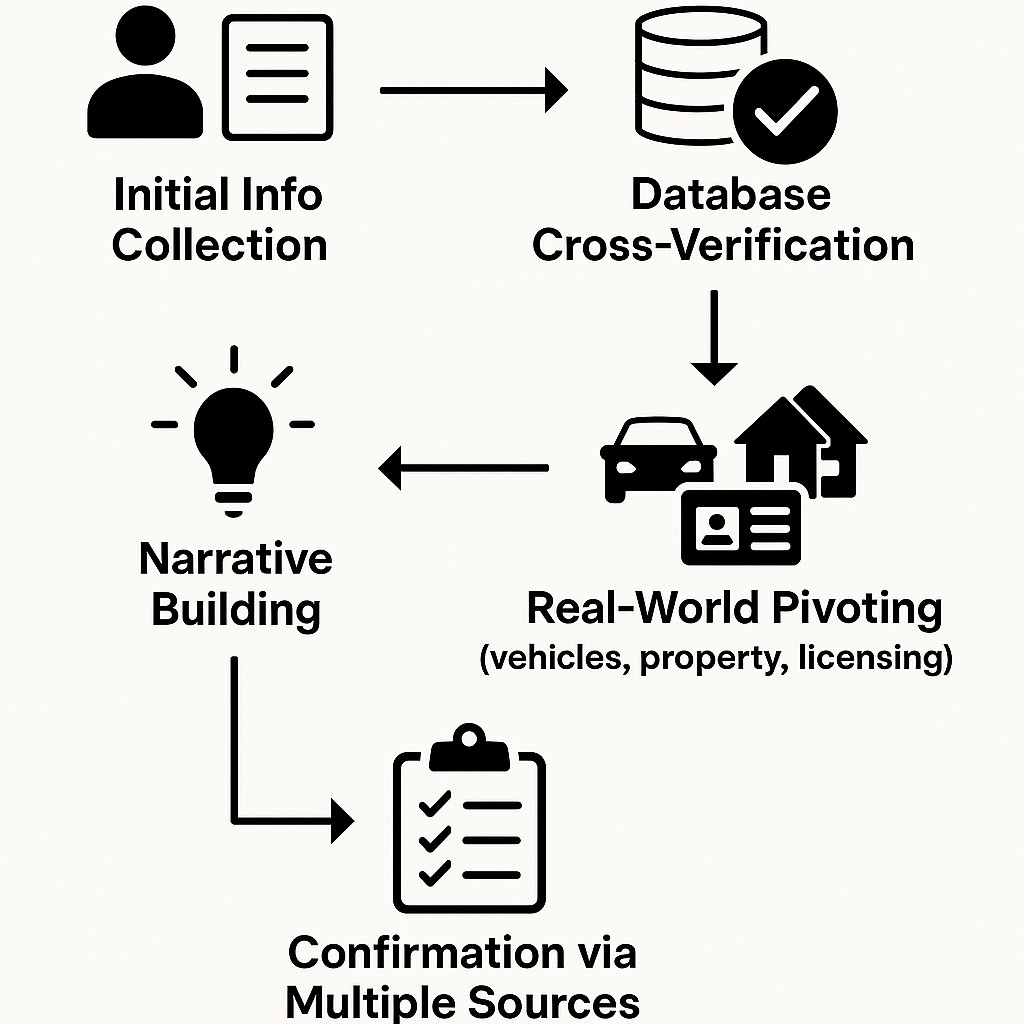
To actually locate someone, you need more than just a name. One piece of information rarely does the job. But give me two or three reasonably solid identifiers, like where they lived, worked, or went to school, and things start to click. With three good data points, I can usually track someone down. With only one, it’s often a guessing game, unless the person has a unique name.

Too often, I see other investigators run a name through one or two databases like IDI, TLO, Delvepoint, or Tracers, grab the most recent address, and move on. That kind of surface-level work doesn’t cut it.

I believe in confirming everything. If I get an address, I want a second or third source to back it up. That might be voter rolls, DMV records, property deeds, or anything else official that strengthens the case. When you’re serious about results, you don’t settle for maybe, you prove it.

Is It Always Possible to Find Someone? Not Exactly.

I like to say everyone can be found with enough time, money, and persistence. But those things aren’t unlimited. Not every case allows for hours of stakeouts or deep dives into digital trails. The real skill lies in knowing the available tools and choosing the smartest, most efficient path forward.

That said, the idea that everyone is findable just isn’t true. Sometimes the details are too vague. Sometimes the request itself feels off. I’ve had more than a few people ask me to find someone they sat next to on a flight last Tuesday, or someone they “forgot” to get a number from after a two-minute conversation.

One person once asked me to find “a guy named Tony” whom they’d met at a music festival in 2017. No last name, no city, not even a photo—just a memory of him wearing a red flannel shirt and liking old cars. That’s not an investigation. That’s a long shot at best, and throws up some red flags at worst.

What It Really Takes to Track Someone Down

Most of my work focuses on U.S.-based cases, primarily involving white collar matters. I’m not chasing international scammers or fugitives from the Most Wanted list. My cases are more grounded, but no less complex.

Often, I’m hired to locate someone who needs to be served in a legal matter. It could be someone covering their tracks or simply hard to pin down due to limited details, a common name, or a transient lifestyle.

In other cases, it’s about finding potential witnesses in civil or criminal matters, like Mike, an Uber driver in Chicago, identified only by a blurry profile picture. Sometimes it involves tracking down former employees who may have crucial knowledge, like Jeffrey Jones from Walmart in Bentonville.

And every so often, the challenge is locating someone with a common name and almost no supporting details, the kind of search where experience, persistence, and a bit of intuition make all the difference.

The Best Tools Private Investigators Use to Find Someone

People always want the list. “What tools do you use?” Here’s the truth: it’s less about having access and more about knowing how to use what you’ve got.

Some of the tools below are not so secret, but they might not be used often to track down people. We’ve worked hundreds of complex people-finding cases, including those that other firms gave up on.

Here are some field-tested tools and techniques we regularly use:

Professional People-Finding Databases (IDI, Delvepoint, etc.)

Never rely on just one. Each source has gaps. Professional investigative databases such as IDI, TLO, Delvepoint, Tracers, and IRB Search will help get a fuller picture. (I’ve had mixed success with commercially available “investigative” database websites like TruthFinder, Spokeo, BeenVerified, and Intelius, so with those, I would proceed cautiously.) One might give you a phone number, another a linked address. You wouldn’t believe how many “unfindable” people pop up once you combine enough datasets together.

License Plate Reader and Vehicle Sightings Databases

LPR databases, like those from DRN or accessible for investigators through TLO, Delvepoint or IRB Search, can be game-changers. They track where a vehicle has been spotted on city streets, in parking lots, or in driveways, using a network of vehicle-capturing cameras that roam the streets. In tough cases, when nothing else is working, a single plate hit can confirm where someone actually is. People may ditch their phone or move without a trace, but most don’t give up their car. Following the vehicle often leads to the person.

Social Media OSINT Tools and Username Tracking

Some of the most powerful clues hide behind usernames, email addresses, and phone numbers. Tools like OSINT.Industries help link social media accounts to usernames, email addresses, and telephone numbers, and Skopenow can identify accounts. WhatsMyName is useful for finding usernames across platforms, and ShadowDragon is great for linking social media accounts and conducting sophisticated, deep analysis and tracing.

Litigation Research Tools (County Courts, Pacer, Judy Records, LexisNexis, etc.)

Local county courts are a great place to start. Even the most minute detail in a traffic infraction might reveal something crucial. For deeper research, check Pacer, Recap, or Judy Records. For more comprehensive litigation coverage, you can use paid databases like LexisNexis, BloombergLaw, or Westlaw.

DMV Records and Driver Data

With permissible purposes (see the DPPA), DMV driving records and vehicle data are powerful tools for locating people. Investigative databases such as IDI, TLO, Delvepoint, Tracers, and IRB Search have some data, but it’s better to go directly to the source. Logan Registration and Denspri are excellent options for accessing individuals’ state records.

Breach Data and Credential Leaks (e.g., Dehashed, Darkside)

In a world where apps get hacked constantly, old email addresses become breadcrumbs. We’ve cracked cases using login data from parking apps, pet sites, and other random corners of the web most people forget ever existed. There are reasonably priced commercially available tools like Dehashed and Snusbase, or more sophisticated tools like Darkside from District 4 Labs.

Facial Recognition Software (e.g., FaceCheck.ID and PimEyes)

Usage of facial recognition tools may be subject to legal regulations and ethical considerations, but a few to check out include FaceCheck.ID and PimEyes.

FOIL Requests

Freedom of Information Law (FOIL) requests can be a powerful way to access records that aren’t readily available online. They’re especially helpful for military service or regulatory complaints. The catch? They often take time, and in many cases, time is the one thing we don’t have.

Professional Licensing Records

Many professions require a state-issued license—everything from doctors and nurses to electricians and nail technicians. These records often include valuable details like middle names, education history, employment status, and sometimes even home addresses. When used correctly, licensing data can be the missing link in a search.

Property Records and Deed Searches

Property records, when combined with voting data or DMV hits, can identify exactly where someone is, even if they’re trying not to be found. The local county recorder’s office is a good starting point; more in-depth research can be done on platforms like LexisNexis or Westlaw, which have a vast collection of nationwide property records, where you might find that vacation property in a neighboring state.

Google Dorking and Advanced Search Tactics

Google remains a vital tool for connecting ideas, but most people only understand it in its simplest form. Knowing how to do proper Google dorking can be a key skill. I also like to use the site MillionShort, which effectively filters out sites with too much SEO that always rank at the top, by, for example, allowing you to disregard the top 100,000 most popular sites. It’s like digging for gold in the depths of the Internet.

Employment Information

This can be a tricky area to nail down. The major investigative databases, such as IDI, TLO, Delvepoint, Tracers, and IRB Search, often fall short when it comes to current employment data. But that doesn’t mean you’re out of options. Tools like ZoomInfo and other subscription-based platforms can offer employment history, titles, and contact details. Resume databases such as Monster and Indeed sometimes surface gold, especially if someone forgot an old resume that they posted years ago. And don’t overlook LinkedIn. A Sales Navigator subscription can be incredibly helpful for tracing work history and finding professional connections. Piecing this info together from multiple sources is often the key to confirming where someone works or worked recently.

Real-World Logic: Habits, Patterns, and Gut Instinct

Sometimes it’s not about the tools; it’s about the thing between your ears. Patterns matter. Habits don’t lie. Maintenance workers live close to their job sites. Ex-partners still pick up mail. Homeless individuals still check the same drop spots. Experience teaches you what to try when the software falls short.

What Situations Require More Than Google or a Database Subscription?

Let me be blunt for a second. If you’re relying on Spokeo, Intelius, or a cheap “people search” site to find someone who doesn’t want to be found, you’re wasting your time. These platforms pull from the same shallow public records and are often filled with outdated or incomplete data.

Google isn’t much better when the person you’re looking for has gone quiet, changed addresses, or actively taken steps to disappear. When you’re dealing with serious matters, a $29/month subscription isn’t going to cut it.

Even with a single-source professional database, you may also be wasting your time.

These cases demand layered investigation, access to professional-only databases, and field-tested strategies that uncover what software alone can’t. Real results don’t come from search bars, they come from experience, creativity, and knowing how to go far beyond the screen.

Why We’re Not the Right Fit for Every Case

More often than not, we succeed, not because we have access to some secret master list, but because we know how to think differently. We don’t rely on one tool or one database. We treat each case like a puzzle, and we know where to look for the missing pieces.

But we’re not the right fit for everyone. If you’re just curious about an old classmate, missed your chance to get someone’s number, or are looking for Jane—the stay-at-home mom who’s lived in the same house for 15 years—Google or a basic subscription site might be enough. In cases like that, you don’t need us.

We come in when the search actually matters: when it’s tied to a legal case, a financial stake, or a personal loss, and you’ve already tried the usual routes. That’s when our approach makes a difference.

A client once came to us after months of trying to serve court papers to a man who had vanished. They’d tried three different firms. Nothing worked. We found him in four days, because we didn’t stop at databases. We followed the trail until it made sense.

If your situation feels like that, and you’re ready for someone to actually solve the puzzle, we’re here. Just know that we can’t promise magic.

Final Thoughts: Finding People Takes More Than a Database

In the past, you may have tried to locate someone using online search tools or hired a firm that delivered little more than a database printout, only to end up with more questions than answers. And if the stakes were high, that kind of uncertainty probably wasn’t just frustrating but costly as well.

Now you’ve seen the difference that layered tools, strategy, and real investigative experience can make. Whether it’s identifying the right John Smith in a city of hundreds or tracking down someone who’s gone completely off the grid, the right process makes all the difference. Moving forward, if you’re facing a legal, personal, or financial matter where getting it right actually matters, and you’re tired of surface-level work, we’re here to help. We don’t deal in guesses. We deal in results.


Enjoyed What You Read?

Join 2,000+ others to get insider tips and tricks delivered to your inbox from what has been voted the best blog in the investigative industry!

What happens when someone really doesn’t want to be found and every tool you’ve tried has come up empty? How do private investigators locate people who’ve changed names, disappeared without a trace, or left behind nothing but a PO Box?

In this article, you’ll get an inside look at 10 real-life investigations where our team tracked down people others had written off as untraceable.

From military records and facial recognition to license plate readers and a bright red shipping tube, these stories show what it really takes to find someone when databases, software, and shortcuts fail.

👇 The 10 Real-Life Cases We Cover

  1. Richard Jones—Found via military records
  2. The Red Tube at the PO Box—Creative field tactics
  3. Facial Recognition Helped Find a Name-Changer—Facial recognition and name change
  4. License Plate Data Revealed a Hidden Address—License plate reader database
  5. The Only Clue Left Was Death—DMV and obituary tracking
  6. Finding a Homeless Heir in the Bronx—Street-level detective work
  7. Connecting Digital Breadcrumbs Across Platforms—Username OSINT mapping
  8. The Breach Data That Cracked the Case—Dark web breach data
  9. Finding Frank Rodriguez with a Simple Assumption—Real-world pattern recognition
  10. The Bentley and the Court Filing—Court filings and car obsession

Case 1: Richard Jones—Found Through Military Records

We got a call one day from a woman chasing a ghost. His name? Richard Jones, her long-lost love from the 1980s. They had met while he was stationed in Virginia with the military. She remembered the car he drove, a 1970s Chevelle, and the way he made her feel. What she didn’t remember? Anything that could actually help us find him.

Richard Jones is one of the most common names on Earth. It was like trying to find a needle in a stack of needles. But we were intrigued and more than a little stubborn.

We started with the obvious; search for every Richard Jones in Virginia from the ’80s. There were over 50. That’s when it hit us: this wasn’t going to be a name match. It had to be a memory match. A gut-check. A long shot built on human instinct.

So we started calling.

Every. Single. One.

We’d open with something that wouldn’t freak them out: “Hey, this is kind of random… but were you ever in the military in Virginia in the 1980s?”

Polite. Direct. But it turned out to be useless.

None of the Richards we reached were her Richard.

We submitted military verification requests for all 50 names as a last-ditch effort. It was a Hail Mary and it took months. Eight months in, we’d gotten 49 nos. Then the final envelope arrived.

It was a hit. One Richard Jones had served in Virginia in the 1980s.

We checked our notes. We had already called him. He said it wasn’t him.

So we called again.

This time, we laid it out: “There’s a woman trying to find someone she loved. We think it’s you.”

Silence on the other end. Then a quiet laugh.

“Oh,” he said. “I didn’t realize that’s what this was about. Yeah. That’s me.”

Why didn’t he say so the first time?

“I just didn’t know what it was all about.”

That was it. Decades later, across dusty records and dead ends, love had finally found its way back.

Lesson: Sometimes it’s not about the tools or the tech. It’s about tenacity and the willingness to follow the trail even when it looks cold.

Case 2: The Red Tube at the PO Box

The client had a $500,000 problem and just a few weeks to solve it.

They had a judgment against a former business partner who had mostly vanished. The only lead? A PO Box in Texas. No residential address. No phone. No property records. The usual databases showed nothing. DMV? No luck. Voter rolls? Another dead end.

They needed to serve him personally, and time was running out.

So we got inventive.

We sent a large, bright red shipping tube to the PO Box, big enough to attract attention. Then, we waited at the post office.

Sure enough, his wife showed up to pick it up. Carrying a giant red tube, she was impossible to overlook.

We followed her directly to their house and served him right then and there.

She didn’t see it coming.

And neither did he.

Lesson: When traditional tools fail, creativity takes the wheel. Sometimes all it takes is a red tube and a little patience.

Case 3: Facial Recognition Helped Find a Name-Changer

A law firm came to us with a serious problem. Their entire case hinged on one man: Cameron Smith.

He wasn’t just a witness. He was the person who had received and documented every single complaint about mold in a mismanaged building. Without him, their case was shaky at best.

They had his name and the company he used to work for. That was it. We couldn’t find anything to tie a Cameron Smith to the management company.

So we started digging through the management company’s social media accounts, post by post. After hours of scrolling, we found a photo: a going-away party for someone named “Cameron Smythe.” Same guy, different spelling.

But it was still not enough to locate him.

Then we tried a facial recognition database.

That’s when everything changed.

The tool flagged a photo from a Costa Rican wedding photographer. Cameron and Joseph, newly married. Turns out, Cameron had changed his last name to his husband’s.

With that extra clue, we found him quickly.

Lesson: Sometimes, the truth hides in a name change. And a single photo can reopen a case that was dead in the water.

Case 4: License Plate Data Revealed a Hidden Address

By the time the law firm handed us the case, they were out of options.

Stacy was a key witness in a sex abuse case, and she’d gone dark. Process servers had already tried four different addresses, all dead ends.

I ran her name through six different databases, hoping broader tools would do the trick. Still nothing.

But I had one thing left: her license plate.

Here’s something I’ve learned over the years. People might ditch their phone, move cities, change names. But most of them hang on to two things: their phone number… and their car.

So I ran the plate through a license plate reader system. These tools scan streets, garages, parking lots.

Her car had been spotted twice in the past few weeks at a brand-new housing development.

That was the lead we needed.

We showed up. We served her. Game over.

Lesson: Cars don’t lie. When people try to disappear, follow the vehicle.

Case 5: The Only Clue Left Was Death

Until 2014, private investigators could access the Social Security Death Index. That ended because of identity theft concerns. These days, most investigative databases don’t flag the dead very well. Sometimes you’ll stumble across an obituary or a stray Facebook post, but often it’s like the person just vanished.

That means we have to get creative.

One Arizona attorney reached out after months of trying to serve a man in a personal injury lawsuit. Every address came up empty. Family social media? Nothing. So we pulled his driver history, a move that sometimes reveals a hidden address.

Instead, it revealed something else.

The Arizona DMV record listed him as deceased. In all my years pulling DMV records, I had never seen that before. But it explained everything.

In another case, we were asked to track down a young security executive. The trail looked promising until we hit silence. Two disconnected numbers. No returned calls. On one last attempt, we finally reached his brother.

The news was simple, and final.

He had passed.

Lesson: Sometimes the hardest truth to uncover isn’t where someone is hiding. It’s that they’re not here anymore.

Case 6: Finding a Homeless Heir in the Bronx

An attorney called me years ago with a question that sounded simple on paper.

“Can you find a man named Victor?”

Victor was the only child of a woman who had just passed away. He hadn’t spoken to her in years, but he was about to inherit a life-changing amount of money.

There was just one problem.

Victor had been homeless in New York City for over a decade.

At first—I’ll be honest—I wasn’t thrilled. The idea of roaming the streets, asking strangers about a guy who hadn’t left a digital footprint in 12 years? It felt like chasing smoke.

But I’ve never been one to back down from a long shot. So I did what I do best: I started digging.

Court records. Jail logs. DMV hits. Old addresses. Dead phone numbers. Anything that could give me a thread to pull. I even called a few homeless shelters around the Bronx.

And then, one tiny lead surfaced. A dusty old address in the Bronx. No confirmation. Just a hunch.

I went anyway.

I knocked. Nothing. Knocked again, harder. I heard shuffling.

Then the door cracked open, and a tired-looking man with tangled hair and a face worn by years of street life peered out.

I told him why I was there.

“I’m looking for Victor.”

He blinked.

“That’s me.”

He couldn’t believe someone had actually found him.

Victor explained that he came to that house once a month to shower and pick up his disability check. A woman living there, a friend he’d met on the street, let him use her place just enough to stay on the system’s radar. The rest of the time, he lived wherever he could.

Lesson: You don’t always find people from behind a keyboard. Sometimes you find them by showing up.

Case 7: Connecting Digital Breadcrumbs Across Platforms

An attorney reached out with a pretty straightforward request. They needed to track down the address of a Facebook user posting defamatory comments about their client. It should’ve been simple.

Except it wasn’t.

The user went by “Strongarm Willy,” and the account was locked down tight. No public posts. No friends list. Just a blurry profile picture and a single clue most people overlook—his user handle: @willythedream.

That little detail was key.

Because people are creatures of habit. They reuse usernames like digital fingerprints. So I dug in with tools like WhatsMyName, OSINT.Industries, and ShadowDragon and started painting a picture. One username turned into a map of accounts across platforms. But none of them had his real name.

That’s when I shifted tactics.

The weak link is almost always a family member.

I started mapping his social circle. Instagram, Twitter, Venmo. And one name kept showing up across them all, Jenny Williams.

Her accounts were wide open, a goldmine.

Scrolling through her photos, I saw something familiar. Jenny’s husband looked pretty close to the blurry photo on Strongarm Willy’s Facebook picture. Digging further, I confirmed her husband’s name was Willy Williams. Better yet, I found his email address, which matched accounts tied to that same @willythedream handle.

Game over.

Lesson: Sometimes the truth isn’t hidden, it’s just scattered. You just need to know where to look and, more importantly, how to connect the dots.

Case 8: The Breach Data That Cracked the Case

James was practically a ghost.

Every database showed him in three different states at once. He had multiple PO Boxes, conflicting addresses, and zero property ownership to tie him down. No phone. No obvious digital trail. He wasn’t wealthy and wasn’t off the grid for noble reasons; he was intentionally keeping his location blurred.

I had a hunch about one of the addresses in Colorado, but a hunch wasn’t good enough. I needed more proof so I didn’t send the client on a wild goose chase.

That’s when I turned to an overlooked but increasingly valuable source: breach data. Specifically, credential leaks from known data breaches. Most people don’t realize how much personal information surfaces when apps and services get hacked.

I ran one of James’s old email addresses through a dark web breach checker. Bingo.

It had been compromised in the ParkMobile data breach, which exposed all kinds of details, including license plates tied to his account. ParkMobile is an app used to pay for street parking.

It was the break I needed.

We took one of the plates and ran it through DMV records. It came back registered to a generic LLC. But the address linked to that LLC? It matched the one I had suspected all along.

Lesson: Sometimes, the breadcrumbs aren’t in public records or databases. They’re buried in places people forget they ever left them, like a parking app from three years earlier.

Case 9: Finding Frank Rodriguez with a Simple Assumption

Every now and then, we get a case that reminds us it’s not about fancy tools; it’s about knowing how the real world works.

The client was on a tight budget and needed to find Frank Rodriguez. The name is not exactly rare, especially in Houston. There were hundreds of hits, most leading nowhere.

Frank was listed as a maintenance manager at a specific building. That was the only detail we had.

But here’s something I’ve learned over the years: most maintenance guys live on-site or at least nearby. It’s part convenience, part job requirement.

So I plugged the address of the building he worked at into a few of the databases.

And there he was.

No data wizardry. No special software. Just one small assumption based on real-world patterns.

Lesson: Sometimes what looks like dumb luck is just experience dressed in plain clothes.

Case 10: The Bentley and the Court Filing

Richard Green had it made. He was a rising Florida attorney, flashy lifestyle and big wins. Then came the gambling. The debt. The temptation. And finally, the fall.

He started siphoning money from his clients’ settlements. Millions of dollars, gone. When the walls closed in, Richard vanished. He bounced from couch to couch, drifting from state to state. No fixed address. No online footprint. Nothing.

For a while, nobody could find him.

But Richard had two fatal flaws.

First, he loved his car; a black Bentley Continental GT convertible. Second, he had a thing for lawsuits. He’d sue anyone who looked at him sideways.

We scoured databases. Nothing pointed to his current location. So we followed the only thread that made sense: his court filings. Turns out, even when you’re running, you still leave paper behind.

Buried in a stack of pro se lawsuits, we found one he’d filed against a convenience store. It said he slipped on a step. The fall wasn’t interesting. The address he listed in the complaint was.

It led us straight to him and his Bentley.

Lesson: If you’re litigious and love a luxury car, odds are you’ll eventually give yourself away.

Final Thoughts: When It’s Time to Call in a Professional

You’ve now seen what really goes into locating someone others have written off as unfindable. It’s rarely about a magic tool. It’s almost always about persistence, creativity, and knowing where to look when the trail runs cold.

If you’re in a situation where finding someone truly matters and surface-level searches, cheap reports, or even previous investigators have failed, you’re not alone.

These kinds of cases require more than effort—they need experience. If you’re ready to solve the puzzle once and for all, reach out to us for a consultation. We can’t promise it’ll be easy, but we do promise we’ll treat your case like it matters, because to you it does.

When the stakes are high, the details matter, and guessing isn’t an option, that’s where we come in.

Enjoyed What You Read?

Join 2,000+ others to get insider tips and tricks delivered to your inbox from what has been voted the best blog in the investigative industry!

“What is the cost to find someone?”

We get asked that question about 17 times a day, in one form or another.

  • How much will it cost?
  • What if I only know the person’s first name?
  • What if I only have limited information on the person?
  • Why can’t I use one of the online consumer databases (TruthFinder, Spokeo, BeenVerified, etc.)?
  • Is there a cost difference between finding a long-lost relative and finding someone to serve in a lawsuit?
  • What if I only saw the person from 82 meters away and could only draw a picture?

And so on and so forth.

We understand. At the end of the day, there is so much information out there about finding people, and you just want to know how much it’s going to cost you.

These are (mostly ;) totally normal questions, but for the most part, you will get answers like “It depends,” or end up signing up for some online database that will charge you $29 a month in perpetuity without giving you any definitive answers.

Before we get started on private investigator fees, it’s worth discussing some of the online, consumer-grade databases, as these will inevitably be part of the conversation.

A brief warning: This post is pretty epic. So here is a cheat sheet if you want the Cliffs Notes version:

  • Consumer-grade databases (e.g., TruthFinder, Spokeo, BeenVerified) are decent, but they are not always up to date and accurate.
  • Although they are not perfect, these consumer-grade databases can be good for some situations; however, for professional jobs where you don’t want to have to question the information you obtain, you should hire a professional.
  • While consumer-facing databases get their information from unregulated data, private investigators have access to professional-level investigative databases, which contain more regulated/more secure data.
  • Private investigators use databases such as TLOxp, IDI, IRBsearch (also known as Accurint), Tracers and LexisNexis, among others.
  • Private investigators must have a permissible purpose to access the information.
  • On average, most private investigators charge anywhere from $100 for standard cases to up to $500 for more difficult cases.
  • Our fees start at $500 to find a person if you have some basic information about the person, such as a full name, date of birth, recent address, workplace, area of residence, etc.
  • Our fees start at $1,000 to find a long-lost relative, friend or similar, or other cases in which you have limited, outdated or historical information.
  • We don’t offer guarantees, but we do promise that we will be completely transparent and upfront about our chances of finding the person. We don’t take on cases if we think we can’t help, and we have a really high success rate in finding people.

Are the online consumer-grade databases (TruthFinder, Spokeo, BeenVerified, etc.) any good?

At this point in your research, I am certain that you have come across one of the many online consumer-facing databases and are wondering whether they are any good. You may have even used a few of them.

With a credit card, anyone can sign up for any one of the dozens of online, consumer-grade databases such as TruthFinder, Spokeo and BeenVerified. They are quick and easy, and they are probably pretty decent for finding a portion of the population.

Are these databases any good? The short answer is that they can be decent, but that comes with a lot of caveats:

  • One is that the data is not particularly good. Based on some of our own research, these databases’ reports tend to be incomplete, not up to date and not particularly accurate. Most of these databases are pretty cheap, so they would fall under the category of “you get what you pay for.”
  • They might have some information right but other information that’s not so accurate. For example, our results showed that some of the addresses were correct, but the telephone numbers were not. Or vice versa. That can be really frustrating if you really need to get in touch with someone.
  • Lastly, based on our own experiences, some of these databases rope you into pretty hefty fees that are hard to get out of. Just a few weeks ago, we were working on a case in which we were trying to determine whether any of the consumer-grade databases had contact information for a business executive (they didn’t). But after taking two seconds to sign up, it took about two hours of phone calls to cancel the service.

(If you want to dig into this more, we suggest you take a spin through the post Intelius vs. Spokeo vs. BeenVerified — A Private Investigator’s Review.)

Although each of these databases is different, they generally contain aggregated consumer information that comes from things like forms that you fill out online and publicly available information from government records.

In simpler terms, this is unregulated data.

Can I just use one of the online consumer databases INSTEAD of hiring a private investigator?

Of course.

In fact, in many scenarios that is exactly what we recommend.

Especially for one-off scenarios, if you want to try to save a few bucks or you are pretty confident that the person can be found easily, it’s no bother if the information is not totally up to date and you don’t mind calling a few wrong numbers.

Why would I hire a private investigator then?

The short answer is you should hire a professional if you want a professional job where you don’t have to question the information you obtain.

It’s that simple.

Otherwise, there is no cut-and-dried answer. We have seen consumers, businesses and law firms use these databases with varying degrees of success. Frankly, we mostly see the results of these databases when they don’t provide the answers the clients are looking for, so our personal opinion might be skewed.

We often get these reports sent to us from attorneys who don’t have any confidence in their results. Sometimes they are right, but about half the time they are not. That’s not a great hit rate, especially in a legal matter. 

What types of databases do private investigators use?

While consumer-facing databases aggregate unregulated data, professional investigative databases generally gather the more regulated data.

There are dozens of professional-grade databases that investigators use to find people’s addresses and phone numbers. In investigative lingo, this is called skip-tracing. When we say “professional-grade,” we mean databases that (for the most part) only investigators have access to — where you need to verify that you are a licensed private investigator in order to access them. In some cases, law firms and certain businesses can access the information as well.

The reason that a license is required is that much of the information in these databases is protected by regulated data and federal laws like the Gramm-Leach-Bliley Act (GLBA), the Fair Credit Reporting Act (FCPA) and the Driver’s Privacy Protection Act (DPPA), and in order to access this information, you need a permissible purpose.

The same way that someone can’t just pull your credit report without some sort of permissible purpose, one cannot search regulated data (which we will discuss in a bit) willy-nilly.

Here are a few of the biggest database providers of aggregated data to the investigative industry:

TLOxp

IDI

IRBsearch (also known as Accurint)

Tracers

LexisNexis

Thomson Reuters CLEAR

Delvepoint

LocatePLUS

What types of permissible purposes are there?

Federal privacy laws protect certain types of information from being released. Nearly all the commercial database providers require that you declare a permissible use under the GLBA and DPPA.

This is not an all-encompassing list, but in order to access these databases, a private investigator must show that, for example, the search complies with legal requirements (GLBA), protects against fraud (GLBA), has the express consent of the consumer (GLBA), is in connection with a litigation proceeding (DPPA) or is on behalf of a government agency (DPPA).

There are more than a dozen permissible uses under the GLBA and DPPA, which you can read more about here; but in summary, some sort of permissible use is required.

Do you need a permissible purpose to find the person?

Yes. 100%, without question.

Why?

In order to use the databases described above, a permissible purpose is required, 100% of the time, to access the protected data.

Do you need to know the REASON why you are attempting to find the person?

We can’t speak for other investigators, but in our case the answer is 100% yes.

It’s our duty and obligation to know why you are trying to find the person.

For a business, it may be to track down a former employee relating to a fraud investigation.

For an investor, it may be in anticipation of litigation.

For an attorney, it might be to find a witness for an upcoming trial.

For the general public, that answer can vary, from trying to get in touch with a long-lost relative to finding an old friend to connecting with a former acquaintance.  

As private investigators, we have some specialized skills and access to some pretty powerful information. As you can imagine, there have been some horror stories of investigators who tracked someone down with tragic results.

The most famous of these stories concerns Rebecca Schaeffer, the actress who was killed by a deranged stalker who had hired a private investigator to track her down. The killer told the private investigator that he was an old friend of Schaeffer’s and wanted her address so he could send her a gift — but he went to her doorstep and shot her.

Had the private investigator vetted the person just a bit more, they might have never taken the case and Rebecca Schaeffer would still be alive.

Do you even need to use investigative databases?

We are fairly certain that any experienced investigator can find just about anyone’s address with some ninja Internet skills and Googling ability. So, while these private investigator databases make our lives much easier in terms of making it quick and easy to find someone, they are not totally necessary.

Take a recent case we worked on where we were able to find a ridiculous amount of information on an executive.

We were tasked with finding information on an executive at a major company who had become the target of Internet trolls. The executive and the company were concerned that these Internet trolls might act upon some of their vague threats, so we were tasked with trying to identify information about the executive and his family to see what information the trolls might be able to come up with.

Without using a single investigative database, the amount of information we were able to come up with was astonishing, even for us, who have been in this business for nearly 20 years. We found out his home address, home phone number (yes, those still exist), his cell phone number, his wife’s name and cell phone number, photos of his entire family from social media, photos and the address of his second home, his mother’s and father’s names, his kids’ names, his dog’s name and even his grandparents’ names.

This information took quite a bit of time to track down without access to the investigative databases, which would have gotten us from point A to point B much quicker. Nevertheless, it wasn’t all that difficult. Just took some time — something Internet trolls appear to have plenty of.

In this case, the man happened to be a pretty high-profile executive who also had quite a big footprint in public records like property, voter registrations and political contributions.

This definitely wouldn’t be the case for everyone, but you get the point.

Can a private investigator find ANYONE?

We always tell any potential client: With unlimited time and resources, virtually anything is possible.

No matter how little information you have.

But, in reality, there is no such thing as unlimited time, and resources (money, in our case) are limited.

So, while we like to think that we can find anyone, that’s more of a pipe dream than a reality.

So, how much does it cost to hire a private investigator to find someone?

On average, we would say most private investigators charge anywhere from $100 to upwards of $500 for more difficult cases. That doesn’t encompass everything, but it captures a good portion of the cases. On the low end, that would mean someone running a database or maybe two and providing you with whatever comes up. On the higher end, that may require a bit of extra legwork.

How much do we charge?

You have arrived near the end of this post, and you may find yourself wondering, well what the heck do WE charge?

These cases can typically be broken down into two categories:

  • Cases in which you have limited information on the person (for example, only a piece or two of identifying information such as a full name, address, date of birth) or information that is dated or really scarce. For example, if you are trying to find a long-lost friend, military buddy or relative, and you have only that person’s relatively common name, approximate age and that’s about it. 
  • Cases in which you have recent, more comprehensive information, such as a person’s name and a recent address or date of birth, or simply a name and company. For example, if you are trying to find a former employee at a local business who moved away or if there is someone on Facebook whom you want to track down.

Diligentia Group fees to find people

Professional Desktop Research

Fee: $500 (flat fee)


Our initial approach is to identify addresses and contact information from professional-grade investigative databases. We utilize multiple cutting-edge investigative databases that aggregate information from a multitude of sources, including credit headers, utility records, public records and open sources, to identify address and telephone number information.

We then analyze the data and provide the best possible address based on other supporting information, such as utility, voter registration, property ownership or driver’s license records. We aren’t just giving you a data dump of the first information we find; we are carefully and thoughtfully analyzing the information so we can give you the best known address.

We will also provide the best known telephone contact information. While in most cases we will provide telephone contact information for the person you are looking for, in some instances, that may not be available, so we may provide you with the contact information of a close relative.

These records are generally reliable; however, they are not always 100% accurate or up to date and may require additional research, such as on-the-ground work. Additionally, while this may be adequate for the vast majority of people, in some cases, people are much more difficult to find. These can include people who move frequently, are running from the law or are in serious financial trouble.

Deep Research and Telephone Inquiries

Fee: $1,000 (flat)


This is for cases where Professional Desktop Research just won’t cut it — the ones that provide more unique challenges and call for deeper research, telephone inquiries and scouring of public records.

In these cases, we will make additional telephone inquiries, such as calling employers, neighbors, adversaries, distant family members or colleagues, to try to get a sense of the person’s whereabouts. This will be done in combination with taking a deeper dive into public records to identify any potential upcoming court appearances, tracking their social media accounts to triangulate their whereabouts, identifying recently registered vehicles and determining whether they recently set up a new business.

In this phase, depending on the intelligence developed, we may conduct an on-site visit to find the person and/or make a few inquiries.

Bespoke Investigation (Long-Lost Relative / Limited Information / Under the Radar)

Fee: $1,000+ ($150 to $250 per hour)


We use this phase for the cases that are hard to wrap up with a nice little bow.

This kind of investigation is saved for those who are seriously living under the radar; and are more complex than a Deep Research case. They typically require specialized databases, creativity, thoughtfulness, some elbow grease and a tailor-made plan; and just about every tool in our tool belt. And more often than not, they require some actual boots-on-the-ground work.

In terms of finding a long-lost relative or friend, we have had a lot of success with these types of cases in the past. Our favorites include the story of Yvette Ferrari, who spent 45 years without knowing her father — until we found him — and the story of Tucker, who was reunited with his father, who didn’t know he existed.

Some other examples our previous “bespoke” cases include:

➔ locating a person who had been homeless for 20 years, living on the streets of New York, who was due a substantial inheritance;

➔ a mother who had been living off the grid in a trailer in the middle of Oregon;

➔ a former soldier who went by the name Richard Smith (quite literally the most common name in the United States) whom a woman had met in Virginia in the 1980s and on whom she had scant details;

➔ and a businessman in Colorado who had protected his tracks so well that we needed to deliver a giant red tube to his P.O. box and wait for days until he picked it up (spoiler alert: we got him!).

Whatever the challenge is, we are up for it.

Dig deeper:

Private Investigator Tips to Find a Long-Lost Friend or Relative

How Much Does It Cost to Find a Person (Long-Lost Friend or Relative)

Using a Private Investigator to Find a Person or Witness

How to Find Someone on the Internet

Why not just use one database?

Simply put, because not all databases are created equally.

There is no ONE database that is the be-all and end-all. Some are better than others. They each have their own strengths and weaknesses.

At the end of the day, it’s our job to analyze all the information and intelligence and provide the most accurate information based on our experience and analysis.

Are there exceptions to these fees?

Yes, tons of them. Way too many to explain here.

If you want to find 100 people, or 1,000 people, that’s a whole different story.

If you are trying to track down an undocumented immigrant who just came into the country, or have a case that pertains to a non-U.S.-based individual (i.e., someone living internationally) or an adoption-related matter, these are different balls of wax entirely.

If you have something you want to discuss that might not easily fit into one of our categories, contact us. 

How long will it take?

For standard cases, such as tracking down an address and phone number, we will typically get back to you within a day or two.

For more complicated matters, it will take several days or weeks to complete the request.

Although this is in no way typical, in one case, we waited over a year to get results from some military requests before we were able to find the right person.

Do you guarantee you’ll be able to find someone?

Unfortunately, we cannot guarantee anything. There are just too many variables, and guarantees can lead to tremendous letdowns.

Just last month, we were asked to find someone by the name Jose Rodriguez who had previously worked at a Walmart in Michigan. He was a potential witness in a slip-and-fall lawsuit. Unfortunately, we just didn’t have enough information to track him down, and the client didn’t want to commit the amount of resources it would have taken to actually track him down. Like contacting all 82 Jose Rodriguezes who have lived near the Walmart in question or tracking down former employees of the Walmart.

However, we were upfront about our lack of confidence in being able to do it without TONS of resources, and the client was understanding.

There are dozens of other stories that follow this same pattern.

But we CAN guarantee you a few things:

➔ We will be completely and sometimes brutally honest about our chances of finding the person.

➔ Our reputation is based on providing our clients with results, not false promises. You can check out some of our feedback here.

➔ We don’t take cases that we can’t help you with.

➔ We have a really high success rate in finding people.

Final thought

If you made it this far, you’ve read (or skimmed through) over 3,461 words (including the title, if you are counting).

Congratulations.

If there was anything we didn’t answer, if something is not clear, or if you have a unique situation, you can set up a time to talk to me personally, here.

Enjoyed What You Read?

Join 2,000+ others to get insider tips and tricks delivered to your inbox from what has been voted the best blog in the investigative industry!

In the era of the internet, finding a long-lost friend or relative often can be done easily and at a low cost. But to locate people who are flying under the digital radar, you may need to use some advanced methods to track them down.

As a last resort, you may need to hire a professional who has the tools, resources and know-how to track down friends or relatives who are more difficult to find.

Before you go down the professional route, here are some tips from someone who has been doing this for 20 years (that’s me!).

Things to Keep in Mind

Here are a few things you should keep in mind.

The more common the person’s name, the more additional information you are going to need in order to locate the person. The proverbial John Smith is going to be much more difficult to find than Kamren Fernsby. While you might be able to find Kamren Fernsby with a few Google searches, finding John Smith with a few Google searches is going to need an act of God.

I frequently see people getting hung up on the spelling of names, where they thought they had a high degree of certainty about the spelling only to be proven wrong. In fact, we are working with a client as I write this who has been trying to find a middle school friend but has been searching for a misspelled name all these years. Don’t be that person. You are human, and people get things wrong all the time. Be conscious of searching under multiple spellings. Also, there’s a chance that the name that you knew the person by may not be the official name (e.g., John Doe might actually be William John Doe) and/or he or she may have changed the name (e.g., through marriage).

This is not going to be easy. You are here reading this blog post for a reason. If it were easy, you probably would have found the person already. I am here to tell you not to give up. It’s 2020 and everyone thinks you should be able to find anyone in a few minutes. That’s just not always the case. If this is really important to you, you are going to have to grind through the process.

Send some emails. Make phone calls. Connect with friends or relatives on social media. The worst that can happen is that you will be no further along than you were at the start.

Last, some people are really hard to find, and locating them will take an enormous amount of time and resources or some professional help.

First Step: Gather Your Facts

Before you begin your search, you need to gather as much information as possible on the subject: full name, middle name, day/month/year of birth, approximate age, schools attended, relatives’ names, profession, addresses, names of friends, jobs held, former employers, etc.

While other information, like physical features, tattoos or shoe size, may come in handy, it isn’t going to be terribly helpful in this phase.

So You Think You Can Google?

You’ve probably heard of Google before ;-), but most searchers don’t really know how to use Google. There are dozens of advanced operators and searches you can try, and there are endless combinations of possibilities for search terms. For the purposes of searching for people, here are some tips: 

“John Doe” – Otherwise known as the exact search, this tells Google to search the exact phrase. It’s critical that you use quotes when searching for exact names or phrases in order to eliminate Google’s guesswork, as Google likes to take a guess at your intent and then gives you results that are not always directly related to your search request if you don’t use quotes.  

“John” “Doe” – This may seem repetitive of the above search, but the above results won’t provide results with John William Doe or John W. Doe. Searching with each word in quotes will return any results containing the two quoted phrases.

“Doe, John” – Many public records, including things like voter rolls, can be listed last name first.

“J. Doe” or “Doe, J.” – Use this just in case the first initial is used instead of the full name. 

“John * Doe” – When you use an asterisk in a search term on Google search, it will leave a placeholder that may be automatically filled by the search engine later. So in this case, you may come up with John Smith Doe or John Kamren Doe.

There are dozens of advanced operators and searches you can try, and there are endless possible combinations. Try using the details collected in the first step along with the name.

Bonus Tip

If you are not finding anything on Google, set up a Google Alert to notify you when something new related to your search is published on the internet.

Bonus Bonus Tip

If you know that the person went to the University of Pennsylvania, you may be able to get a digital copy of the yearbook through the school website. Also, you can do a site-specific search to look for specific mentions of the person you are looking for on the University of Pennsylvania website: site:upenn.edu “john doe”

Google Alternatives

Google is the 800-pound gorilla and still the king of the hill, but there are dozens of other really good search engines, like Bing and DuckDuckGo, and country-specific search engines like Yandex, which is great for Russian-language searches. 

There are also some alternative and specialized search engines, like Runnaroo, which integrates dozens of deep search sources to provide more relevant search results.

Bonus Tip

I love using search engines like millionshort.com, which lets you remove any results from the top one million websites, so you can get some really deep search results that normally wouldn’t show up until page 167 on Google.

Bonus Bonus Tip

If you have an old photo, try uploading it to the Yandex Image search engine. They have a shockingly good facial recognition search engine. It’s a real long shot, but it might be worth a try if you have a photo of the person as a young adult.

Social Media

There were about 3.5 billion social network users in the world and about 2.3 billion users on Facebook as of 2019, so there is a pretty good chance the person you are looking for is on one of the various social media platforms, and the best place to start is probably going to be Facebook.

Virtually all social media sites, including Facebook, have some type of search functionality to search for a person’s name. You also typically can search by phone number, email address and username to varying degrees on each of the platforms. But keep in mind that Facebook users can restrict their names from showing up on public searches. It’s also smart to keep in mind that many people will use a different username or alternative name on their forward-facing profiles.

Bonus Tip

In addition to using the using the built-in search functionality of the biggest social media platforms, you can get some additional results using a site search.

site:facebook.com “John Doe”

site:twitter.com “John Doe”

site:instagram.com “John Doe”

Bonus Bonus Tip

Everyone has heard of Facebook, Instagram, Twitter and Pinterest. But don’t forget sites like LinkedIn (professional networking), country-specific social media platforms like VK (Russia) or WeChat (China), popular messaging apps (Telegram, Skype and WhatsApp), niche sites popular with younger generations (TikTok and Snapchat) or one of the dozens of niche social media platforms.

It’s also helpful to remember that not everyone is on social media. While 3.5 billion sounds like a lot, that’s only about 45% of the population, and while 68% are reportedly on Facebook, not all of them can be found on public search engines, and some may be using a different name.

Paid Databases

In the United States, there are a number of available commercial investigative databases that are good at tracking down people IF you have enough information to find them. In fact, we did a review of some of the most popular databases out there (Intelius vs. Spokeo vs. BeenVerified).

Many of these sites make bold claims about how much information they can obtain and their accuracy. Personally, I think it’s a lot of marketing speak and they don’t have a lot to back it up. I say that because I use professional investigative databases that I pay thousands of dollars a month to access, and they have huge holes as well. For example, phone numbers and email addresses are often inaccurate, and address history is really difficult to nail down with any real degree of accuracy without other data to back it up.

That being said, these databases also can be really helpful. If you do end up shelling out some money for these databases, don’t let it go to waste. If they give you 17 different phone numbers, email addresses and physical addresses, write or call each and every one of them. Take notes on the responses to each.

Nobody said it was going to be easy.

Other “Free” and Paid Sites

There are literally hundreds of free sites that could be useful, but here are some sites I have found to be the most valuable resources (paid sites are marked with $):

  • Alumni Networks/Yearbooks – Most schools have some type of alumni network that can help you connect with a former classmate. Many colleges and universities post old yearbooks on their respective websites. Archive.org also has a massive collection of old yearbooks.
  • Archive.org – Do you know, for example, that in 2002, the person you are looking for was the owner or an executive of a small business or the owner of a website? While the website and the business might be long gone, you can check Archive.org, for any pages captured back during that time period that might help provide some details about the person’s background. 
  • SearchSystems.net – This is a guide to over 70,000 public record databases across the country, including county clerk websites, criminal repositories, civil litigation searches and real-property records. 
  • Ancestry.com ($) – This site can assist you with finding historical records like marriage records, census records, old phone directories, military records and the like. Much of the information on Ancestry is more than 30 years old. 
  • Newspapers.com ($) – This is a great source of old newspaper clippings.

Last Resort

Even with all of these resources, there’s a chance that you may not find the person you are looking for. We’ve had cases in which we spent weeks tracking down a homeless man in New York City and another in which we ultimately found a birth mother living off the grid in a trailer in Oregon. While these results are more the exception rather than the rule, they do happen.

If you are at the end of your rope, you may be ready to hire a professional. Certain cases are just best suited for a professional, someone who does this on a daily basis and can give you an honest assessment of what can be done.

Enjoyed What You Read?

Join 2,000+ others to get insider tips and tricks delivered to your inbox from what has been voted the best blog in the investigative industry!

In 2019, one would think it would be pretty easy to locate people with the plethora of information available on the Internet. And generally it is, as we found in our recent review of some commercially available databases. While it’s not “free” (what most people on the interwebs are looking for), it’s easier today to locate people than it has ever been.

But that has a number of caveats.

1) The person has a common name

Common names are the bane of one’s existence when you are trying to locate someone. Unless you have the full name, date of birth, and social security number, as well as a hair sample, DNA, and a handwriting exemplar, you are never going to find James Smith from New York.

OK, that might be a bit excessive, but unless you have LOTS of information on someone with a common name, they are going to be really tough to find. And when I say LOTS, I don’t just mean a description of physical characteristics or a recollection of a tattoo.

2) Technology is not what you see on TV

Your favorite crime drama probably showed a blurry photo from a distant surveillance camera that the detectives were miraculously able to blow up so they could see people’s faces as clear as day. Then, with the magic of television, they were able to run facial recognition through a database of every person in the world, and out of thin air, pull up a full dossier of everything that person has ever done and accomplished.

Technology just isn’t there yet, although it may be soon enough…

3) Information is not publicly available

We recently received a request to find a Jose Fernandez who had previously worked for a large corporation in Dallas. Seems easy enough to distinguish the 4,000 Jose Fernandezes in Dallas. The company is not going to give anyone his details, unless you use some sketchy method to provide a pretext for the company to get them to do so, or employ some other unscrupulous method. The IRS might know, but they won’t divulge his information either. Unless he has self-disclosed that information on a resume, social media, or elsewhere, Mr. Fernandez is not going to be easy to find.

4) The search is cost prohibitive

Now, finding Jose Fernandez might be possible, but unless he was the key to a multimillion-dollar lawsuit or someone with deep pockets was willing to spend the money, it might be too cost prohibitive. You could call former employees of the company and ask them if they knew him or know where he works now. Or you could make a list of every Jose Fernandez who lived in the Dallas area and call them one by one, something I have actually done in a different context.

Note: If you need some assistance in those areas, let me know, and I can send you our bank details so you can wire the retainer.

5) You might not have the right information

Sometimes, you may have information that is completely inaccurate. Like the wrong spelling of a name. Wrong birthday. Or even the wrong name.

Years ago, we worked on a case for a Connecticut man. His mother, on her deathbed, mentioned in passing that his father was not who he thought it was; it was a man that she had had an affair with for years in the 1950s. She provided scant details, like his name and the New York department store where he had worked. We spent years trying to track him down, but without success. Several years after working with the client, I heard back from him, and he said that he found his father (who had passed away) after speaking with friends and family members.

His mother had given him the wrong name and the wrong department store. We were doomed to failure.

But at least it had a happy ending.

6) Not everyone can be found

A few years ago, we were asked to identify a man who was owed about $100,000 after his mother had passed away. The man hadn’t been seen or heard from in many years, and the last that anyone had heard of him, he was homeless. The client was about 100 percent sure we would never find him, but we found his last reported address, and what do you know, he was there. He was living on the streets but had stopped at the apartment where he had once lived to sleep for the night.

It was complete luck. If we hadn’t had that miraculous stroke of luck that day, we may have never found him, unless we had spent dozens of hours combing the streets, which was out of the budget range of the client (see #4 above).

7) The person lives off the grid

There was an interesting story a while back about a privacy nut who spent $30,000 to have himself removed from every known database so that no human could track him down. He went so far as to even buy himself a decoy house and hire a private investigator to check his work. It’s a fascinating read, if you haven’t seen it.

And there are also stories of people living off the grid, paying cash barters and not using any electronic databases. That’s a bit extreme, but there are people who do it.

8) Some people don’t want to be heard from

Whitey Bulger, one of the most wanted men in history, lived in California unnoticed for more than 15 years by paying cash, keeping to himself, living an unassuming lifestyle, and rarely venturing out in public. This is a completely extreme case, but there are people who just don’t want to be found. Especially people who are in trouble with the law or are running from someone or something.

9) Are you working with old information?

Last week, we received a call from a Pennsylvania man who, because of closed adoption rules, was only recently able to finally get the name of his birth mother. But he had only a name and an age from when he was born in the 1950s. The name, of course, was common enough that finding her would not be easy. But the bigger problem was that she was most likely married long ago and carrying a different name, which would not be in any electronic database records that are readily available.

Most electronic information that is easily searchable and accessible will date back to the 1980s, but anything from the 1950s will not only be difficult to find but will require some serious digging.

10) People can remove themselves from databases

There is a cottage industry of privacy nuts who will do everything not to leave a trace of their existence. If you are interested in learning more, Michael Bazzell has a great book and podcast. Some may have good reasons, such as concerns for their safety. But others just want to be hidden from the Internet. What most people don’t know is that you can remove your personal information from public databases and people-search websites. Given the hundreds of sites, it’s pretty much like having a full-time job, but it can be done. Here is a good place to start.

Enjoyed What You Read?

Join 2,000+ others to get insider tips and tricks delivered to your inbox from what has been voted the best blog in the investigative industry!

One of the most frequently asked questions we get is, “Can a private investigator find someone?”

In short, the answer is 100% yes! Private investigators can find just about anyone. It’s a core skill that just about every investigator can do. Some, of course, are better than others are.

But that’s not the whole answer. If you are looking for a more complete answer, it’s a bit more complicated than that.

What does it depend on?

(This is not a discussion of missing persons/adults, abducted children, runaway teens or even human trafficking. That’s a whole different ball of wax.)

Why you are looking for the person?

The reality is that private investigators have access to some powerful stuff and are bound by state and federal laws and ethics that prohibit us from giving information to anyone. I say this to people all the time – everyone sounds like they have the best of intentions, but their real motives are a bit more sinister.

Most people who reach out to us are looking for someone whom they haven’t been in touch with for many years, like an old friend or a family member. Or it could be someone they dated many years ago. Whatever the case is, it’s typically someone they have not been in touch with in several years.

In other scenarios, it’s someone they have been in touch with recently who has mysteriously stopped calling back, a “friend” that they are just trying to reach, or an old flame (that didn’t end so well) and they just want to “get back in touch.”

These are two very different scenarios. The first group of individuals may have the best of intentions, while the second group has a distinct possibility of having some not-so-good-intentions.

In either case, however, a private investigator needs to take precautions. Why? Take the case of Rebecca Schaeffer, the model and actress who was shot by an obsessed fan who stalked her for years. He found her only with the help of a private investigator.

To combat this, in most cases, we will contact the person they are trying to find and make sure that it’s okay to pass along their contact information. Chances are that if it’s scenario number two, the potential client will just go away.

How much information do you have?

We’ve discussed this in posts before. We get requests all the time from people who are trying to find someone without knowing anything about them. Like, they only know that they were at the 7:30 p.m. showing of “Star Wars” in Park City, Utah, last night.

It might be possible if we spent hundreds of man-hours combing through social media, interviewing people at the movie theater, and revisiting the movie theater every night for the following few weeks in the hope that the person would show up again.

And just the other day I got an inquiry from someone who had a “very sweet and short encounter” with Chris from the Bronx, New York, who was in Texas the week before.

For whatever reason, some people think there is some magical way that private investigators find someone. The reality is that it takes some skill, investigative tools and a little bit of know-how.

What type of information is valuable? First name, middle name, last name, month/day/year of birth, Zodiac sign, birthplace, where the person’s family is from, parents’ names, siblings’ names, friends’ names, neighborhood he or she grew up in, school name, college name, former employer, or even an address from 40 years ago can each be a valuable piece of information when you’re trying to find someone.

How much you are willing to spend to find them?

There are a couple of things to consider here. First, anyone can use the do-it-yourself approach. We have a number of resources on this website that can help you. There are also a number of consumer-based online databases out there such as Intelius or PeopleSmart that may be able to help you. Spend as much time as you want.

But if you get to a point where you are stuck and need to hire a professional, there are a couple of things to consider.

First, you are paying a private investigator for not only his expertise, but also for access to information that consumers don’t have.

The truth is, if you don’t really have much money to put toward finding the person and you haven’t been able to find them on your own, you’re probably not going to be able to afford to find them.

Fees vary widely between private investigators and range from a few hundred dollars to possibly thousands of dollars (more about our fees here). It really depends on the complexity of the case, but the simple fact is that by the time you have contacted a private investigator, you’ve probably already done quite a bit of work, so it’s unlikely to be as simple as a quick Google or database search.

Do you physically find them?

In some cases, there is a reason that you need to find out where the person is physically. It may be to serve papers, or to prove they are violating some sort of court order. In other cases, there may be a need for just a phone number or mailing address.

Either way, these are very different scenarios – one requires some legwork, while the other can be done behind the computer.

How patient are you?

We just wrapped up a case in which it took us more than one and a half years to find a person. Yes, you read that right. One and a half years.

The person that we were looking for had a really common name, making it challenging to find him. But, we knew the general vicinity of where he had lived and that he was in the U.S. Army. So, we ended up sending nearly 50 requests to verify his military service, and after a year and a half, we got the response we were looking for.

Luckily, our client was in no rush.

Otherwise, they would not have been able to find them.

In conclusion…

Each case has its own unique challenges. Some cases are more complex than others are. Common names, lack of information, or historic information all change the complexity of the case.

In other cases, the person we are trying to find may be living off the grid, or covering their tracks if they just don’t want to be found.

Can a private investigator find someone?

Absolutely.

But it depends on why you are looking for the person, how much information you have, how much you are willing to spend, if you need to physically find them, and how patient you are.

Guide to Hiring a Private Investigator

Enjoyed What You Read?

Join 2,000+ others to get insider tips and tricks delivered to your inbox from what has been voted the best blog in the investigative industry!

Here’s a question that pops up so often, I figured I would share it with everyone:

How much does it cost for a private investigator to find a person?

At this point you have probably spent countless hours scouring the Web. Maybe you spent some money using one of the many online databases, reached out to everyone you know and have searched Facebook until you turned blue in the face.

You may have even used some of our tips in How to Find Someone on the Internet.

But you are stuck. Every lead you have found has ended up a dead end.

So now you are considering getting some professional help and may just want to hire a private investigator.

Of course, one of the questions that everyone has when they want to hire a private investigator is how much does it cost to find a person. The problem with answering this question, though, is that there are so many possible scenarios that the answer is not so simple.

I am going to do my best here to give you some realistic price ranges, but keep in mind that every situation is unique. There are literally hundreds of factors that can change things.

For example, the amount of information you have (full name, date of birth, etc.), the commonality of the person’s name (hint: finding John Smith is not going to be easy) or trying to find a person living completely “off the grid” may require investigation outside the scope of what is offered here.

Below is a quick rundown of how we approach it with our clients. However, keep in mind that this may not be the way every private investigator does it.

What Do We Do?

After gathering some initial information and before even taking your case, we will conduct a 10- to 20-minute phone interview, gathering as much information as we can in order to find the person.

After obtaining all the information, we will conduct some initial research to determine whether finding the person will be realistic. Only then are we willing to take on the case.

What Will It Cost?

We presume that you have searched Google and done all of the “normal” things to find the person you are looking for. If you haven’t tried tips in How to Find Someone on the Internet, go ahead, we will wait …

For a first phase, we charge a $1,000 flat fee (plus tax if applicable). This covers our time and effort, database costs and any other costs associated with finding the person during the first phase.

Keep in mind that it may take some additional work after the first phase if the person is difficult to find (see below), but we have a strong track record of finding the person in the first phase.

What Will Be Provided When the Investigation Is Completed?

At the conclusion of the case, in addition to providing information about the person’s address and phone numbers (if available), we will also provide some details that came up during the course of the investigation. For example, if criminal records, a bankruptcy record or court documents were identified during the course of the investigation, we will provide that to you.

How Long Will It Take?

Typically, it will take approximately five business days to complete the search.

Do You Guarantee Results?

I know that you probably want some sort of guarantee, but unfortunately, there are too many possibilities to guarantee anything. There are an infinite number of possible reasons that things may not end up the right way, factors that are completely out of anyone’s control. The person may be dead, may never answer your phone calls or letters, or may have moved halfway around the world and is living in the woods.

Every situation is unique and it’s impossible to guarantee that the person will be found immediately. In some instances, additional research or on-the-ground investigation will be needed to find the person.

But here is what we can tell you:

  • Our reputation is based on providing our clients with results, not giving false promises. We will do everything in our power to find the person, but we can’t make any guarantees.
  • Before retaining us, we will provide you with an open and honest assessment as to whether we think the person can or will be found.
  • We are realistic about our possibilities; we don’t take on cases that we don’t feel we can help with (frankly, we turn away more cases than we accept).
  • We have a very high success rate in finding people (you can check out our recent case study Finding a Biological Father).

Final Thought

We have outlined some general guidelines as to how much it would cost to find a person. We haven’t covered everything here, so if you have some additional questions, feel free to set up a time to talk to an expert in finding people.

Guide to Hiring a Private Investigator

Enjoyed What You Read?

Join 2,000+ others to get insider tips and tricks delivered to your inbox from what has been voted the best blog in the investigative industry!