
Litigation Support – White Collar Fraud Investigation – Corporate Fraud Investigation

In today’s information age, the clichéd old-school private detective has dropped their fedora and library card and turned to the Internet and investigative databases to gather intelligence.

Although this approach has tremendous value for its speed, cost effectiveness and ability to broadly search a wide variety of records, relying on the Internet and database records has exposed inconsistent and erroneous information.

We have found the most effective and thorough way to gather intelligence is to utilize a multi-pronged investigative approach. The key to this investigative approach is to identify mutually supporting information from various disparate sources to gather a more accurate, comprehensive and complete picture.

Three-Pronged Approach

As noted in the diagram above, we utilize three distinct approaches to gather information:

  • Online Sources: Proprietary databases and online sources offer a quick, easy and cost effective way to aggregate information.
  • Source-Based Information: Online sources are quick and easy, but if you want to obtain more in-depth information on facts and information, there’s no better place to go than the source.
  • “Human” Intelligence: Includes information which may not be obtained elsewhere including from interviews, surveillance or dumpster diving.

Each approach provides its own benefits and risks, but when used collaboratively, they provide the best opportunity to uncover critical information.
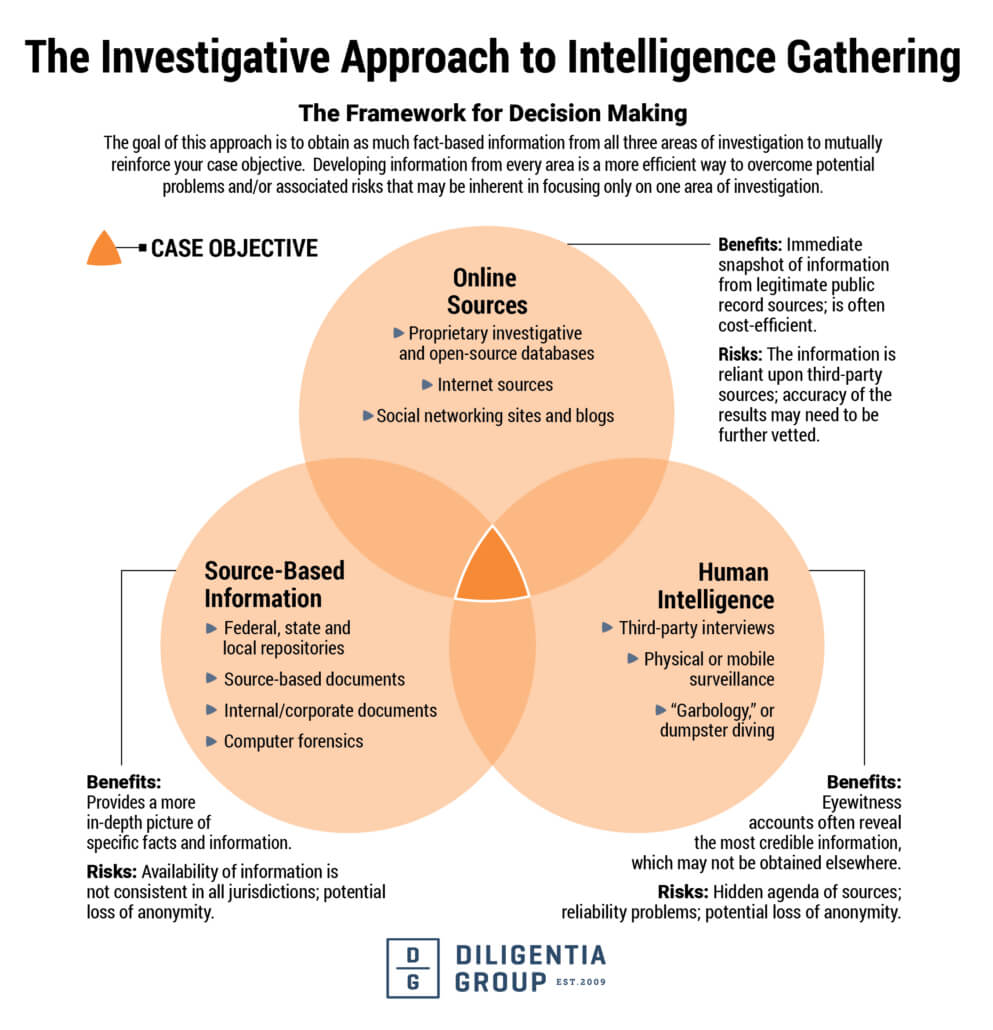
Private Investigator Approach Intelligence Gathering

Examples of This Investigative Approach Uncovering Critical Information

  • A review of state securities regulators records disclosed that a candidate at an international investment bank was the subject of an ongoing criminal probe in South America. This information was not available through FINRA’s BrokerCheck system which is available on the Internet.
  • Database searches through criminal record repositories and database records did not identify any criminal record information on the subject of a background investigation, but a review of records at the local courthouse disclosed that the individual had been previously arrested for battery.  The record was not identified through other sources because the name was misspelled when the court provided the information to the outside sources and database providers.
  • An investigation into one of the main principals of an acquisition target did not identify any risk-relevant issues in open-source records, but interviews with former employees disclosed that two former secretaries had previously made allegations of sexual misconduct.  These allegations did not show up in the public record because charges had not been formally filed.
  • Four days of surveillance did not reveal any activity for an individual who was allegedly disabled and unable to work, but additional research identified that the individual had set up a corporation in New York and research later disclosed that the individual was running an Internet consulting business out of their house.

There Is No “One-Size Fits All” Approach

This investigative approach does not detract from the value of the information obtained from any one of the three distinct areas. In fact, in certain cases, using only one of the three approaches may be the most effective route to accomplishing the case objective.  However, using this three-pronged approach gives a private detective multiple weapons to identify fact-based information and overcomes potential problems and/or risks which may be inherent in only focusing on one area of investigation.

Final Thought

This is not a ground-breaking approach, but in today’s Internet age people tend to rely too much on quick and easy solutions.

For any private detective, gathering as much intelligence and information as you can from various sources can ultimately lead to making better decisions and ultimately reaching the client’s case objective.

Enjoyed What You Read?

Join 2,000+ others to get insider tips and tricks delivered to your inbox from what has been voted the best blog in the investigative industry!

Up until about 2006, phone records could be easily obtained by a private investigator (or anyone with a credit card and Internet connection) for as little as $100 through various online vendors.  In order to obtain phone records, these services would typically use pretexting, where an individual would falsely identify themselves as the owner of the phone number in order to obtain confidential phone records.

Hewlett Packard Spy Scandal

Everything changed in 2006, when pretexting was thrown into the public spotlight. Hewlett Packard hired private investigators to find out who leaked confidential information to the media.  Using pretexting, the private investigators hired by Hewlett Packard falsely identified themselves as the owners of the phone number and were able to access private phone records of board members and nine journalists who covered the company without obtaining their permission.  Four private investigators were later criminally charged when felonies.

2007: Pretexting Becomes Federal Offense

When the Hewlett Packard scandal broke in late 2006, pretexting to obtain phone records was a bit of a legal gray area, but in January 2007, President Bush signed the Telephone Records and Privacy Protection Act of 2006, which makes it a federal felony to fraudulently acquire telephone records. While a private investigator can use legitimate tools to try to identify the telephone carrier for a particular phone number and may be able to use the legal system to get the phone records through a court order, obtaining phone records using deceit or without specific permission is a federal offense.

Final Thought

While pretexting is/was the most common way to get phone records, other ways to obtain phone records include hacking and good-old-fashioned bribery, but as their names might suggest, these are also against the law.  So unless you are the owner of the phone, you, or the person you have hired to get the phone records, are breaking federal and state statutes.

And if you think that you are insulated from fines or prosecution by sub-contracting the work out to someone else, think again – Hewlett Packard was fined $14.5 million and the Chairwoman and Chief Ethics Officer were criminally charged in the matter.

Enjoyed What You Read?

Join 2,000+ others to get insider tips and tricks delivered to your inbox from what has been voted the best blog in the investigative industry!

Hello group,
I just did an IRB search [a well-respected database for private investigators] for an individual specifically looking for criminal history. It is known that she has an arrest in 2009. It doesn’t show on the report. What other site should I check that might return what I am looking for.

The above was recently posted by a New York private investigator on a message board dedicated to members of the security and investigation business. Utilizing an online database widely used by private investigators, the investigator was unable to identify a known criminal record.

Since a licensed private investigator was confused, it probably goes without saying that other people are confused as well.

Here are few answers to help clear up the confusion:

Confusion #1: There is no central repository for federal, state, and local criminal records

While there are certain jurisdictions that sell criminal record history information to vendors who charge a fee for the public or investigators to access, most jurisdictions have little or no access to information through outside sources.

The most direct and comprehensive way to conduct a criminal record search is: 1) send someone to the local courthouse or 2) conduct a search through an official repository run by the state or local government in each individual jurisdiction that the person lived or worked.

There are no shortcuts, one-stop shops, “investigative” databases [IRB included] or other sources for this information.

Confusion #2: Conducting a criminal record history check is not as easy as pressing a button

There are over 3,000 local courthouses in the U.S. and the procedures to access these records vary.

In some cases, the only way to access the records is to send someone to the local court.  In other cases local courts offer access to records online while some states have a central repository for collecting and searching records (see How to Conduct a New York Criminal Record Search).

Confusion #3: There is no such thing as a “nationwide” criminal check

There is only one “true” nationwide criminal record search in the U.S., the N.C.I.C. (National Criminal Information Center), which is a central repository for criminal record information that is available only to law enforcement agencies and related criminal justice organizations.

There is no way for the general public to access the N.C.I.C. database.

Confusion #4: Even if you know about a criminal record, it may not come up in a criminal record search

There are many possible reasons that a criminal record may not come up in a search at a courthouse or an official repository run by the state or local government.

The reasons may vary by jurisdiction: the record may have expunged, the criminal act may have occurred in a neighboring jurisdiction, public access may be limited to certain charges (e.g. infractions may not be reportable), the criminal act may have occurred when the person was a juvenile or the person plead to a lesser offense which was not reportable.  To confuse the issue more, there are also federal criminal records, which would not be available in local courthouses.

Final Thought

The bottom line, if you are confused about how to get criminal records, hire a professional private investigator who can help guide you in the right direction.  And if you are looking for a New York private investigator who knows how to get a criminal record, look no further.

If you are interested in learning more about this, check out our previous post entitled The Truth about a “Nationwide” Criminal Check.

Enjoyed What You Read?

Join 2,000+ others to get insider tips and tricks delivered to your inbox from what has been voted the best blog in the investigative industry!

Not every person, corporation or law firm needs to hire a private investigator on a regular basis.  Realistically and thankfully, a private investigator is not someone that everyone has on speed dial.

But if a situation requires one, before you hire a private investigator, take into consideration these questions:

What is your objective?

Are you trying to find someone, collect on a judgment, determine if it’s worth suing someone or perhaps investigate a complex matter? With some cases, the specific objective may be obvious, but often clients are not sure what they really want. Having an ultimate goal or objective before you hire a private investigator can help control costs and focus the investigator in the right direction.

Do you need subject matter expertise?

Investigators often have a specialty. These include surveillance, matrimonial cases, insurance disability matters, internal fraud investigations, adoption, computer forensics, forensic accounting, litigation support, due diligence investigation and background checks.  Hiring the wrong investigator for the wrong job may doom your case from the start. Before you hire a private investigator make sure the investigator you hire has a proven track record in the area you present to them.

What do you already know?

It’s important to collect every relevant piece of written or electronic information in your possession to provide to the investigator. Also, be sure to tell them everything you know—even if it’s not written down. This insures that the investigator has the best tools to be effective and efficient so that they can hit the ground running.

How will the information be used?

Are you trying to get information for your own use or do you anticipate litigation relevant to the information?  In the first instance, it may be appropriate to deal directly with the investigator, but if there is litigation in the works, your investigator should be retained by an attorney to protect work product privilege.

What are your expectations?

We all love a good Sherlock Holmes novel or an old episode of Colombo, but it’s called fiction for a reason. Understanding what the investigator can legally, properly and ethically do will save you from unrealistic expectations and trouble down the road.

What are the risks if inquiries become known?

What if the investigator is caught digging around? If the inquiries the investigator is making are exposed, what’s the backlash?  Think this through. This is key to developing a leak proof investigative strategy to avoid embarrassment or worse.  An investigative approach depends on the sensitivity of the case—make sure you and the investigator are on the same page about technique. Is it necessary to take every precaution and be sensitive or can the investigator go in with guns blazing?

Enjoyed What You Read?

Join 2,000+ others to get insider tips and tricks delivered to your inbox from what has been voted the best blog in the investigative industry!

According to the Association of Certified Fraud Examiners manual, the Right to Financial Privacy Act prohibits financial institutions from disclosing bank records or account information about individual customers to governmental agencies without: 1) the customer’s consent, 2) a court order, 3) subpoena, 4) search warrant, or 5) other formal demand, with limited exceptions.

Even though the statute is limited in scope and only applies to demands specifically by government agencies, most financial institutions will not release information without one of the above listed authorizations.

Even with law enforcement agencies, the most effective way to get bank records or account information is with the customer’s consent.

There are many private investigators who claim that they have the ability to obtain bank records, account information, account details and other financial information.

While this may be true, the fact of the matter remains – obtaining banking or financial details without specific authority is against federal and state statutes.

How does a “rogue” investigator get bank records?

The two most common ways that investigators obtain bank records or account information is through a source in the banking industry or through pretexting. [To save you the Google search on pretexting, it’s loosely defined as the practice of getting your personal information under false pretenses.]

Although pretexting does have legitimate and legal uses [which is a story for another post], the use of pretexting to obtain financial information about another person is protected under the The Gramm-Leach Bliley Act, passed in 1999, which imposed strict penalties for individuals who obtain information about a third party account through pretext or deceit.

Word of Caution

After reading this, you may be thinking, “if I hire an investigator to get banking records, it’s the investigators problem, not mine.”  Consider this though – if you are ever asked to testify as to how the information was obtained, not only will the evidence be thrown out, but there may be legal implications against you and the investigator.

There are several instances investigators conducting a “banking sweep” only to later find that the information was fake.  For example, in 2009, a Toronto private investigator charged his client $60,000 for a “banking sweep.”  The investigator reportedly identified $2.6 million in the Cayman Islands and the Bahamas, but the information was later found to be bogus.

Are there legal ways to get bank information?

There are legal ways to identify bank accounts such as this case study where we identified bank accounts in a divorce filing.

But what you really need to figure out is what you are trying to do?  Are you really trying to conduct an asset investigationfind assets or locate hidden assets?

Final Thought

Information obtained from “inside” sources can be extremely valuable for any investigator, but when the information obtained is by unlawful means, there can be serious legal implications.

Guide to Hiring a Private Investigator

Enjoyed What You Read?

Join 2,000+ others to get insider tips and tricks delivered to your inbox from what has been voted the best blog in the investigative industry!

A pre-litigation asset search can provide you or your client with valuable information to determine if a lawsuit is worth filing or to gain leverage in the course of negotiations prior to filing a lawsuit.

Going through litigation is expensive.  There is nothing worse than racking up tens of thousands of dollars in attorney’s fees only to find the person or company you are suing doesn’t have anything of value.  In other cases, you may be in the midst of negotiating a settlement prior to filing a lawsuit and want to see how far you can push the negotiations, or if you should cut your losses and settle.

In pre-litigation mode, attorneys don’t have the luxury of having the legal authority to access information about liquid assets such as bank accounts and investment accounts.  Attorneys need information quickly, discreetly and most importantly, legally.

What to consider?

Determining whether you should sue a person or a company has two parts – what they may own and what other potential liabilities they may have.  Of course there may be a whole host of hidden assets, but here are a few key assets and potential liabilities that can be identified quickly, discreetly and legally in a pre-litigation asset search:

Assets


Personal Assets

The most significant asset that people own is typically their home, but other assets that can be identified through open sources include motor vehicles, boats and airplanes.  Beyond the obvious assets held directly by a person, assets may also be held by a close associate, family trust, family member or shell company.  Real property assets may have also been recently transferred to other related parties or held overseas.

Business Assets

In addition to holding individual assets, assets may also be held in a corporate entity.   Identifying corporate affiliations through secretary of state filings and other research is an important step in identifying assets held by affiliated companies which may not be held by the subject directly.

Liabilities


Bankruptcy

Obviously, if the person or company has filed for bankruptcy protection, you will eventually be notified and you can file a claim in the bankruptcy proceeding.  What if you haven’t been notified yet?  If the person or company has a history of filing for bankruptcy protection, wouldn’t you want to know?

Civil Litigation

If other civil litigation has already been initiated against the person or company you are about to sue, you may be in a long line of creditors once your lawsuit has finally been settled.  It may also be a sign that you should settle fast.

Judgments/Liens

If the person or company has been subject to recent judgments and/or lien filings, this may be a sign that the company is already heading for trouble.

Final thought

Conducting a pre-litigation asset search can quickly identify assets and potential liabilities that can help you make a more informed decision about whether you should file a lawsuit or if you should cut your losses and settle prior to filing a lawsuit.

Enjoyed What You Read?

Join 2,000+ others to get insider tips and tricks delivered to your inbox from what has been voted the best blog in the investigative industry!

Whatever reason you have for trying to find a person or witness – whether it’s part of litigation, a long lost relative, birth parents or a key witness – retaining a private investigator is probably your last resort.

You’ve probably taken it as far as you can; you’ve “googled” everything you can think of but you’ve hit nothing but dead ends and are desperate to find this person or witness, no matter what it takes.

Google is everything, but not the only thing

We love Google – it’s one of the most important tools in our business, but because you can’t find it on Google, doesn’t mean it can’t be found.

We’ve talked quite a bit on this website about how powerful Google is; but Google is not everything, and in some cases it gives people a false sense that there is nothing out there.

Well, did you know that Google has less than 1% of the web indexed?  Think about that next time you don’t find something on Google.

What information should you provide the private investigator?

Every piece of information is important, no matter how small you may think it is.

Where the person’s family is from, middle name, sibling’s name, friend’s name, neighborhood they grew up in, month/day of birth, school name, college name, former employer, or address from 40 years ago may all be valuable pieces of information when trying to find someone.

The fact of the matter is, you never know what that one critical piece of information could be.

Stick with the facts

While information you heard through a friend of a friend of a friend may come in to play, it’s important to recognize fact from fiction.

Because you heard that someone may have moved to Charleston, South Carolina does not make it fact.

You could end up wasting valuable time and money chasing down avenues that are not relevant.

What’s the best approach?

From our perspective, the most effective way to tackle this is to use all of the information gathered in the initial consultation to conduct exhaustive searches through investigative databases.

Investigative databases are much more powerful than consumer level databases (and Google searches for that matter) and are an effective and cost efficient way of finding a person or witness.

Advances in investigative databases give investigators a wide array of open source records, as well as information gathered from credit agencies, proprietary sources and even social networks to identity the whereabouts of a person.

If the person still has not been found, information identified through the first phase of the investigative research can help to identify information that can be helpful in the second phase, which may include interviews with former neighbors, friends, colleagues, spouses, etc.

Ultimately, it may require visiting old neighborhoods, employers or digging through archived records at a local library; the reality is that every case is different depending on the circumstances, and how badly you want to find the person.

How much does it cost?

It’s safe to say that by the time a private investigator has received a request to find the person, it’s not going to be as easy as checking the phonebook or “googling” the person’s name. It’s safe to assume that every possible avenue has been exhausted by the time it’s landed in a private investigators hands.

Based on that, it can cost anywhere from a couple of hundred dollars, to thousands of dollars for extremely difficult to find witnesses or people that don’t necessarily want to be found.

One final thought – the less information that you start with, more likely than not, the more expensive it will be.

If you want to get a better idea on the cost, visit our post: How Much Does It Cost To Find a Person.

Enjoyed What You Read?

Join 2,000+ others to get insider tips and tricks delivered to your inbox from what has been voted the best blog in the investigative industry!

When will you need a corporate private investigator? To act fast and understand the extent of the damage and stop it…or to preemptively reduce the risk of substantial and expensive problems down the road?  Depending on your answers to the questions below, now might be the time to hire a corporate private investigator.

Due Diligence Investigations

If you are a financial institution, investor or attorney…

  • As the economic climate incrementally improves, are you absolutely certain you know the level of credibility of the recipient of your institution’s money?
  • Is a company you are backing financially viable and ready for their IPO?
  • Who are you or your client really acquiring? Are the key assets worth what they say they are?
  • Do you know what your subject’s competitors and vendors think of them?
  • Have there been any federal sanctions or regulatory actions against your subject?
  • Is senior management reputable? Do the principals of the company of interest have criminal records? Bankruptcies? Civil actions filed against them?

Comprehensive Background Investigations

If you are a business decision maker, member of a board, non-profit institution, attorney…

  • Hiring a new CEO or Executive Director? Is she who she says she is?
  • Nominating new members of your Board of Directors? Have they every filed for bankruptcy? Committed a crime? Made a statement in the press that would embarrass your organization?
  • Do you conduct background investigators on new hires put into high risk positions?
  • What would sources in the industry say about your subject?
  • If you discreetly spoke with your subject’s former colleagues, what would they say?
  • What about an ex-spouse or neighbor? Are their bones in the closet?

Legal Investigations

If you are an attorney or working on behalf of general counsel…

  • Are you certain you have unearthed every possible witness?
  • Using computer forensics, did you check the hard drives of every computer relevant to your case?
  • Have you pulled trash? Is there something in someone’s trash that could help you win the case?
  • Are you confident that your expert witness is the expert you need him to be? Is the opposing expert witness have any issues that can be used to attack his credibility?
  • Have you worked with a forensic accountant to catch any well-hidden secrets in the financial books?

Asset Searches

Are you trying to recover a judgment or trying to figure out if someone is worth suing…

  • Do you know all of the addresses where your subject has resided over the past 20 years? Worked? Operated? If it is a company, where are their factories and warehouses?
  • Is there any property in your subject’s name? Or, perhaps, is there is property in the name of a family member, spouse or business partner?
  • Does your subject own a boat? How many cars?
  • Are your subject’s assets listed in a divorce filing?
  • With proper permissions, have you reviewed your subject’s emails and bank records?

Finding People

Does somebody owe you money, are you trying to find a missing heir or do you need to serve papers…

  • Have you really checked every possible place for your missing subject?
  • Did you contacted family members, colleagues or former business associates?
  • Have public records identified any new information about the missing subject?
  • Are they active on any social networks that may give a clue as to their whereabouts?
  • Are there other reasons why they may not want to be found?

Enjoyed What You Read?

Join 2,000+ others to get insider tips and tricks delivered to your inbox from what has been voted the best blog in the investigative industry!