Posts

Recently, we have been working with two business owners regarding what they believed were sealed or expunged criminal records.

These cases had very different outcomes.

In the first scenario, a financial institution scrutinized a business owner when he applied for a significant loan. A background check was conducted as part of the evaluation process, and it revealed a felony record for dealing in stolen goods. The business owner, believing that his record had been expunged, was taken aback by this revelation and questioned the result.

In the second case, a man was selling his business and was subject to a background check as part of that process. The businessman believed that an old criminal case from his college days had been sealed, but he wanted to double-check. The client ran a TruthFinder search on himself and didn’t find the record. This was not terribly surprising, given our previous testing of TruthFinder. Not only did we find the criminal record, but we also found a second criminal case against him that he had completely forgotten about. Neither of the cases were sealed, and both were open to the public.

Neither of these situations was as straightforward as they seemed.

In the first scenario, the business owner had gone through the entire process of sealing and removing his record from the public realm. So, if anyone ever went to the court and searched the official records, the result would come back with no records.

However, we found the record in numerous investigative databases, and it turns out that the financial institution had also found the record in one of those databases. There is a dirty little secret in the world of public records: many of these local jurisdictions sell these records to various database aggregators, so once they are out in the wild, so to speak, it’s difficult to rein them back in. So, in this case, the record had been sealed many years after it was filed, so while it was removed from the official records, the record remained in the reports that could be obtained from dozens (if not hundreds) of various database providers that maintain these records.

The client is now going through the resource-intensive process of removing the record from these various database providers.

In the second scenario, the client was adamant that the case he was aware of was sealed. After all, he didn’t find it on TruthFinder. But as we have found before, TruthFinder’s criminal record repository can give you a false sense of security. So we dug our heels in, thinking that we were going to have to get creative about finding any record of the case, like by contacting the police or checking old police blotters.

So we were surprised when it came up in a few databases and even more surprised when a second case came up. The court where the offense took place also confirmed the records and sent us copies of the cases. Both of the cases were really old and, frankly, not particularly meaningful given that the client hadn’t been in any trouble for 20+ years, save for a few minor run-ins with the police in college. Nevertheless, they were pretty serious offenses, and their discovery could jeopardize the entire deal.

What are the takeaways from these two scenarios?

  • If you are a businessperson and subject to potential scrutiny, you should conduct your own due diligence to ensure that any purportedly sealed or expunged records are not out there. Don’t just assume that nobody will be able to find these records once they’re sealed. Nothing could potentially kill a deal faster than lying on a background investigation questionnaire.
  • Even in cases where a record is officially sealed with the court, it may exist in perpetuity in various other investigative databases because many counties and courts sell their information to third parties. Removing the records from the various databases is relatively straightforward, but it’s a time-consuming process. Intel Techniques’ Data Removal Guide is a good place to start.
  • For any motivated party, there are still many other ways to find criminal offenses, including calls for service records through local law enforcement.
  • The various online database “background check” providers can give you a false sense of security. If you’re seeking an affordable method to uncover some personal but incomplete information, TruthFinder might be a viable option. However, if your goal is to obtain reliable and comprehensive information more than half the time from reputable sources, it may be better to consult a professional.

Enjoyed What You Read?

Join 2,000+ others to get insider tips and tricks delivered to your inbox from what has been voted the best blog in the investigative industry!

Dozens of websites offer background checks for a few dollars. And if you haven’t had the pleasure, you can google “background check” and get ready to be bombarded.

Go ahead. We’ll wait.

Most of the dozens of services offered by these firms are for things like tenant screenings and run-of-the-mill pre-employment backgrounds. The firms do a few things pretty well, like verifying that a person exists, determining if they were involved in any serious crimes (in the past few years), or learning whether they are sex offenders or appear on terrorist watch lists. With the subject’s permission, you can get some work history or degree verifications for a few extra dollars.

Depending on various factors, these services can range from a few dollars to $500.

But what if you need more than determining whether you are dealing with the proverbial axe murderer,  sex offender or an international terrorist?

What if you’re looking to develop information about a person’s character, potential risks or conflicts, omissions in their reported history, material misrepresentations or ties to fringe groups?

You want to go beyond online sources to find trouble in a person’s past (even if their name wasn’t on it) or go beyond searching back only a few years.

Or maybe you want a deep analysis of their online history, an examination of their 82,000 tweets or a link analysis to identify possible connections to unsavory characters.

This type of deep background check is typically saved for C-level executives, potential business partners, board members, acquisition targets, an adversary in high-stakes litigation or a high-ranking official (unless it’s George Santos, but that’s another post).

The kinds of situations where there is a lot at stake, including reputation, public perception, money or justice.

Those types of no-holds-barred background checks can cost tens of thousands of dollars.

So why do these deep background checks cost so much?

No Single Source

Using a single source of information could save you time and money. And lots of headaches.

Imagine just typing a name into a database and getting all the juicy details that you need. The problem is that there is no single source of information. It just doesn’t exist. There are lots of platforms that claim to provide deep, thorough, nationwide, complete background investigations. They just don’t exist.

Unlike a background screening service that will typically use a single source for things such as criminal records, deep background checks use multiple sources for things like criminal records and in some cases, dozens upon dozens of sources for thoroughness.

For example, for a person living in New York City, I would run through about 8 different sources: a combination of professional investigative databases, state and local databases, and a statewide criminal database, along with sending someone to the courthouse (most lower-level courts in New York City are not covered well online).

Court records, are another prime example — an unbelievably powerful resource for background investigations on so many levels. We might research a dozen or more separate sources for civil and criminal litigation records on an average background investigation.

You read that right, a dozen.

Why?

Because there is no single reliable source. There are local and state court websites, state criminal databases, federal repositories and state repositories. Then there is the actual court itself, which you might think would be the single-most-reliable source — the particular courthouse in the area where the person lives.

But in some cases, you would be dead wrong.

There are dozens of reasons, but generally, these records are contained in various city, county, state and federal silos that don’t talk to each other, so there are mountains of records scattered everywhere. And if you want to actually be “comprehensive,” you need to do this research in each county and state where a person has lived from the time they turned 18, which in some cases could be dozens of jurisdictions.

Yes, many powerful (and expensive) paid databases aggregate data from all over the country. They are pretty reliable, but none are totally comprehensive.

Resource Intensive

Digging deep is time-consuming and resource intensive.

If you have ever been on social media, you know that doomscrolling is a thing. You could spend hours scrolling before you even blink. But doomscrolling in your personal life usually means you are mindlessly scrolling; reviewing and analyzing social media in an investigation require a whole other level of attention and focus.

And that doesn’t even consider finding the social media profiles in the first place, especially when you are researching John Smith. In a business where time is money, that can be costly. And that’s just one part (albeit an important one) of a deep background check.

It’s easier just to google something and report that as fact. It’s not as easy to do the analysis and dig in.

Court records are another good example. While some databases may be able to identify the existence of a record, the analysis is equally important. What actually happened?  Was that public drunkenness conviction a college-age mistake? Or something more serious? Or was that divorce a nasty knock-down, drag-out fight? Or an amicable separation?

You won’t know until you review and analyze the documents, which you have to collect (often by sending someone to the court), and then you have to read them and draft a concise summary from the dozens of pages of legal mumbo-jumbo.

Analysis

We are in an age of misinformation. The reality is that anyone can post anything online. Some of this is easy to prove or disprove while other things can take some real digging. Doing a bit of googling and reporting a Reddit post as fact is not really doing anyone any favors.

Last year, I was at a conference discussing some advanced open-source investigative techniques, and one of the topics discussed was the spread of misinformation. One of the speakers posted what I thought was a great quote from Mark Twain, which I was going to steal until I realized that Mark Twain never actually said it.

Ironic that the speaker, a trained professional who was discussing the topic of misinformation, posted a fake quote, huh?

Snopes took some time to dig into this, speaking to Twain experts who found no evidence that Twain ever wrote or uttered this phrase.

In the real world, we recently did work on someone who was a bit of a “fake” entrepreneur. It makes me chuckle when I see someone who expounds on their business successes and clings to the false illusion that they are some guru with splashy articles on third-rate websites, self-published prominence, glitzy videos and fancy “awards” from places you have never heard of.

It’s easier just to google something and report that as fact.

It’s not as easy to do the analysis and dig in.

Thoroughness

To be thorough, you need to access various sources, the best of which cost some serious money.

A baseline subscription to LexisNexis (historical public records and news sources), Westlaw (historical public records and news sources), Bloomberg/Bloomberg Law (news and historical legal filings) and Factiva (news) will set you back thousands of dollars a month.

You might be asking yourself, why is it necessary to be so thorough?

In many background checks it may not be necessary, but if there is something on the line where uncovering any bits of information might be helpful, it just may.

For example, we recently found three separate DWI cases over a matter of a few years against a person in some database searches. Several other databases we searched did not have any records of these DWI cases and — get this — the courts where the cases were filed did not have any of the records.

Why?

A basic background check may suffice for some basic questions, but if you are looking to get answers to some nuanced questions, perhaps not.

Because the court expunged the records. In a typical background search for employment purposes, these records could not even be reported. But if an incoming CEO of a major public company has a pretty serious drinking problem, I think that would be something you would want to know.

News media sources are another great example. Nexis and Proquest are amazing sources for general news information and include thousands of sources worldwide. But they don’t include the entire archives of The Wall Street Journal, Reuters or Bloomberg. And historical newspapers are much better represented on places like Newspapers.com.

I was recently working with another investigator who had asked us to help with a deep background check on a hedge fund manager in the context of potential litigation. It was a bit out of the investigator’s wheelhouse, so he asked us to help out. When all was done, we sent the investigator an invoice that included more than $600 in database charges and on-site court fees, which the investigator was quite surprised by.

That was just our cost; no markup included.

Expertise

Expertise comes in all shapes and sizes. For someone with a deep understanding of background investigations, it’s a combination of having expertise in understanding the universe of available information, synthesizing that information into actionable intelligence and understanding your limitations. A finite number of people in the world have the skills, knowledge and expertise to do a truly deep background check.

I’ve spent thousands of hours of work to master this craft. I’ve worked on cases involving some of the highest political offices in the land and have spent hundreds of hours digging into some really powerful people.

And when you have been doing things for this long, you collect what may seem like a lot of “useless” information to most of the world, but it is extraordinarily valuable information in your little bubble. Like access to a database of historical records from California that has been floating around for years and includes things like birth records and divorces dating back to the 1970s. Or how to get historical Financial Industry Regulatory Authority reports from state securities regulators. Or where to go for court searches in California (Baxter Research), Massachusetts (R&R Search), or Illinois (AM Legal Services). Or that Premier Due Diligence can handle public record searches all over the country. And if I need copies of corporate documents quickly, Capitol Services is my go-to.

In this day and age, having a deep bench of knowledge of social media is crucial. While most people have at least a rudimentary knowledge of how to get around social media and scroll through someone’s feed to see if there are any major red flags, it takes some serious amounts of manpower, powerful (and pricey) tools like Maltego and ShadowDragon, or some serious know-how to get beyond that.

Like finding hidden accounts, extracting deep links to groups, close-knit friends and confidants, or membership to extremist group sites.

Getting Your Money’s Worth

The cost of a deep background check is important to consider, but it should not be the primary deciding factor. The decision should be made based on a comprehensive evaluation and how it aligns with the overall strategy and goals.

A basic background check may suffice for some basic questions, but if you are looking to get answers to some nuanced questions, perhaps not.

I will leave you with a famous quote:

Enjoyed What You Read?

Join 2,000+ others to get insider tips and tricks delivered to your inbox from what has been voted the best blog in the investigative industry!

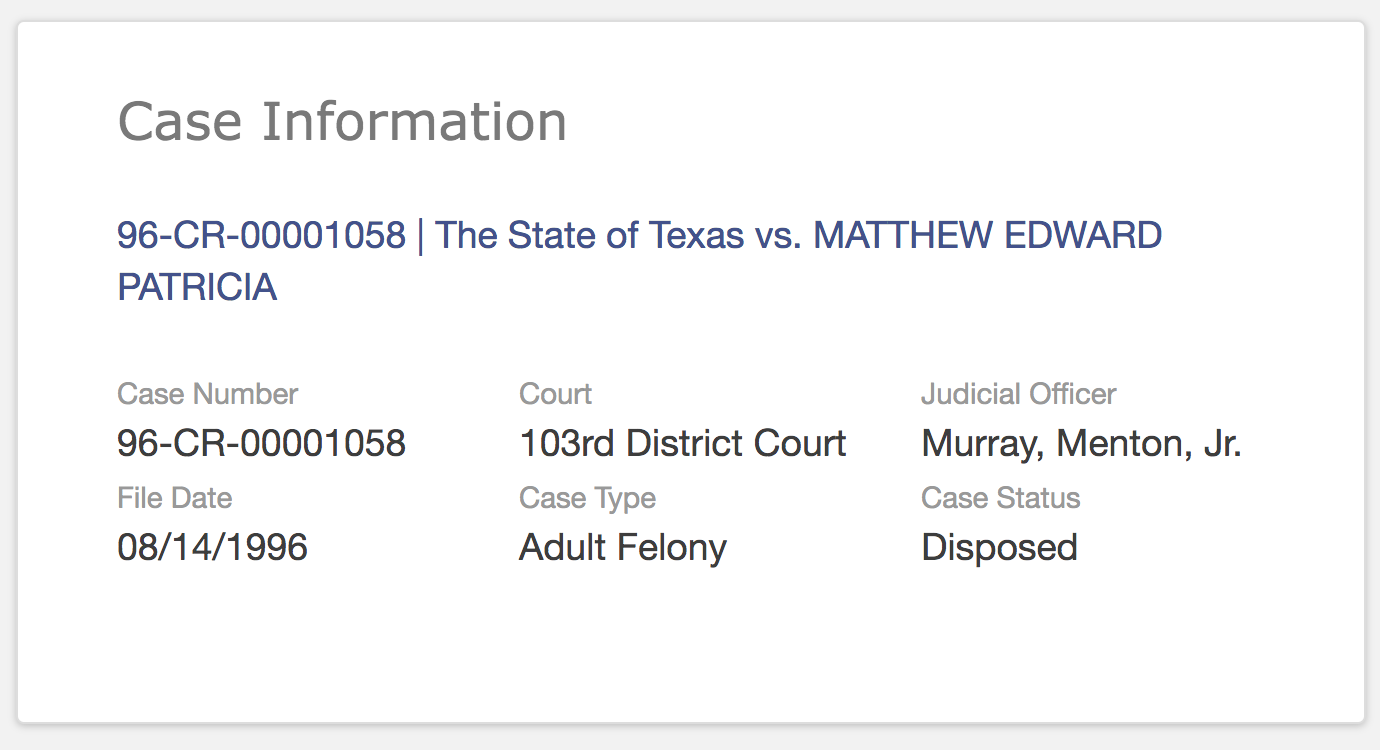
According to recently published report in the The Detroit News, the newly hired coach of the Detroit Lions, Matt Patricia, was arrested for aggravated assault in 1996. Patricia was on spring break in South Padre Island, when Patricia and another fraternity brother “burst” into an upscale hotel room and sexually assaulted a woman. Patricia and his fraternity brother were arrested and later indicted for aggravated sexual assault, but the two men never stood trial and the case was later dismissed.

As an investigator who has conducted thousands of “deep dive” investigations of high-profile individuals, this particular case caught my eye for a number of reasons.

How could the Lions not be aware of this? Was this criminal record readily available in public records or was this information brought to the attention of The Detroit News by a source? What can be done to prevent publicly embarrassing things such as this in the future?

Let’s tackle these questions.

Why weren’t the Lions aware of this?

When initially contacted by The Detroit News to comment on Patricia’s arrest, the team president said, “I don’t know anything about this.”

How is it possible that a multimillion-dollar business, with seemingly unlimited resources, could not know about this? Was the arrest something that was buried so deep that it would be nearly impossible to find? Or was this a failure to do any type of meaningful background check?

The Lions told The Detroit News the arrest “eluded them during a background check that only searched for criminal convictions.”

“We did a complete background check,” said Wood, the Lions’ president. “Our background check was limited to employment matters only and does not disclose any criminal matters that don’t result in a conviction or a plea agreement.”

There are a couple of things going on here that need some additional explanation.

For one, I searched for Patricia’s name in a national criminal record database that many investigators use, and easily found the record. It took me all of two seconds to find that a record existed and another two minutes to pull up some docket information on the Cameron County website.

Matt Patricia Criminal Record

While there are cases in which indiscretions are buried so deep they are nearly impossible to find without some sort of whistleblower or source, this is not one of those cases.

I won’t bore you with the details, but the vast majority of readily available criminal record databases and court records searches are for convictions only. To the layman, that means that criminal record databases typically only include records that resulted in some sort of verdict.

So, for example, if you were arrested but not charged or arrested, or indicted but the case was thrown out, those records will not be part of the criminal court records and cannot be easily identified in a background check. The only way to potentially get that record would be to submit a Freedom of Information Act request to the police department.

In this case, Patricia was not convicted. In a typical situation, this record would not be easily available. But in this case, it was. I don’t have a good explanation for this other than to say that this record happened to be digitized (many records over 20 years old are buried in a court card catalog), and it happened to be in a place where they report non-convictions.

In summary, there are certain states that also provide information on arrests and charges that do not result in a conviction. So, for example, if this were to have happened in New York, it would have been significantly more difficult to find, if not impossible. An investigator would have probably had to file a Freedom of Information Act request in every city that Patricia has ever been known to live in or visit; even then, it might not have been found. In this case, the arrest was across the country.

So how could the Lions not have known about this if they did a “complete background check”?

Technically, the Lions’ “background check” primarily includes criminal convictions, because most records are for conviction only. But even though this case did not result in a conviction, whoever was doing this background check should have been able to catch this arrest since it was in a widely used national criminal database ( “national” criminal records are a bit of a misnomer).

Let’s just forget the fact that the firm the Lions hired to do a background check did a shitty background investigation. Should the firm have known about this?

If you are hiring someone who is going to be publicly scrutinized, you have to ask difficult questions. Or make them fill out some type of questionnaire or form that asks them difficult questions. Anything that may come up that would publicly embarrass the organization. Or could potentially impede his ability to do his work properly.

It may not need to be at the level of the 127-page questionnaire for national security positions, but anything is better than nothing.

What’s particularly interesting about this case is that these types of indiscretions, arrests, etc., may not be found, even in a “complete” background investigation. While it’s pretty clear that the background check should have found something in Patricia’s case, there are other situations where such an event may not come up, since non-conviction records are hard to come by. Also, criminal record searches are filed county-by-county and typically focus on the counties where a person has lived or worked. Makes sense, right?

But in this case, Patricia was arrested in a place he was just visiting. Unless you knew that he spent some time there, you wouldn’t necessarily search in that county.

So were the Lions just following the letter of the law?

The Lions’ president seemed to be alluding to state and federal laws in the article when he said:

“We did a complete background check. Our background check was limited to employment matters only and does not disclose any criminal matters that don’t result in a conviction or a plea agreement.”

Let’s break this down.

So, if they did a “complete background check,” how was this missed? I guess complete means different things to different people. I’ve spent hundreds of hours doing background investigations on some folks, which included one-on-one conversations with past elementary school classmates. If that was “complete,” this hardly qualifies.

Granted, the Lions or other firms may not think it’s necessary to spend tens of thousands of dollars scrutinizing somebody’s background. In many cases, they are probably right. But you have to do enough poking around so something embarrassing like this doesn’t happen.

But it’s the second part of that quote that bothers me, that the background check was “limited to employment matters” and did “not disclose any criminal matters that don’t result in a conviction or a plea agreement.”

So they wouldn’t care if he was robbing banks as long as he could craft a good defensive scheme against Aaron Rodgers?

In fairness, state labor laws (which vary from state to state) and federal labor laws protect employers from making hiring decisions based solely on criminal records. According to the article:

Michigan employers are allowed by law to ask prospective employees about arrests for felonies, but not misdemeanors. In Massachusetts, where Patricia worked for the Patriots from 2004 until earlier this year, state law bars employers from asking about arrests that did not end in a conviction.

You will have to ask someone much smarter than me, but does this really apply to someone like Patricia? They’re hiring someone who is the public face of a very public organization and will be scrutinized to death, but they can’t ask prospective employees about past indiscretions?

I think you can make a very good argument that it doesn’t make sense.

How to prevent this in the future

First, I am a private investigator, not a labor attorney, so do not take this as any sort of legal advice. These suggestions are about high-level public positions or executive-level hires; they do not apply for your average employee hire.

1) Do a “complete” background check.

That does not necessarily mean sending a written request to every police department across the country to find out if there are any criminal arrests. Or flying around the country interviewing everyone that the person has ever met. But it does mean doing comprehensive criminal record research and civil record searches as well as deep public record research and open source research.

2) Develop a background check questionnaire.

Work with your attorney to develop a background check questionnaire. The 127-page National Security Position questionnaire may be a bit of an overkill, but it’s a start. At the very least, you should be asking about basic history, whether or not they have had any criminal past, civil litigation, bankruptcies or arrests.

3) Conduct interviews!

Any type of “complete” background check should include some form of human intelligence, or interviews. Public record searches, open source searches and a review of social media can tell you a lot, but interviews with adversaries, friends or former subordinates might be illuminating.

Guide to Hiring a Private Investigator

Enjoyed What You Read?

Join 2,000+ others to get insider tips and tricks delivered to your inbox from what has been voted the best blog in the investigative industry!

The Wall Street Journal published an article the other day about why red flags were missed in background checks on a number of high-profile cases in which an employee’s “prior transgression or act of concealment embarrasses a well-known company or university.”

The article highlights a number of recent episodes in which executives at Yahoo, Veritas Software, and the U.S. Department of Homeland Security as well as a number of university administrators and coaches have been fired or forced to resign because they misrepresented their credentials.

The article also discusses Matthew Martoma, who was expelled from Harvard Law School for forging a transcript. Martoma changed his name, received an MBA from Stanford University, and went on to be a hedge fund manager at SAC Capital, then one of the most prestigious hedge funds in the world. He was convicted Thursday for his participation in the most lucrative insider trading case ever.

And it’s not just embarrassing misrepresentations. The Washington Navy Yard shooter, Aaron Alexis, who in September killed 12 people, was arrested on several occasions, but nonetheless held onto his security clearance.

So why did background investigations fail?

1There is no one-stop shop

Conducting a background investigation is not as simple as throwing a name into a computer that then spits out the data. For one thing, there are still quite a number of manual processes that need to be completed. But also, there are hundreds of sources of information and hundreds of data points that need to be researched and analyzed. Some firms rely on a single-source database for their background investigations, but the fact of the matter is that there is no single source that captures all the data.

2Technology gives false confidence

 A lawyer once joked that private investigators are just an expensive Google search. You ask other people, and they think Google has all the answers. It certainly may be able to help lead you to the all the answers, but until Google indexes all the world’s information (which Google has said will take 300 more years), it’s not even close.

3Low-budget background checks

The cost of a proper background investigation is something that most firms are reluctant to pay. The best and most specialized proprietary databases are expensive. What’s more, a significant amount of extremely valuable information, such as court records, is not available online and may require an in-person visit. Most firms aren’t willing to pay the expense of conducting a background check properly, which involves visiting courthouses or personally retrieving records.

4Finding “red flags” takes skill and analysis

Of course, anyone who misrepresents their credentials should be easy to spot by even the most basic of background investigations. But in the case of Martoma, his expulsion, his name change (he changed his name after leaving Harvard), and his reported litigation came up only in a comprehensive background investigation by a skilled investigator digging through mounds of records.

5False sense of security

 A large Midwestern investment firm recently contacted us about conducting comprehensive background investigations on their senior executives. Their new chief executive officer had just been fired, after five months on the job, when it was discovered that he had been involved in sexual relationships with at least four people in the office. The $15 background check they had done had given them false confidence that he was the right guy for the job, somehow missing the fact that he was a complete loser. Between salary, fees, moving costs, and everything else, the situation cost them about $100,000. It was only when they lost all that money that they decided to do anything about it, though.

In closing …

I gave a presentation to a local business owners a few years ago and asked the group if they conducted background checks on new employees. Several raised their hands and said that they “Googled” job candidates, or that they used one of the various online services and paid less than $50. One even said that they hired people from other big firms and relied on the background investigation that would have been done previously.

The fact is that the “Google” background investigation and the “background investigation that the other firm did” are not really background investigations at all. Neither are those $15 online “background checks.”

Which is why they fail.

[hs_action id=”4366″]

Enjoyed What You Read?

Join 2,000+ others to get insider tips and tricks delivered to your inbox from what has been voted the best blog in the investigative industry!

There are a number of things that are included in a background investigation that go beyond what is looked at in a typical background check.

While a background check typically includes criminal background checks, driving records (if the job demands the skill), verification of past employment, verification of academic degree and a credit check, a background investigation gathers information from various disparate sources to create a more accurate, comprehensive and complete picture of a person’s past.

Each investigative firm will have its own set of information that is researched, but in the most comprehensive forms of a background investigation, the following information should be included in a background investigation:

1Personal Identifier Verification – Identifiers such as a date of birth and Social Security number are key to linking criminal records, bankruptcy records and other public records to the subject of the extensive background check.

2Address History Verification – Knowing where the individual has lived is critical to determining which courts are necessary to search in order to identify any historical civil and criminal history, and to find information from other public records sources.

3Professional History Verification – A timeline of any employment affiliations, board memberships and nonprofit affiliations can show a history of affiliations with organizations riddled with scandals.

4News Media Review – Most people are under the false impression that all news media publications are easily accessible on the Internet. Historical and international comprehensive news media can identify past issues that can’t be found on the Internet.

5Internet Searches – With the explosion of social media and the perceived “anonymity” of the Web, some people will put just about anything on the Internet.

6Corporate Affiliation – U.S.-based corporations where the individual is a corporate officer or registered agent can identify businesses or hidden affiliations.

7Criminal Record History (State and Federal) – Checking local and state criminal records is one of the most important facets of a background investigation. It’s essential to conduct research at local courthouses or at other official government repositories of information.

8Civil Litigation (State and Federal) – As with criminal record history, it’s essential to conduct research at local courthouses, official government repositories, or proprietary databases that cover the jurisdictions in which the individual has lived. Records of civil litigation can identify disputes with previous business partners, harassment allegations or a history of litigiousness.

9Bankruptcy Records – A history of bankruptcy or financial issues could reveal critical financial details.

10U.S. Tax Court Records – U.S. Tax Court records can reveal unpaid taxes or disputes over taxes, which can lead to further information on income or assets.

11UCC Filings – Has the person been a creditor or debtor in any UCC filings? Did he or she pledge any assets as part of financing?

12Assets – Information relating to real property, motor vehicles, watercraft and aircraft records may show a pattern of living beyond one’s means.

13Judgment Filings – A history of judgment filings may identify a history of financial issues and/or litigiousness.

14Lien Filings – Similar to judgment filings, historical state or federal tax liens may show a history of financial trouble.

15Department of Motor Vehicle Records – A driving record request can identify traffic violations and, in most states, driving under the influence records, which some states consider a criminal record.

16Professional Licensing Verification – Records with local, state or federal regulatory bodies may reveal regulatory actions against professional licensees, such as a certified public accountant, doctor, nurse, an attorney or even a private investigator.

17Professional Affiliations – In addition to having a professional license, professionals typically are affiliated with organizations that award certain credentials or designations, but you don’t know if they are really part of the organization unless you check.

18Financial Regulatory Searches – Especially for individuals who have previously served in the banking or financial industry, searches of records belonging to financial regulatory bodies may identify previous violations or regulatory matters.

19Government Compliance Lists – A review of government compliance lists can identify sanctions from regulatory bodies or politically exposed persons around the world.

20Campaign Contributions – Political contributions may identify strong political ties or connections with polarizing political groups.

This post is part of a series of posts titled Background Investigations 101 – What You Need To Know


Enjoyed What You Read?

Join 2,000+ others to get insider tips and tricks delivered to your inbox from what has been voted the best blog in the investigative industry!

Utilizing a professional private investigator to conduct a background check can cost you anywhere from a few hundred to several thousand dollars, depending on several important factors, most notably the depth of information that you are seeking to obtain.

As with any service, the more involved the project (in terms of both time and expenses), the more it is going to cost and typically, neither the cheapest nor the most expensive option is always the best choice.

To assist you in understanding the cost of a professional background check, we have listed some important questions to consider before engaging a private investigator to conduct your next background check.

How prominent is the subject of the investigation?

Conducting a comprehensive background check on Warren Buffett, a pharmacist in San Diego, is much different from profiling Warren H. Buffet, the Oracle of Omaha and founder of Berkshire Hathaway. The larger the footprint, the more public the person has been, the more  information a professional investigator must identify, locate and present to the client.

How much is YOUR potential loss?

Any potential investment carries with it a certain level of risk or loss. While the potential “loss” associated with hiring a nanny who has a criminal record or is a registered sex offender cannot easily be quantified, most people would not consider spending thousands of dollars conducting a background check on their potential child care provider. But there are also some who are hesitant to spend a few thousand dollars for a thorough review of a subject’s background before making a $5 million investment with a relatively unknown hedge fund operation. The key is to balance your potential risk.

What is the objective of the assignment?

Are you trying to find out if an individual can satisfy a $1,500 judgment against him, or is there something in a person’s past that could potentially discredit an expert witness? Logically speaking, it does not make financial sense to spend thousands of dollars to collect $1,500, but if you are seeking any piece of information to discredit someone, you may have to dig deep. Needless to say, the deeper you may want to go, the more expensive the search can get.

How common is the subject’s name?

Conducting background checks on someone with the name “John Smith” and someone named “Farique Noonsaby ” are two very different propositions. While most criminal records in the U.S. provide some sort of identification number (e.g., Social Security number, date of birth, etc.) to match identifying information to the right subject, the majority of other records available do not.

A comprehensive background check may require an in-depth review and analysis of every lawsuit identified, derogatory news article or social media posting about “John Smith,” which will be both time-consuming and more expensive in terms of out-of-pocket disbursements for the investigator.

What is your potential risk or exposure?

A CFO who has access to millions of dollars and an administrative assistant who is answering the phones have two totally different “exposure” profiles. The same thing goes for any investment opportunity; investing with a person or company with loose regulations and oversight (e.g., hedge funds, unregistered investment advisors, etc.) is much different from investing in a publicly traded company – although Enron, WorldCom and Tyco may have taught us otherwise. In the litigation arena, a comprehensive background check on a key witness in a high-stakes legal proceeding may be the only opportunity you will have to sway the case for your client.

Final Thought

Ultimately, what a background check should provide is peace of mind or a deeper understanding of someone so that you can confidently make an informed decision, something that an online background check, a low-cost background check or a private investigator who lacks experience conducting a background check cannot provide.

Enjoyed What You Read?

Join 2,000+ others to get insider tips and tricks delivered to your inbox from what has been voted the best blog in the investigative industry!