I spend a lot of time on LinkedIn. In part, I am on there to catch up on peers, colleagues and industry trends, but truth be told, I am primarily on there conducting investigations in the context of legal matters, where I am trying to track down some former company employees who can discuss corporate malfeasance, policies or insights into business practices. I am also finding some human intelligence for discreet source inquiries.
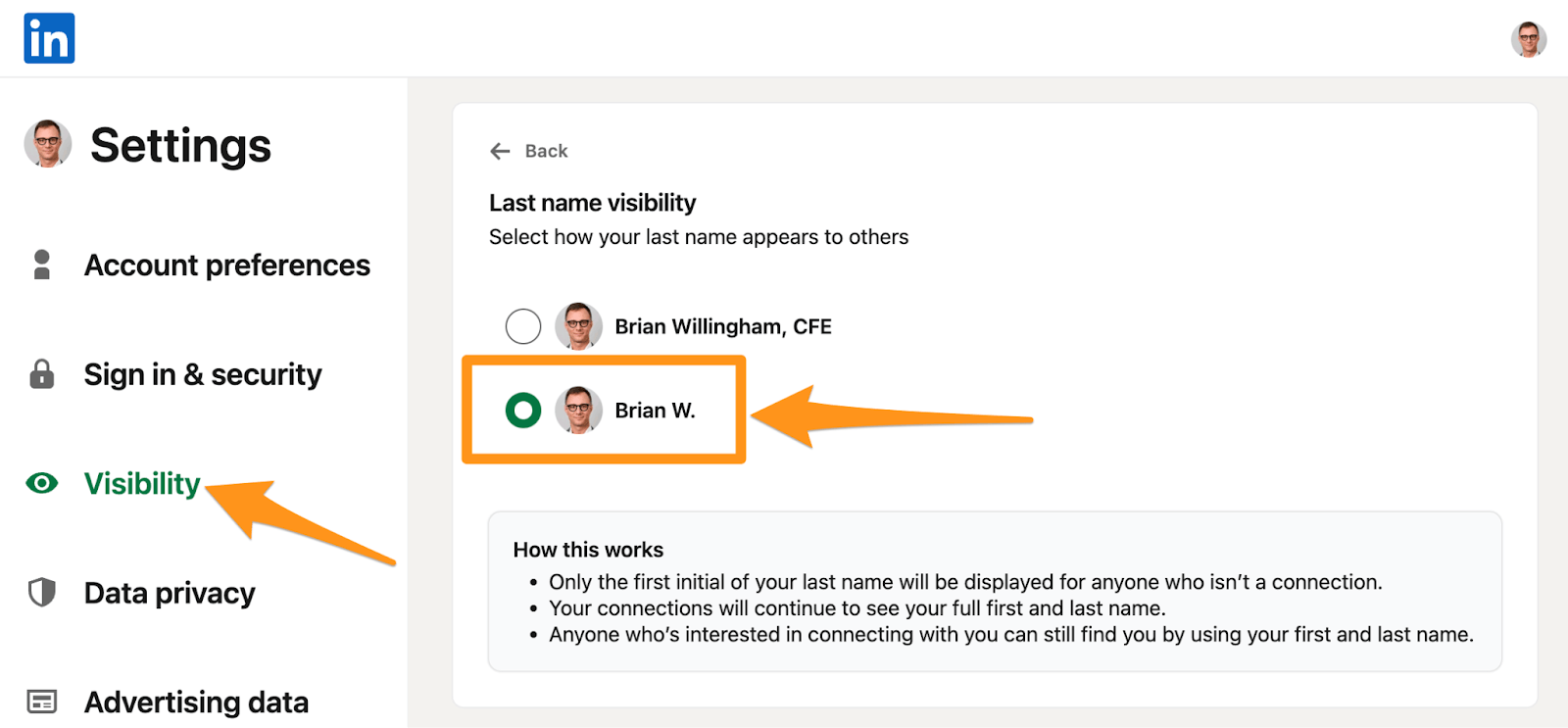
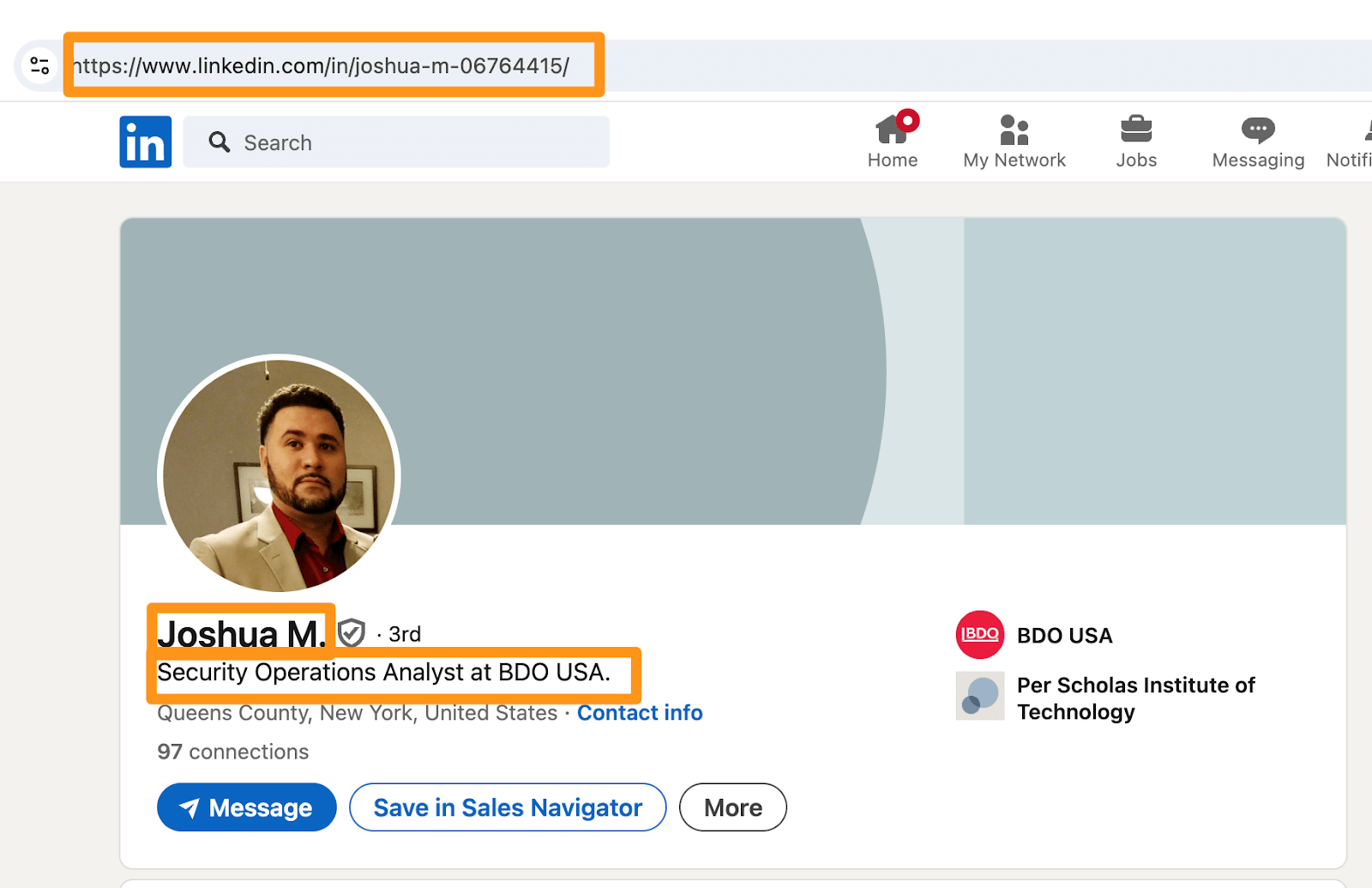
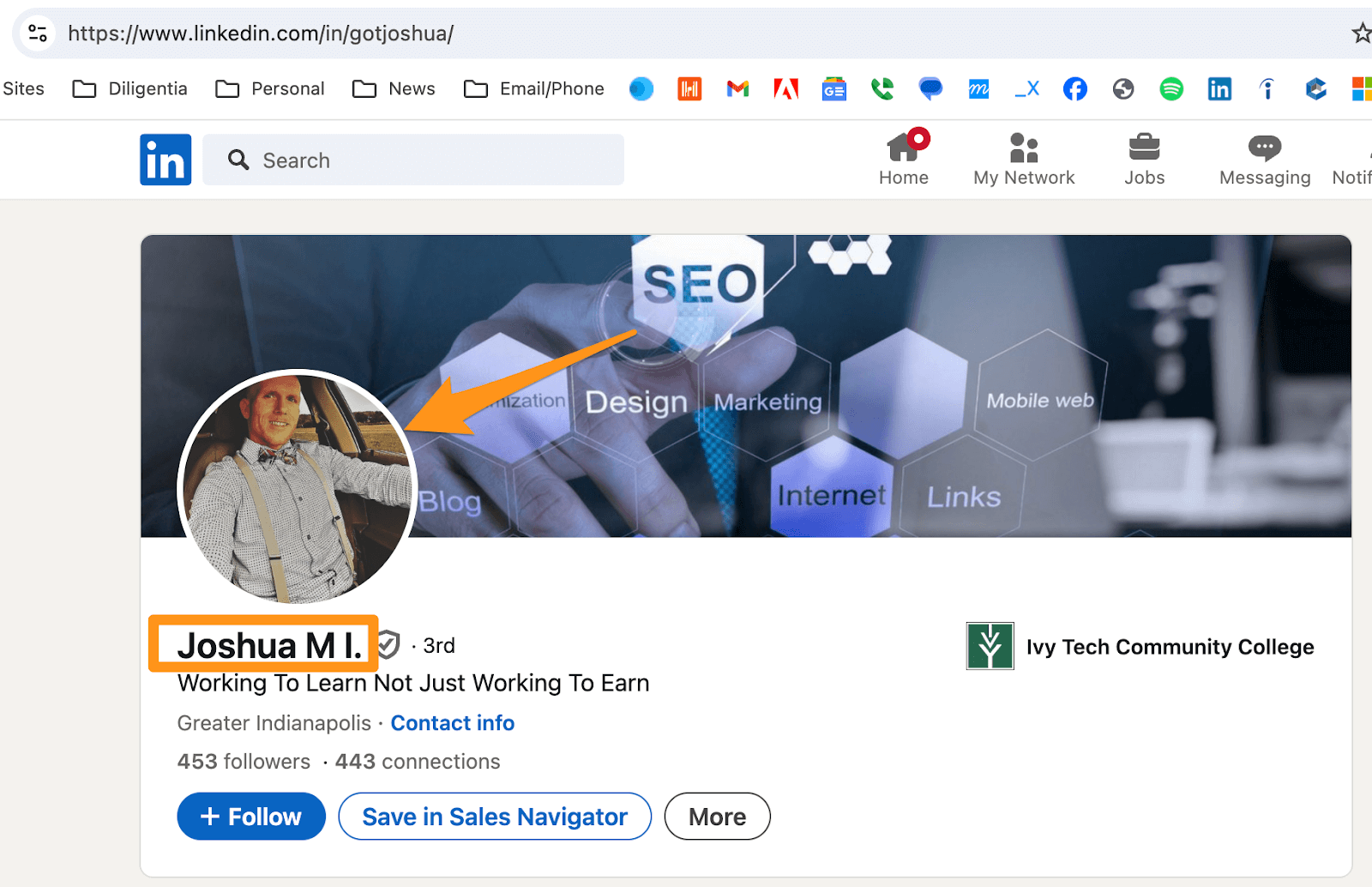
Every so often, you come across a LinkedIn profile that doesn’t contain the person’s full name—for example, “Joshua M.” LinkedIn users can choose to display only their first name and the first letter of their last name for anyone who isn’t a connection by going to settings and privacy, then visibility.
I get it.
Some people want to keep some semblance of privacy.
While some may see the lack of last names as a hindrance and move on, I see it as a fun little challenge.
The key is finding a pivot point—a point of inflection where you can combine multiple data points. For example, a middle name, date of birth or social media profile might find a data point to help identify who the person is when you pivot to another source. In my case, that might mean plugging the person’s middle name or date of birth into an investigative database to determine their full name.
There are dozens of ways to determine a person’s last name or entire identity, some of which require deep research, but below, I’ve outlined some of the most common.
I’ve included six examples of people named “Joshua M.” where no last name is revealed. Note that I’ve got nothing against anyone by the name Joshua. Or “Joshua M.”
I just thought it would be a fun exercise to find examples of people with the same name.
I have organized these from the most common way to the more uncommon ones.
Without further ado …
1 URL
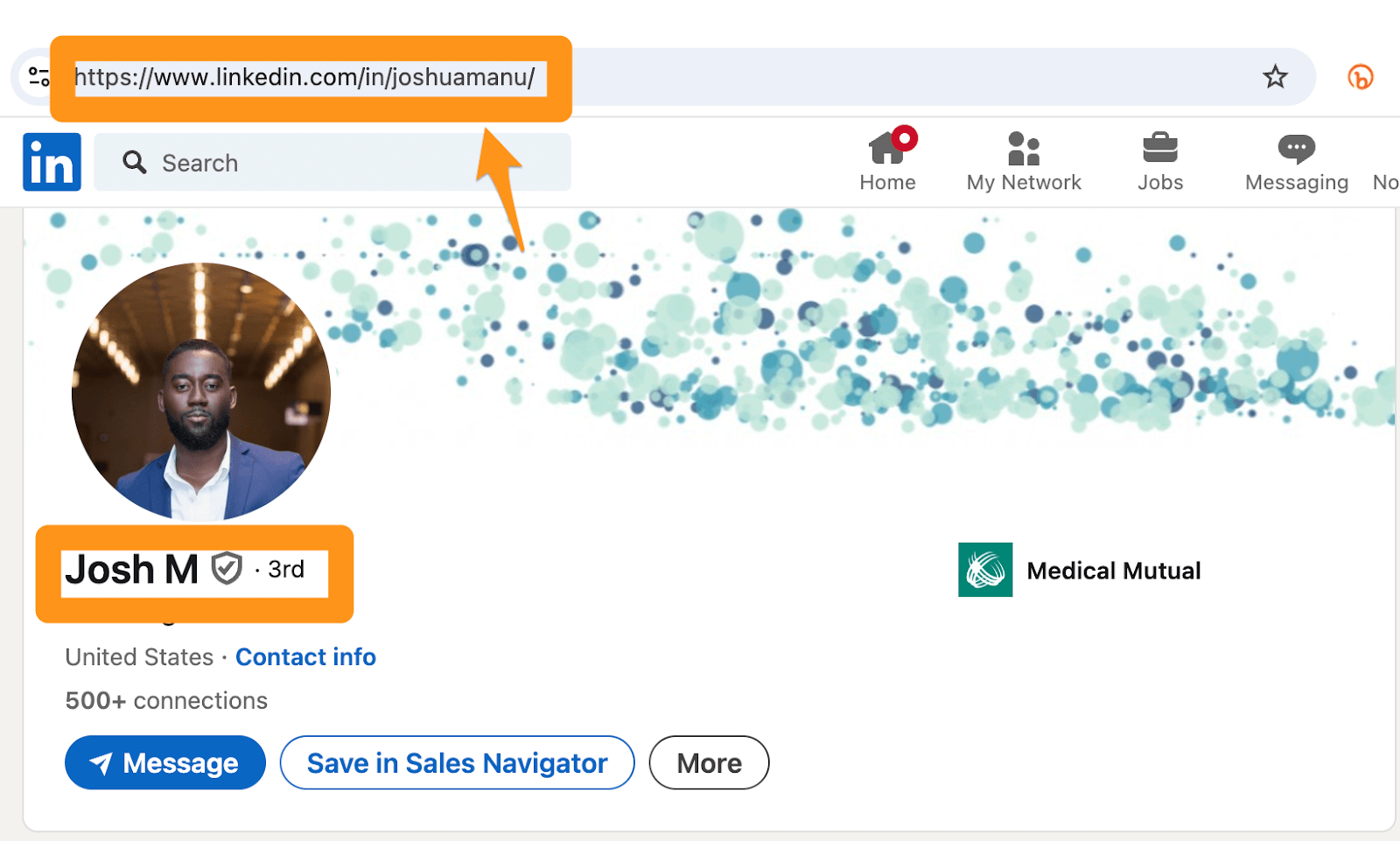
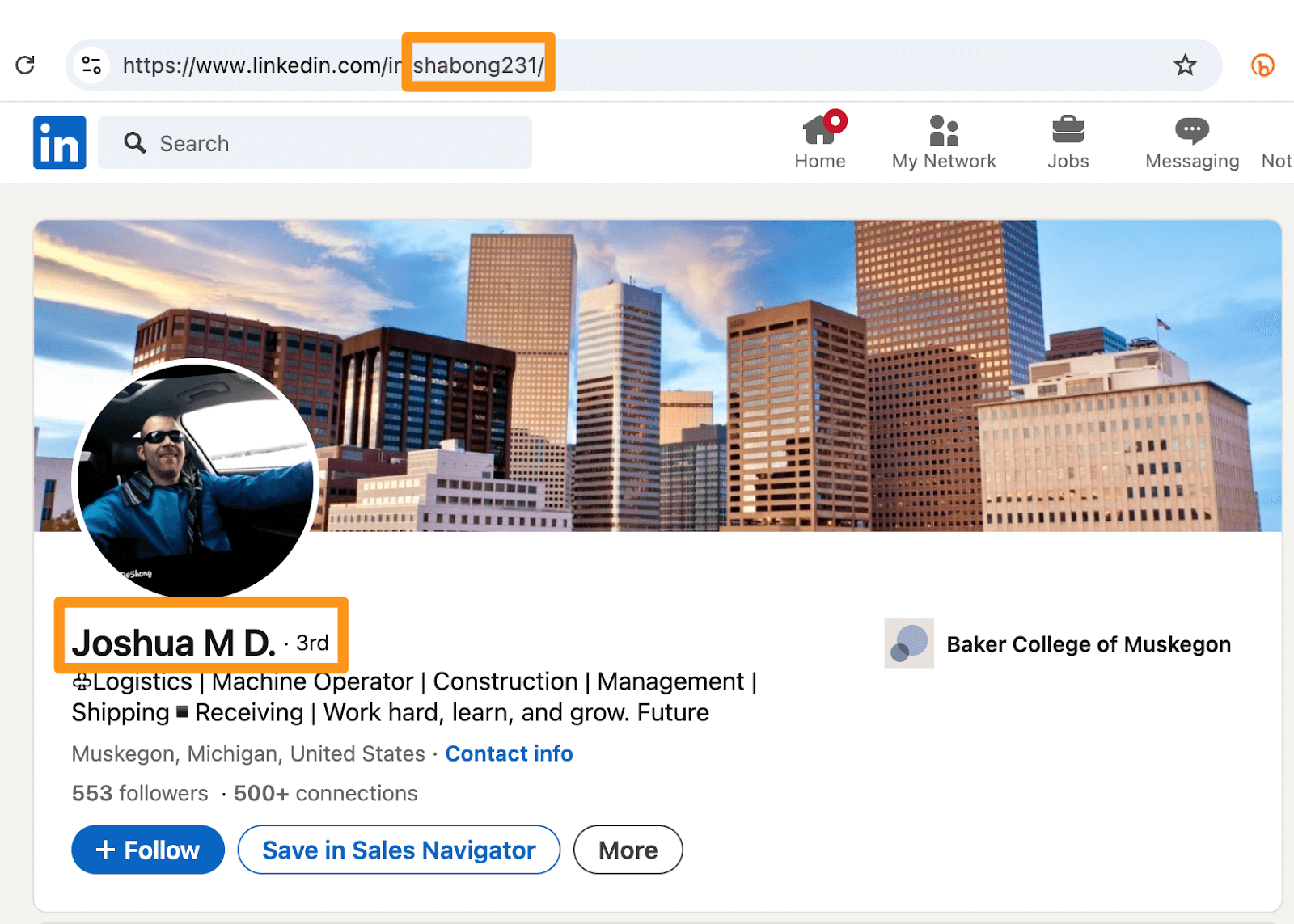
The URL is the easiest and most common way to determine a person’s last name. Quite often, when only the initial of the last name is listed, the URL has the entire last name. I suspect the URL was created long before the person decided to go private and forgot to change it. (Here’s how to change your public profile URL on LinkedIn.)
2 Contact Info
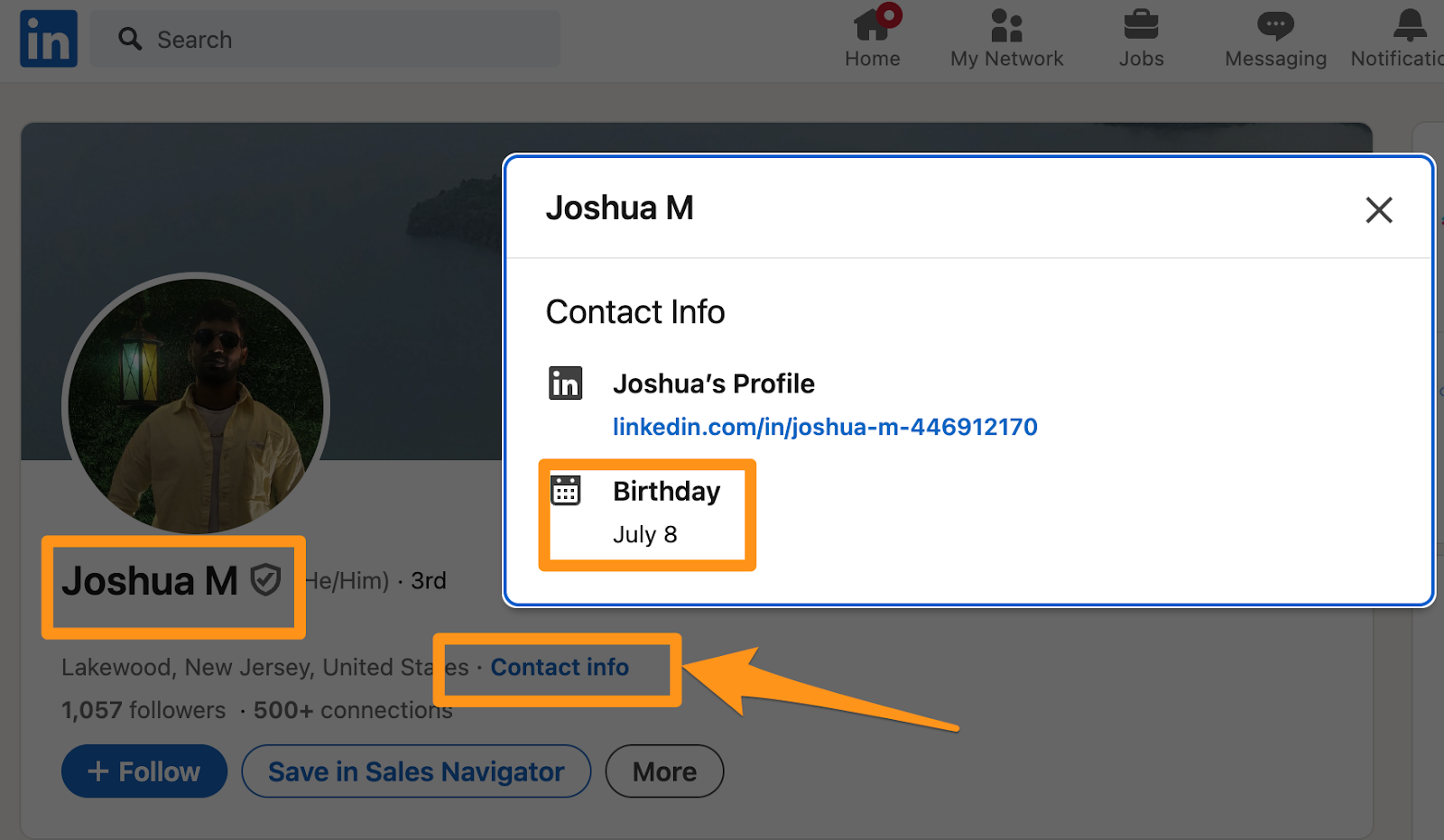
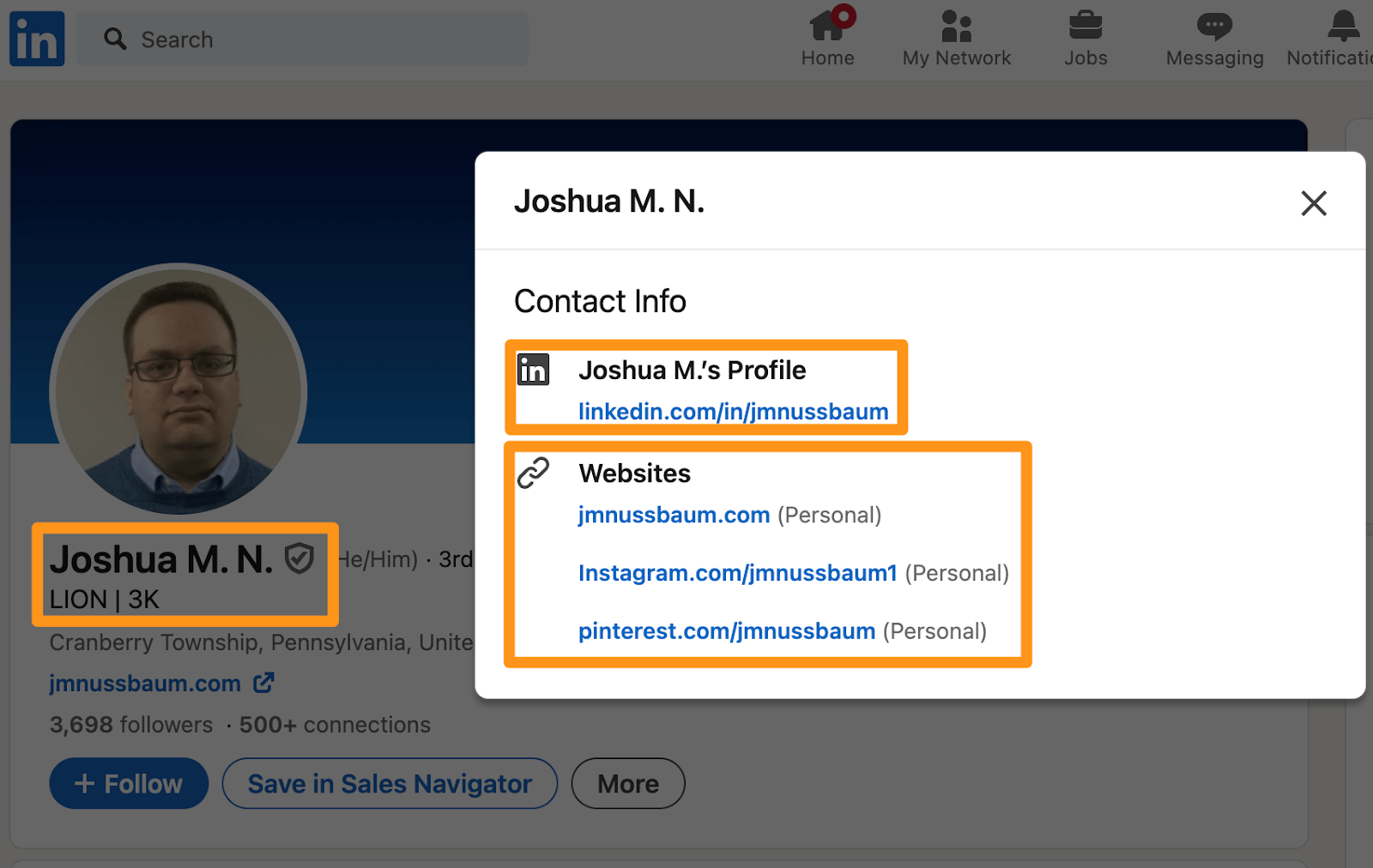
Every LinkedIn profile has a link to “Contact Info” underneath their name, which typically contains little information other than what is otherwise available on the profile. But in some cases, you can find an email address, date of birth, personal website link or handle on another social media platform, any of which you can use to pivot.
3 Credentials
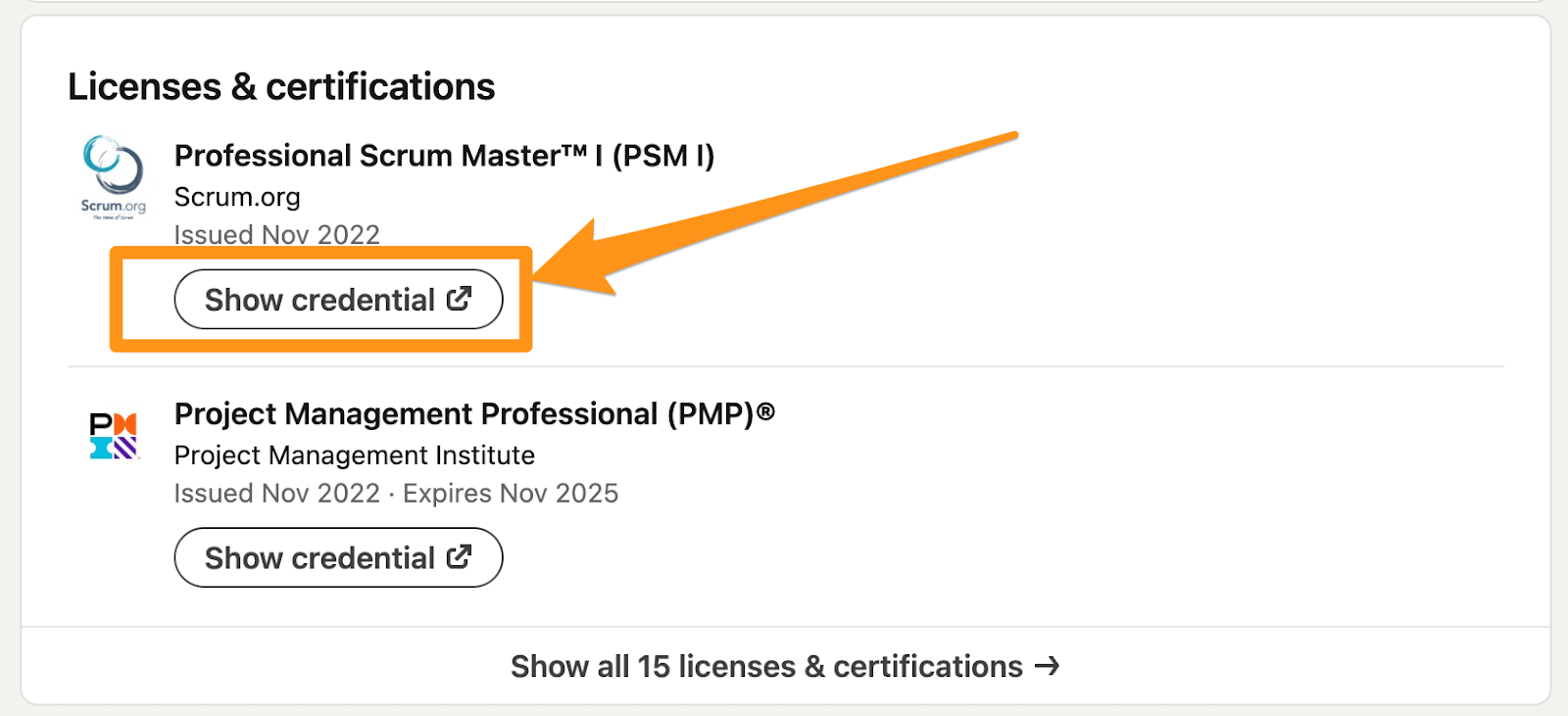
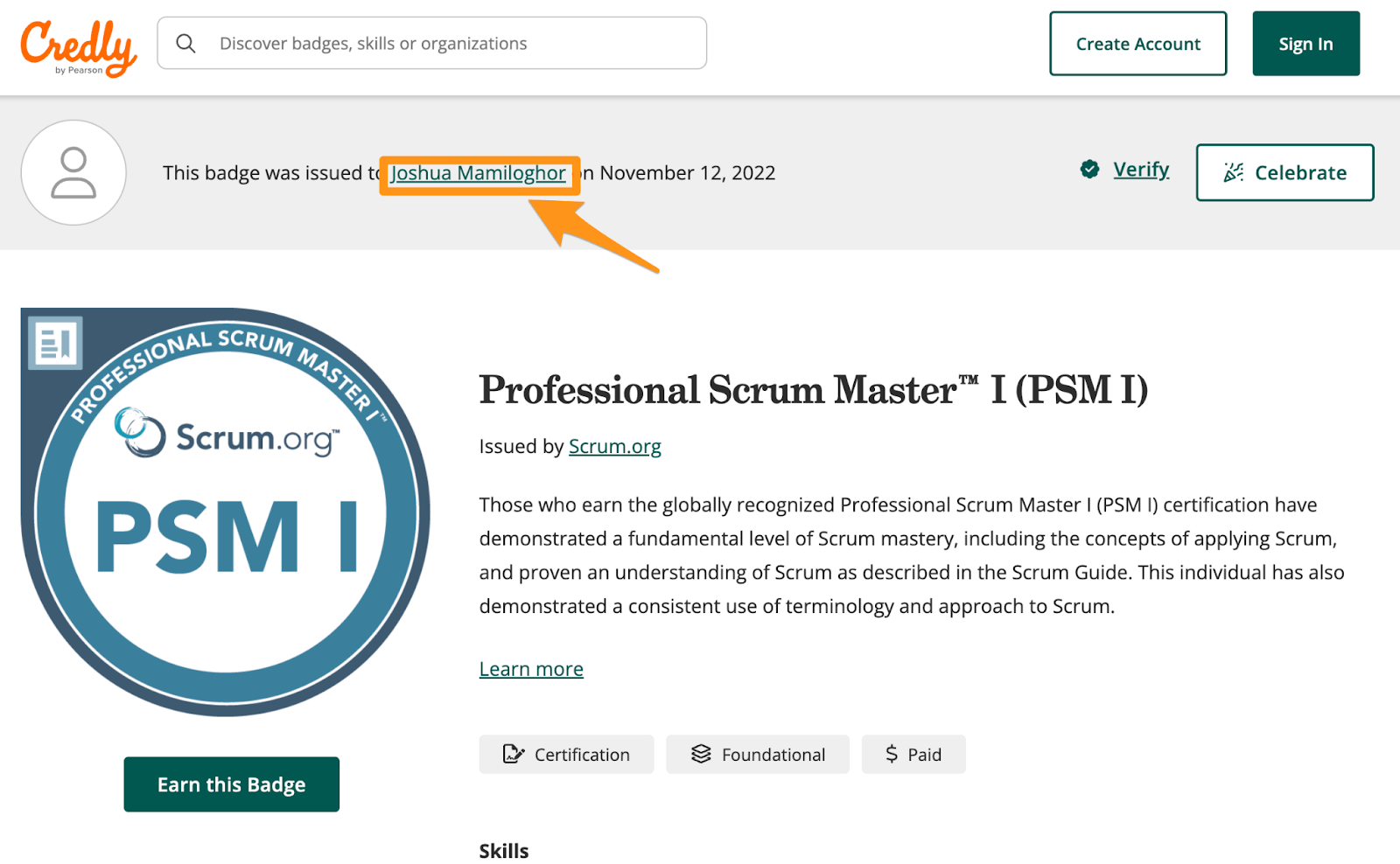
When the URL and contact info come up empty, a credential or professional license might be your answer. Since LinkedIn is a professional social networking platform, people often like displaying their credentials. More commonly, these credentials can be verified by simply clicking on the “Show credential” button, which brings you to a page that shows their full name.
Voilà!
In other cases, it requires some manual effort. For example, a licensed nurse, a lawyer or a doctor can be verified through the local, state or national board by simply checking their license status. This can be a bit hit or miss, though, since not all of these websites allow you to search by just a first name.
4 Creative Googling
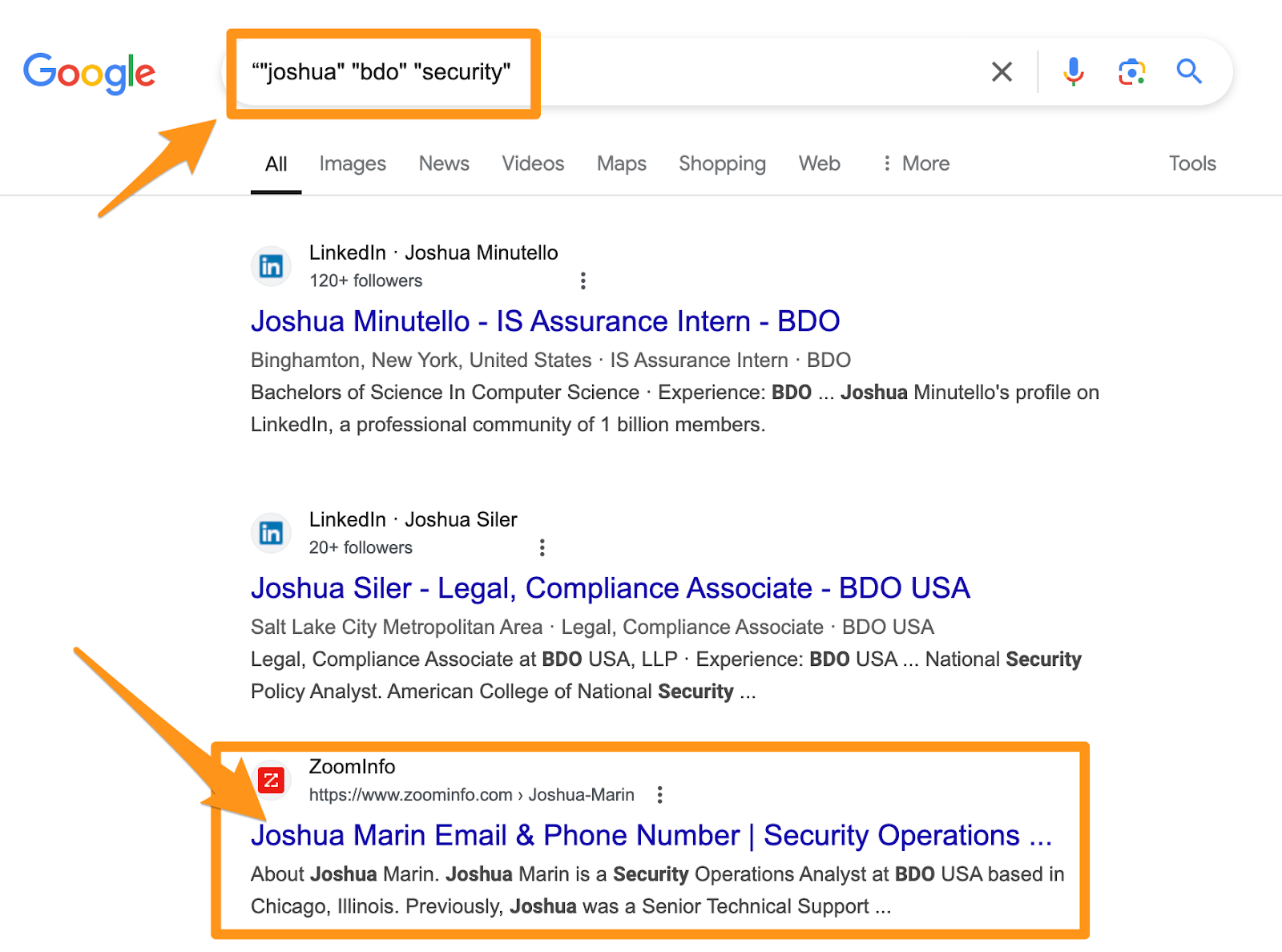
One of the best pivot points is finding unique data on a particular individual. So, even if you only have a person’s first name, like Joshua, but they went to Deep Springs College (the smallest higher education school in the United States) and you know their approximate age, you might get lucky with some googling. So, in this case, we have a guy who works in the security business, and with a not-so-creative but effective Google search, you may be able to identify another online profile for them.
5 Image Search
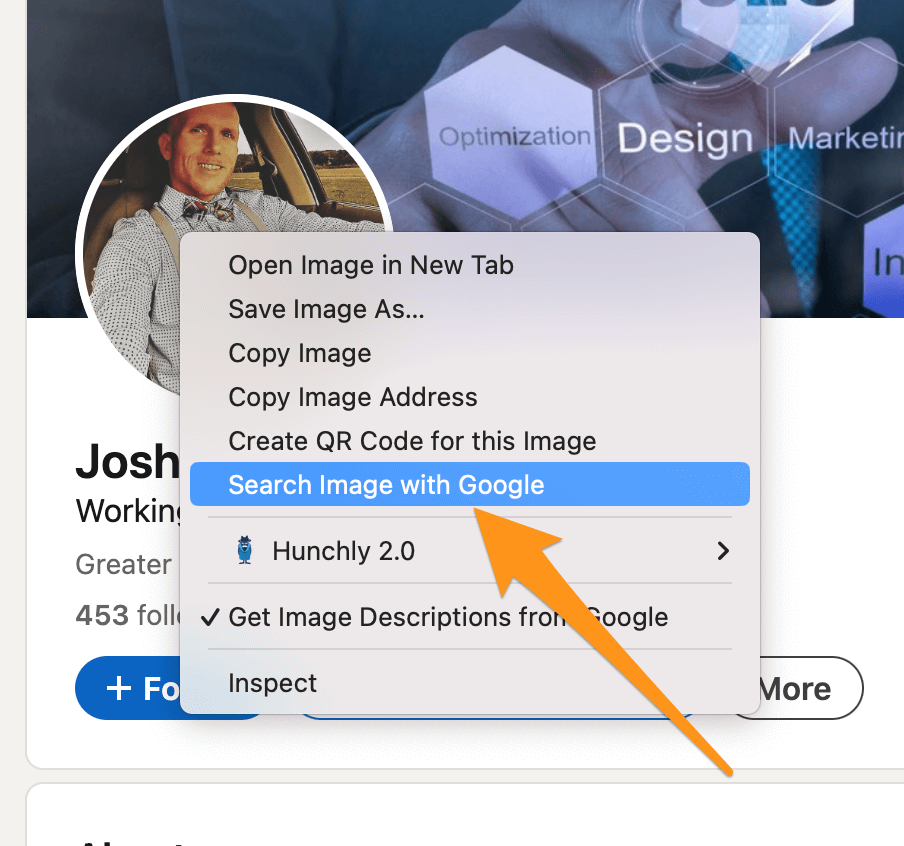
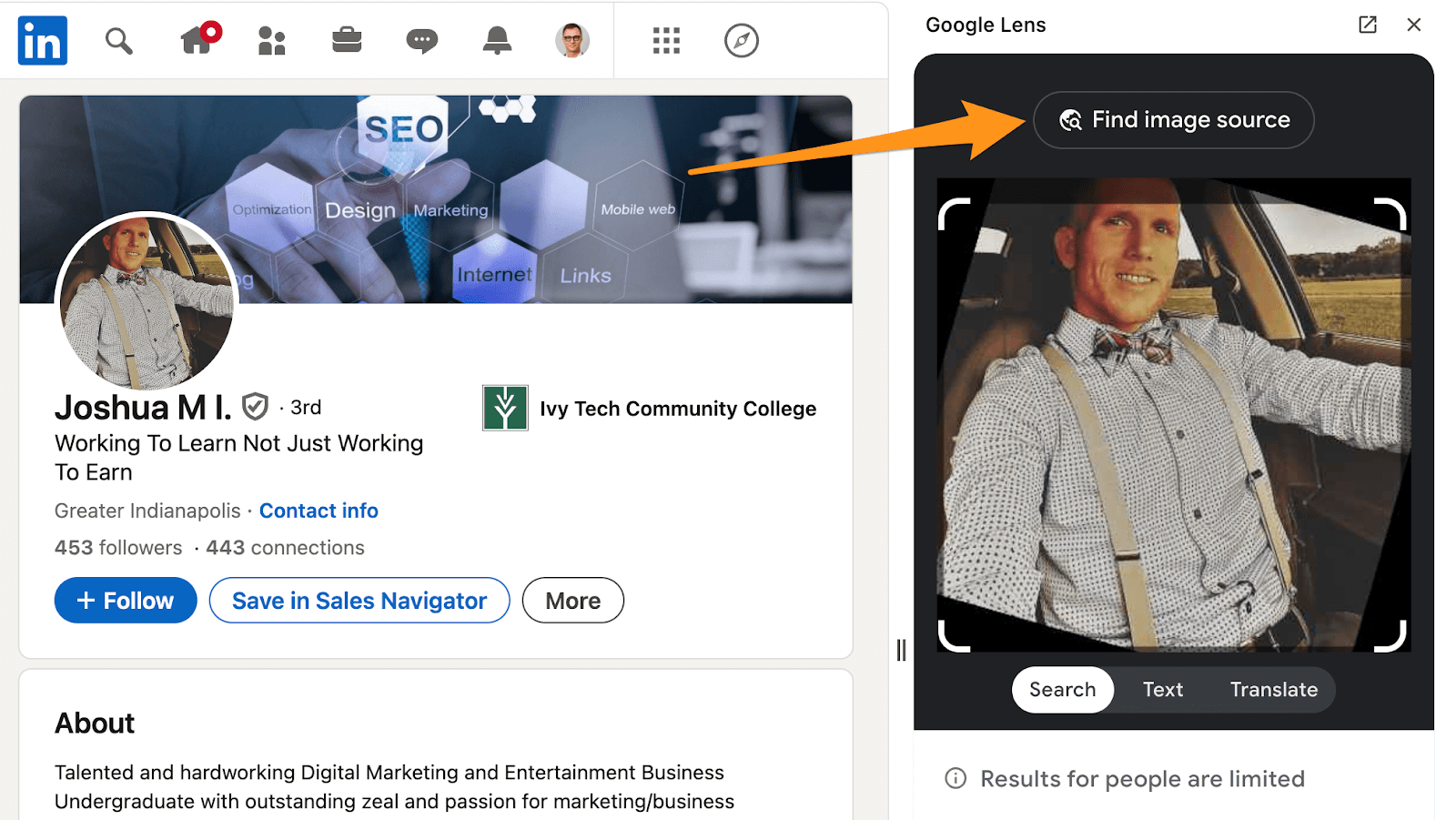
The image of the person can be a good source of leads. There may be some interesting detail in the photo, like a name tag or some unique item, that you can pivot from. You can use some commercially available facial recognition reverse image searches, like FaceCheck.ID or PimEyes. But you can also search the image in Google to see whether the photo has been used elsewhere. In this case, you can see that the user has a Pinterest account with the same exact photo and their full name.
Truth be told, Google image searches for people leave much to be desired. In fact, Google warns that “results for people are limited,” there are times when fortune may favor you.
6 Username
On many social media sites, people use their full name; on others, you will see users have a particular handle or username, like “babykitty1993.” LinkedIn users primarily use their real name in the URL.
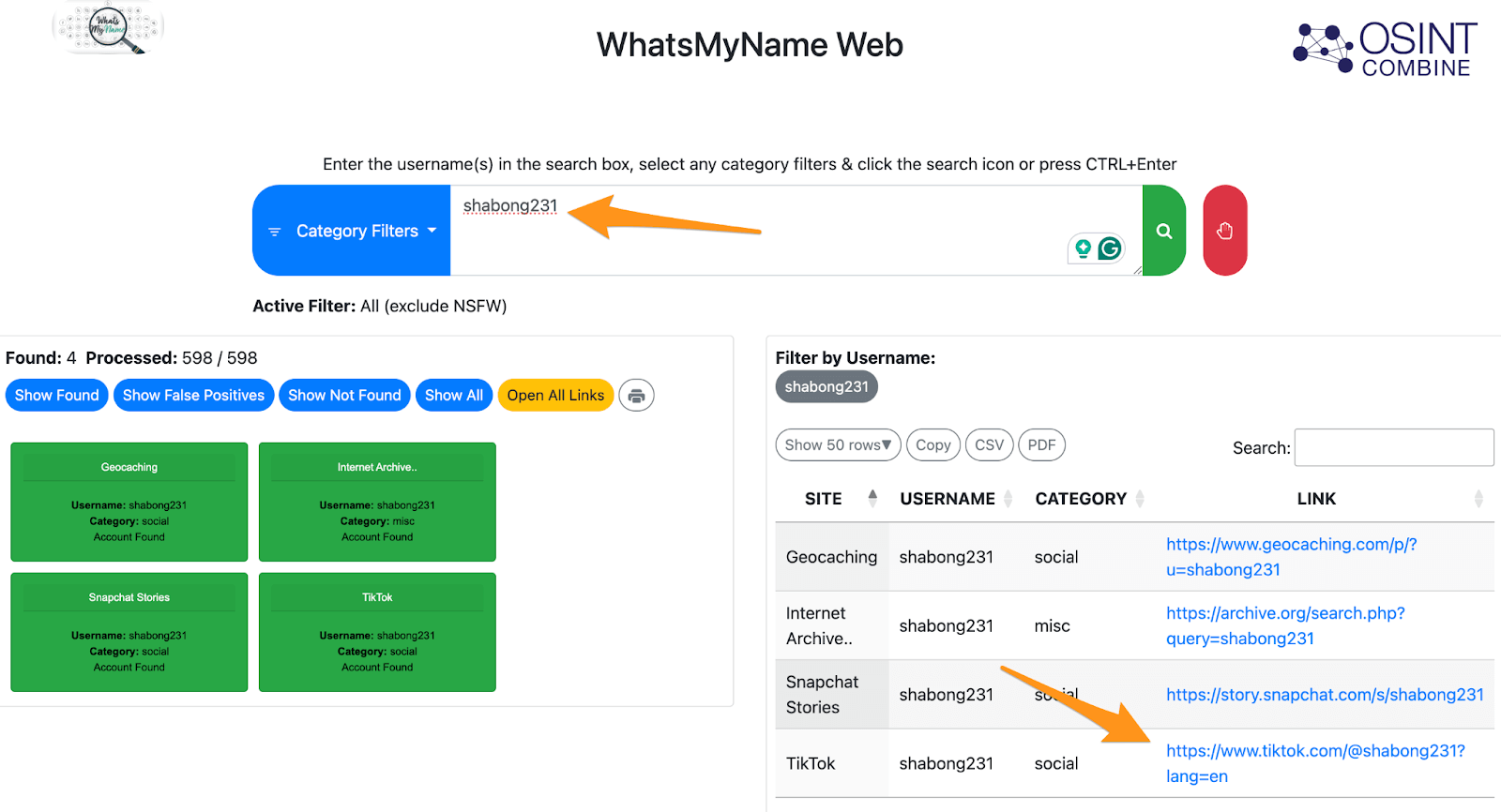
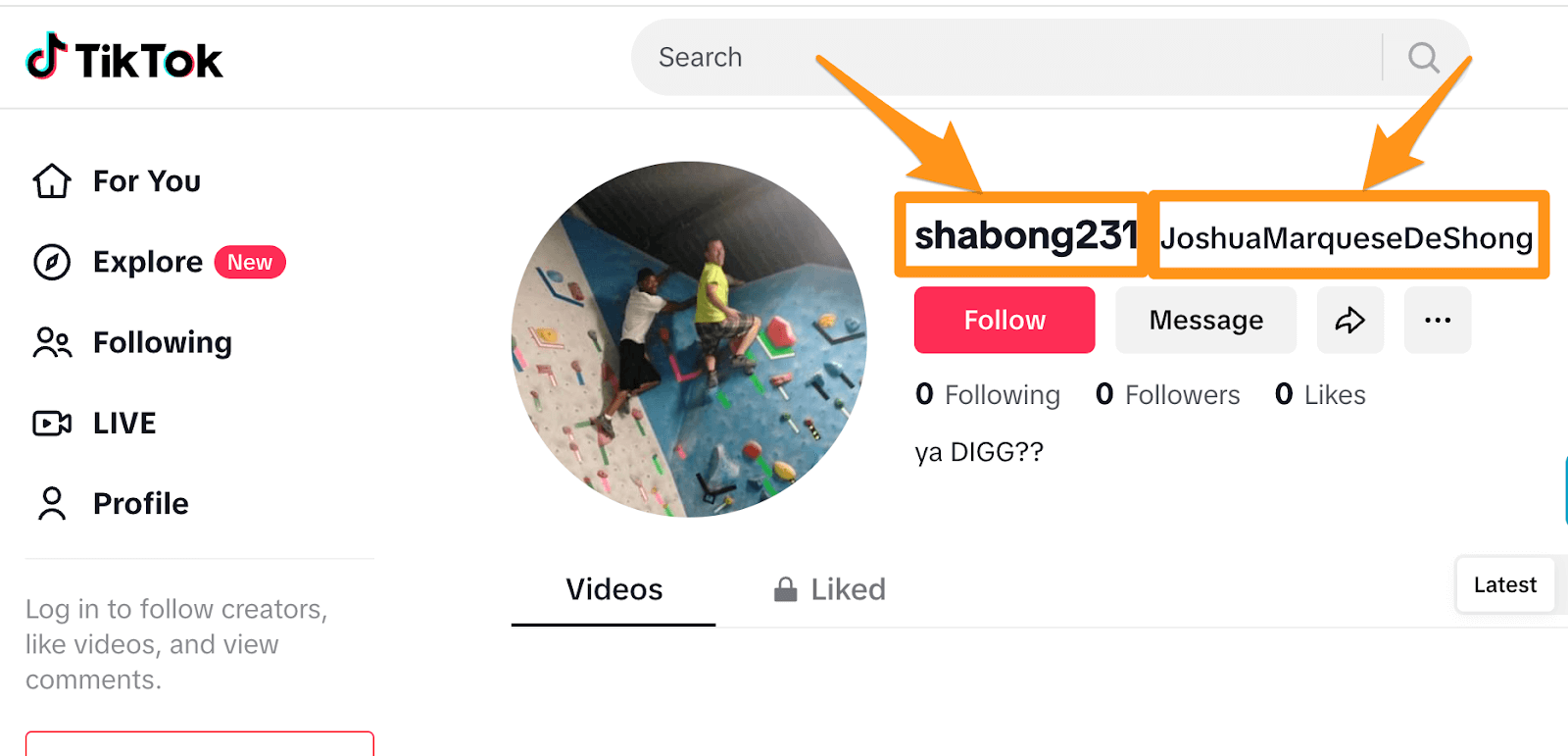
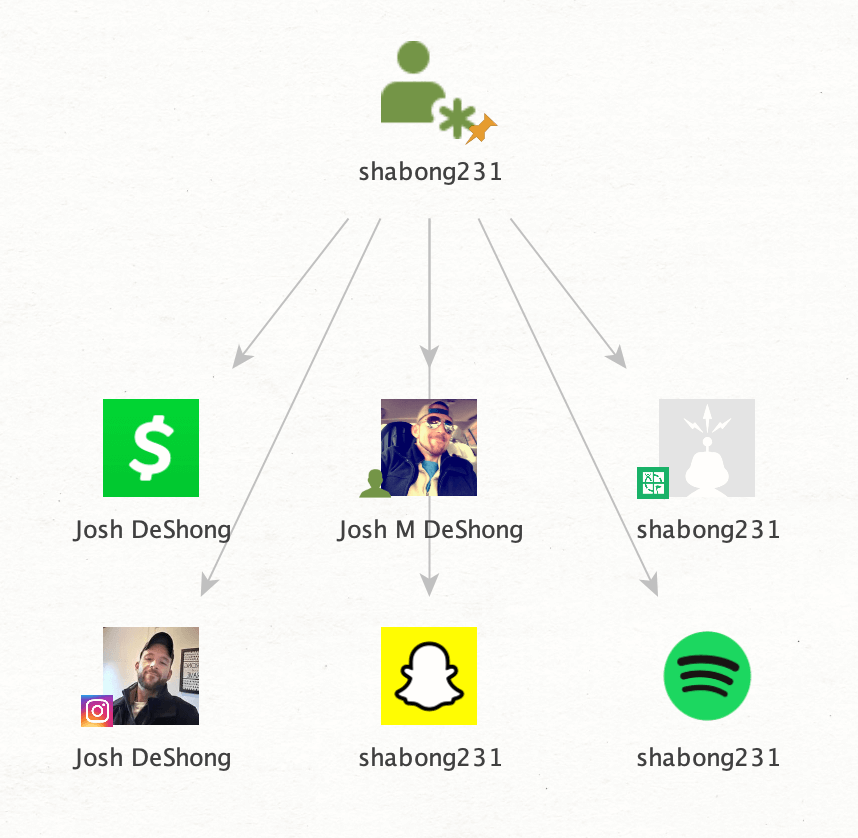
Usernames are typically unique to a person and are often used across multiple platforms. So when you get a username, it’s usually gold. In this case, the user has a particular username in the URL, and by searching that username on WhatsMyName, which searches across hundreds of platforms, you can find other platforms where the user has an account. You can even take it a step further and use OSINT.Industries or Maltego and ShadowDragon to further vet the username on other social media sites.
Screenshot from OSINT.Industries
Screenshot from Maltego / ShadowDragon
Closing
There you have it. Six simple ways to unlock the full name from a LinkedIn profile.
While LinkedIn offers a layer of privacy by allowing users to display only partial names, there are several creative and effective methods for uncovering the full name behind the profile. Whether conducting research, seeking professional connections or satisfying your curiosity, these six techniques can provide the insights you need without needing to resort to more-invasive tactics.
https://diligentiagroup.com/wp-content/uploads/2024/08/LinkedIn-Profile-Hacks-6-Simple-Steps-to-Reveal-Someones-Full-Name.png400750Brian Willinghamhttps://diligentiagroup.com/wp-content/uploads/2021/01/DG_mainlogo-navy@2x.pngBrian Willingham2024-08-15 08:58:452024-08-15 09:32:19LinkedIn Profile Hacks: 6 Simple Steps to Reveal Someone’s Full Name
Dozens of websites offer background checks for a few dollars. And if you haven’t had the pleasure, you can google “background check” and get ready to be bombarded.
Go ahead. We’ll wait.
Most of the dozens of services offered by these firms are for things like tenant screenings and run-of-the-mill pre-employment backgrounds. The firms do a few things pretty well, like verifying that a person exists, determining if they were involved in any serious crimes (in the past few years), or learning whether they are sex offenders or appear on terrorist watch lists. With the subject’s permission, you can get some work history or degree verifications for a few extra dollars.
Depending on various factors, these services can range from a few dollars to $500.
But what if you need more than determining whether you are dealing with the proverbial axe murderer, sex offender or an international terrorist?
What if you’re looking to develop information about a person’s character, potential risks or conflicts, omissions in their reported history, material misrepresentations or ties to fringe groups?
You want to go beyond online sources to find trouble in a person’s past (even if their name wasn’t on it) or go beyond searching back only a few years.
Or maybe you want a deep analysis of their online history, an examination of their 82,000 tweets or a link analysis to identify possible connections to unsavory characters.
This type of deep background check is typically saved for C-level executives, potential business partners, board members, acquisition targets, an adversary in high-stakes litigation or a high-ranking official (unless it’s George Santos, but that’s another post).
The kinds of situations where there is a lot at stake, including reputation, public perception, money or justice.
Those types of no-holds-barred background checks can cost tens of thousands of dollars.
So why do these deep background checks cost so much?
No Single Source
Using a single source of information could save you time and money. And lots of headaches.
Imagine just typing a name into a database and getting all the juicy details that you need. The problem is that there is no single source of information. It just doesn’t exist. There are lots of platforms that claim to provide deep, thorough, nationwide, complete background investigations. They just don’t exist.
Unlike a background screening service that will typically use a single source for things such as criminal records, deep background checks use multiple sources for things like criminal records and in some cases, dozens upon dozens of sources for thoroughness.
For example, for a person living in New York City, I would run through about 8 different sources: a combination of professional investigative databases, state and local databases, and a statewide criminal database, along with sending someone to the courthouse (most lower-level courts in New York City are not covered well online).
Court records, are another prime example — an unbelievably powerful resource for background investigations on so many levels. We might research a dozen or more separate sources for civil and criminal litigation records on an average background investigation.
You read that right, a dozen.
Why?
Because there is no single reliable source. There are local and state court websites, state criminal databases, federal repositories and state repositories. Then there is the actual court itself, which you might think would be the single-most-reliable source — the particular courthouse in the area where the person lives.
But in some cases, you would be dead wrong.
There are dozens of reasons, but generally, these records are contained in various city, county, state and federal silos that don’t talk to each other, so there are mountains of records scattered everywhere. And if you want to actually be “comprehensive,” you need to do this research in each county and state where a person has lived from the time they turned 18, which in some cases could be dozens of jurisdictions.
Yes, many powerful (and expensive) paid databases aggregate data from all over the country. They are pretty reliable, but none are totally comprehensive.
Resource Intensive
Digging deep is time-consuming and resource intensive.
If you have ever been on social media, you know that doomscrolling is a thing. You could spend hours scrolling before you even blink. But doomscrolling in your personal life usually means you are mindlessly scrolling; reviewing and analyzing social media in an investigation require a whole other level of attention and focus.
And that doesn’t even consider finding the social media profiles in the first place, especially when you are researching John Smith. In a business where time is money, that can be costly. And that’s just one part (albeit an important one) of a deep background check.
It’s easier just to google something and report that as fact. It’s not as easy to do the analysis and dig in.
Court records are another good example. While some databases may be able to identify the existence of a record, the analysis is equally important. What actually happened? Was that public drunkenness conviction a college-age mistake? Or something more serious? Or was that divorce a nasty knock-down, drag-out fight? Or an amicable separation?
You won’t know until you review and analyze the documents, which you have to collect (often by sending someone to the court), and then you have to read them and draft a concise summary from the dozens of pages of legal mumbo-jumbo.
Analysis
We are in an age of misinformation. The reality is that anyone can post anything online. Some of this is easy to prove or disprove while other things can take some real digging. Doing a bit of googling and reporting a Reddit post as fact is not really doing anyone any favors.
Last year, I was at a conference discussing some advanced open-source investigative techniques, and one of the topics discussed was the spread of misinformation. One of the speakers posted what I thought was a great quote from Mark Twain, which I was going to steal until I realized that Mark Twain never actually said it.
Ironic that the speaker, a trained professional who was discussing the topic of misinformation, posted a fake quote, huh?
Snopes took some time to dig into this, speaking to Twain experts who found no evidence that Twain ever wrote or uttered this phrase.
In the real world, we recently did work on someone who was a bit of a “fake” entrepreneur. It makes me chuckle when I see someone who expounds on their business successes and clings to the false illusion that they are some guru with splashy articles on third-rate websites, self-published prominence, glitzy videos and fancy “awards” from places you have never heard of.
It’s easier just to google something and report that as fact.
It’s not as easy to do the analysis and dig in.
Thoroughness
To be thorough, you need to access various sources, the best of which cost some serious money.
A baseline subscription to LexisNexis (historical public records and news sources), Westlaw (historical public records and news sources), Bloomberg/Bloomberg Law (news and historical legal filings) and Factiva (news) will set you back thousands of dollars a month.
You might be asking yourself, why is it necessary to be so thorough?
In many background checks it may not be necessary, but if there is something on the line where uncovering any bits of information might be helpful, it just may.
For example, we recently found three separate DWI cases over a matter of a few years against a person in some database searches. Several other databases we searched did not have any records of these DWI cases and — get this — the courts where the cases were filed did not have any of the records.
Why?
A basic background check may suffice for some basic questions, but if you are looking to get answers to some nuanced questions, perhaps not.
Because the court expunged the records. In a typical background search for employment purposes, these records could not even be reported. But if an incoming CEO of a major public company has a pretty serious drinking problem, I think that would be something you would want to know.
News media sources are another great example. Nexis and Proquest are amazing sources for general news information and include thousands of sources worldwide. But they don’t include the entire archives of The Wall Street Journal, Reuters or Bloomberg. And historical newspapers are much better represented on places like Newspapers.com.
I was recently working with another investigator who had asked us to help with a deep background check on a hedge fund manager in the context of potential litigation. It was a bit out of the investigator’s wheelhouse, so he asked us to help out. When all was done, we sent the investigator an invoice that included more than $600 in database charges and on-site court fees, which the investigator was quite surprised by.
That was just our cost; no markup included.
Expertise
Expertise comes in all shapes and sizes. For someone with a deep understanding of background investigations, it’s a combination of having expertise in understanding the universe of available information, synthesizing that information into actionable intelligence and understanding your limitations. A finite number of people in the world have the skills, knowledge and expertise to do a truly deep background check.
I’ve spent thousands of hours of work to master this craft. I’ve worked on cases involving some of the highest political offices in the land and have spent hundreds of hours digging into some really powerful people.
And when you have been doing things for this long, you collect what may seem like a lot of “useless” information to most of the world, but it is extraordinarily valuable information in your little bubble. Like access to a database of historical records from California that has been floating around for years and includes things like birth records and divorces dating back to the 1970s. Or how to get historical Financial Industry Regulatory Authority reports from state securities regulators. Or where to go for court searches in California (Baxter Research), Massachusetts (R&R Search), or Illinois (AM Legal Services). Or that Premier Due Diligence can handle public record searches all over the country. And if I need copies of corporate documents quickly, Capitol Services is my go-to.
In this day and age, having a deep bench of knowledge of social media is crucial. While most people have at least a rudimentary knowledge of how to get around social media and scroll through someone’s feed to see if there are any major red flags, it takes some serious amounts of manpower, powerful (and pricey) tools like Maltego and ShadowDragon, or some serious know-how to get beyond that.
Like finding hidden accounts, extracting deep links to groups, close-knit friends and confidants, or membership to extremist group sites.
Getting Your Money’s Worth
The cost of a deep background check is important to consider, but it should not be the primary deciding factor. The decision should be made based on a comprehensive evaluation and how it aligns with the overall strategy and goals.
A basic background check may suffice for some basic questions, but if you are looking to get answers to some nuanced questions, perhaps not.
https://diligentiagroup.com/wp-content/uploads/2023/01/WHY-DOES-A-DEEP-BACKGROUND-CHECK-COST-SO-MUCH.png400750Brian Willinghamhttps://diligentiagroup.com/wp-content/uploads/2021/01/DG_mainlogo-navy@2x.pngBrian Willingham2023-02-02 06:01:002023-01-26 08:03:50Why Does a Deep Background Check Cost So Much?
The George Santos fiasco provides a glimpse into the biggest background investigation failure I have ever seen. It was a failure on so many levels, but from the prospective of someone who does a lot of this kind of work, the “background investigation” conducted by the Democratic Congressional Campaign Committee (DCCC) had some huge mistakes.
For those who haven’t been following closely, back in November 2022, the members of his district on Long Island, New York elected George Santos to serve in Congress. He ran as a “seasoned Wall Street financier and investor,” as a graduate of Baruch College and NYU with a stellar GPA, and as someone who had worked for the likes of Goldman Sachs and Citigroup and owned a real estate portfolio of 13 properties worth millions of dollars.
After his election, it was revealed that he lied about:
There have been reports that some people in his own party knew about some of this before he was elected, which is mind-boggling.
For now, I will focus on the background investigation conducted by the DCCC, which published an 87-page “research memo” (or “research book”). It’s a bit of semantics, but I will call this a background investigation. In political lingo, this is called opposition research (or oppo research), which is the practice of collecting anything and everything that may destroy the opponent’s campaign.
Before I get into the issues with the DCCC report, a few positives:
The author did an amazing job of sourcing the information. There are links to tweets, articles and even screenshots from databases showing political contributions. Personally, I am a big fan of sourcing the work.
It’s clear that they scoured news media and social media—like every single tweet and Facebook post. Doing this is time-consuming and resource intense, and so these searches are often skipped over because of that.
I also appreciate the fact that they put in a caveat that “this is preliminary research, and further research will be necessary on George Santos.” As someone who does this work for a living, there are always limitations, and it’s important to note it (although they could have done a better job of making that more prominent).
So, here are the biggest mistakes that came out of the 87-page background investigation of George Santos:
1) Failure to Act
Background investigations don’t exist in a vacuum; one needs to act on the information for them to have any value.
To whoever wrote this report: I feel for you. I too have worked on cases where there was a clear need to dig further or act on the information provided. But, despite our best efforts, the people in control must make the decision to act.
2) Too Much Information
The average reader would have needed 3.5 hours to read the 26,000-word, 87-page report.
87. Pages. Is. Too. Long.
[END]
3) Long-Winded “Significant Findings” Summary
The 87-page report contains an 10-page executive summary, which included that “Santos’s website had an issues page as of January 2021, but it was later taken down” and “Santos filed a Personal Financial Disclosure covering calendar year 2020.”
An executive summary should be a snapshot of the information, with the critical points clearly laid out concisely. Whoever reads this can get a pretty good idea of what they are about without spending 3.5 hours reading the whole thing.
Not 10 pages of mostly insignificant findings.
Get. To. The. Point.
10-Pages of “Significant Findings”
4) Lack of Analysis
Put the pieces together. There was a lot of cutting and pasting of significant portions of news articles, but there was a lack of actual analysis.
For example, the facts that Santos had multiple evictions for a few thousand dollars and unpaid credit card bills for a few thousand dollars are not particularly earth-shattering.
But when you couple them with the fact that he claimed to be running his family firm with more than $80 million in assets, and he ran on a platform as a “seasoned Wall Street financier and investor,” that adds a little weight to the evictions and unpaid credit card bills.
5) Reliance on Personal Statements
I see this often. A person makes a personal statement about his or her own work history, education history or fantastic accomplishment, and it’s repeated as a fact.
One of my favorite examples of this was the fraudster Mouli Cohen, a self-described billionaire who claimed that President George H.W. Bush granted him “Millionaire Residency” status, the first such honor ever bestowed.
It was repeated everywhere, but it was total nonsense.
Repetition makes lies sound true.
6) Lack of Depth
The report indicated that Santos’ education included an undergraduate degree from Baruch and an MBA from NYU.
Degree verification typically requires a signed release, which the DCCC didn’t have, so it’s hard to argue that they should have caught this. But don’t just regurgitate what Santos has said in public statements.
If someone was paying attention, however, he or she would have noticed that in some places Santos indicated earning a degree from Baruch, while in other places he said he earned degrees from both Baruch and NYU.
It should have been a sign to dig further or at least raised a yellow flag.
7) Thin Public Records Searches
The report did well referencing sources and links, even in the public record database area. But they were too reliant on commercial databases and didn’t go directly to the sources.
The public record research was really thin, and where they really messed up was the criminal record section.
From the report:
“Santos appeared to have no criminal record.
NOTE: Further research [is] necessary to determine whether Santos has a criminal record.”
Where did they search? Did they search the fictional nationwide criminal database? And which is it? Does he have a record? Or is “further research” necessary?
I’ve talked about this endlessly before. Criminal records are misunderstood, so it’s best to be pretty specific about what was searched. Because it might bite you in the a$$.
Oh yeah, he did have a criminal record — in Brazil. Which I am guessing wasn’t part of their mythical criminal database.
8) Understand the Scope
Santos ran on a platform as a “seasoned Wall Street financier and investor” who had worked for the likes of Goldman Sachs and Citigroup, and he reportedly ran his “family’s firm” that managed $80 million in assets, including multiple properties.
None of that is true.
If the whole reason he is there is because of this, one would think that this is something that you would want to check the veracity of.
But they never bothered to check regulatory records to see if he worked at Goldman Sachs or Citigroup, and they never bothered to check whether the “$80 million” family firm had any public-facing assets. If they did, there would have been some more yellow flags.
Avoiding Mistakes in the Future
This might be the last “George Santos” we see for a while in terms of pulling the wool over people’s eyes in such a public way.
But don’t be fooled; charlatans like George Santos are everywhere.
And this fiasco could have been easily avoided with a more intentional approach to the background investigation.
https://diligentiagroup.com/wp-content/uploads/2023/01/Mistakes-Background-Investigation-George-Santos.png400750Brian Willinghamhttps://diligentiagroup.com/wp-content/uploads/2021/01/DG_mainlogo-navy@2x.pngBrian Willingham2023-01-19 06:00:002023-01-19 08:05:55The 8 Biggest Mistakes in the George Santos Background Investigation
I’ve always been skeptical about commercially available “investigative” database websites like TruthFinder, Spokeo, BeenVerified and Intelius. These services get a bit of a bad rap for overselling their information, charging customers in perpetuity and providing inaccurate information. I wasn’t really sure how the accuracy of any of these services could compare to that of investigative databases like TLO, IDI, IRB, Tracers and Delvepoint, which can be accessed only by professionals. So I’ve sort of dismissed sites like TruthFinder as ineffective.
Recently, however, I spoke to a private investigator who “swore by” TruthFinder, noting that it was nearly as good as professional investigative databases, especially for social media data. In fact, the investigator said that he preferred TruthFinder over some of the paid investigative databases that you need a private investigator license to access.
Frankly, it shocked me.
Is it possible that commercially available websites that anyone can access with a credit card are just as good as the professional investigative databases we pay thousands of dollars for monthly and need to jump through hoops to sign up for?
When I reached out to said investigator, he noted that “swear by” is a “little strong.” Still, the investigator found it “very useful” for its flat monthly fee and its social media data, which is better than that of one of the leading professional investigative databases that focus on social media.
Then I got a call from a journalist who was writing a book, and he asked if we could help track down a former professional wrestler. I told him I felt we weren’t a great fit for this, as we usually take on more complex projects, and there was an issue with the permissions required for our databases. I explained that we must have a permissible purpose for accessing professional private investigator databases. In short, federal privacy laws protect certain types of information from being released. Nearly all commercial database providers require that you declare a permissible use, and journalistic reasons don’t fall under that category.
We tested some commercially available databases a few years back, comparing Intelius to Spokeo and BeenVerified specifically for background check reports. This time, I wanted to test the data to see how good it was, specifically phone numbers, address history, social media data and criminal records. The results of our research on Intelius, Spokeo and BeenVerified were a bit of a mixed bag, but I could see the value they provide for some.
Disclosure: If this is not abundantly clear, I was not paid to write this article and do not earn a cent by using or referencing any of these services. We paid out of our pocket to run all the searches described below, and we spent about 30 hours of research time working on this.
I wanted to do this research for a few reasons.
For one, we frequently get questions about the effectiveness of these online services. While I generally presume that the data is of far lower quality than the regulated data we have access to, I wanted to see for myself.
Also, there might be a time and a place where one of these services could be helpful, for example if we just wanted to find an old neighbor’s contact information, wanted to contact a potential business lead or had some other reason that didn’t require permission.
I was interested in a few specific areas that are extraordinarily valuable for a private investigator:
Current telephone number
Current address
Social media accounts
Criminal records
All these areas are critical for private investigators and amateur sleuths alike:
An accurate, up-to-date phone number is crucial for interviews and identifying social media or other accounts.
There is no simple way of identifying social media accounts. Even in 2022, it’s still a manual process, but any quick links to social media data can provide a valuable way to dig into someone’s personal life.
Current addresses are extraordinarily valuable for process service. Additionally, identifying a person’s whereabouts and present jurisdiction is critical for conducting things like criminal record searches and litigation research.
Last, criminal records are sort of the lifeblood of conducting investigations of individuals.
To accomplish this, we did a few things:
For phone numbers, we found some recent telephone interviews we conducted and matched the known phone numbers to the data in TruthFinder to see if their database had the phone number at all.
We compared the social media results on TruthFinder to those of a leading professional investigative database and also compared the results to our manual efforts.
We picked ten addresses of known individuals we have recently investigated, as well as a mixture of friends and family members, for whom we have 100% certainty on mailing address.
Last, we found six individuals with known criminal histories and checked TruthFinder’s records to see if they were accurate.
A Word of Caution
During our research, we found several individuals we researched were not in the TruthFinder database. We suspect this is because these individuals have decided to opt out of the database so that their information could not be viewed publicly. Everyone can remove themselves from these databases; there are websites dedicated to just that.
TruthFinder versus Professional Private Investigator Database Analysis
A couple of notes before we begin. This exercise is not a professional research project; as you can see, there are some small and varied sample sizes here. This is meant for informational purposes only and is purely anecdotal.
Telephone Numbers
We researched the accuracy of information from professional investigative databases and that of TruthFinder. To that end, we checked 50 telephone numbers that are known to be current phone numbers. When I say “known” and “current” phone numbers, these are numbers that we have confirmed with 100% certainty, where we have either personally interviewed these individuals or have confirmed that they answer the phone.
Of those 50 actual phone numbers, we ran a TruthFinder background report and compared the numbers identified by TruthFinder to those we had confirmed.
Out of the 50 numbers, TruthFinder could identify only 29 (58%) accurately.
For a professional who relies on getting accurate information, it’s not ideal, but for a member of the public trying to contact a friend or relative or even a journalist looking to reach a potential interview subject, it might get the job done.
Social Media
Next, we tested the accuracy of TruthFinder’s ability to identify an individual’s social media accounts. For the purposes of this research, we focused on only a few of the most popular social media platforms: Facebook, Instagram, LinkedIn and Twitter.
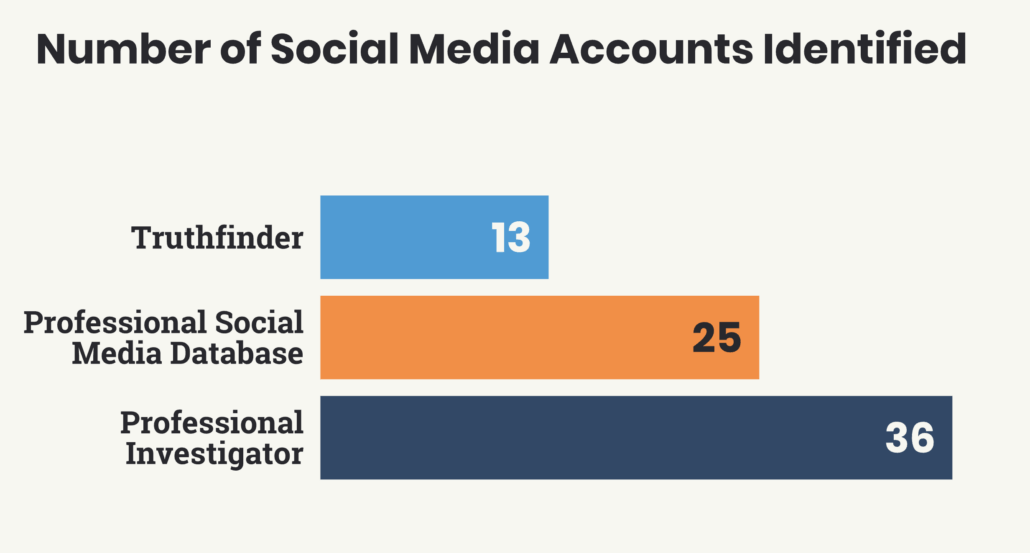
For this test, we used ten individuals for whom we recently conducted in-depth social media research. Of those ten individuals, we identified 36 separate social media accounts on the social media platforms mentioned above. In some cases, individuals had multiple accounts on the same platform, and in other cases, no social media accounts were identified for a person on a particular platform.
Out of the 36 total accounts we were personally able to identify on these various platforms, TruthFinder could identify only 13 (36%) accurately, which is not a great hit rate.
Our professional social media database found 25 of the 36 platforms (70%). Although it’s not perfect, this database does provide beneficial information (i.e., usernames or profile pictures), which can be very helpful in identifying additional accounts.
Still, the professional investigator won here, which goes to show that social media research still requires some human touch.
Addresses
We also explored the accuracy of identifying an individual’s current mailing address. To do this, we used information from 25 different individuals for whom we had accurately confirmed current addresses. These individuals were a combination of people we personally know and those from investigations we have recently completed.
For those 25 known addresses, we ran a TruthFinder background report and compared the addresses identified by TruthFinder to our known information.
TruthFinder fared much better with identifying addresses. Out of the 25 tested, TruthFinder was able to accurately identify 18 (72%) as current addresses for the people we used in our research.
This could prove most useful for a process server looking to serve a potential litigant or witness.
Criminal History
Finally, we researched TruthFinder’s ability to provide accurate criminal background information on an individual.
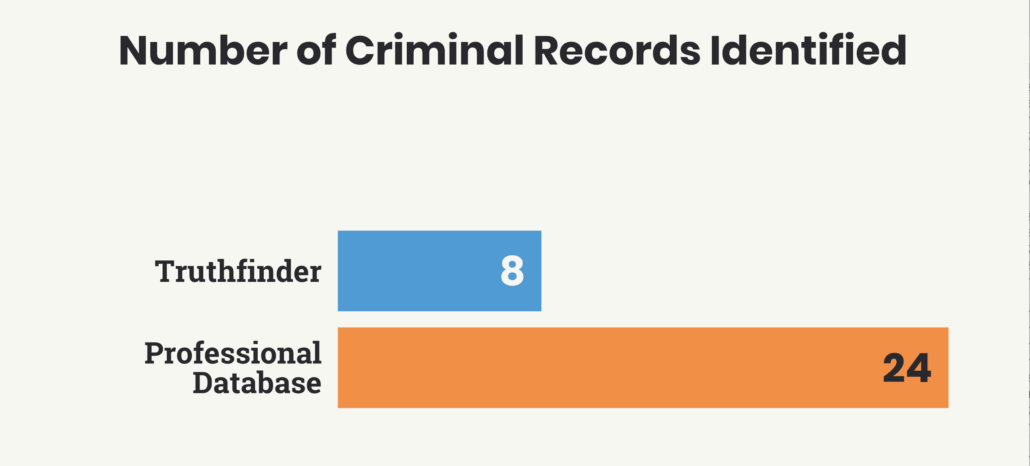
In this case, we utilized six individuals with a known criminal history, people who collectively had 24 criminal charges that were pretty serious in nature, including battery, burglary and willful child cruelty.
Four of the individuals had a collective 14 criminal offenses that we had previously identified using professional investigative databases and our own research of court documents and records. Of the 14 offenses, TruthFinder accurately identified eight. The ones that TruthFinder missed were all committed before 2000, but they were pretty serious charges, including felony drug charges and misdemeanor assault charges.
For the two remaining individuals, TruthFinder had no record at all. Although it’s not entirely clear why they weren’t in the database, given their extensive criminal histories, these individuals may have opted out of the TruthFinder database. These two individuals had some pretty significant charges of petty larceny, burglary and felony battery, so it makes sense that they might want to have themselves removed from these public databases.
These individuals were not, however, removed from our professional databases. While it is possible to have your information scrubbed from investigative databases or even have court records expunged/sealed, those are much more rigorous processes that require legitimate reasons.
Also, certain states—such as New York, where you have to shell out nearly $100 to do a criminal search through the New York State Office of Court Administration—have almost zero coverage of criminal histories in these online databases.
In Summary
If you’re looking for a cheap way to (possibly) identify some personal (but incomplete) information, TruthFinder may not be a bad option.
But if you are interested in getting reliable and comprehensive information more than half the time and from reputable sources, you might want to look to a professional.
After publishing the post, the investigator reached out to add the following comment: “I’m not surprised by your results, nor did I or have I claimed Truthfinder was as good. What I still believe is it is “good enough” for. And by that I mean, TLO/Accurint reports, while not expensive, are not cheap either and it’s often a cost not recoverable, i.e. overhead. The question is, in many situations, I’m looking for some information, enough, and often I get it via TruthFinder and a few other fixed fee subscriptions. The bottom line, I know what I’m getting, but a lot of times that’s all I want to pay for.”
https://diligentiagroup.com/wp-content/uploads/2022/06/Truthfinder-vs-Professional-Private-Investigator-Databases.png400750Brian Willinghamhttps://diligentiagroup.com/wp-content/uploads/2021/01/DG_mainlogo-navy@2x.pngBrian Willingham2022-06-22 06:00:002022-06-22 09:13:28TruthFinder versus Professional Private Investigator Databases
Even in their most basic form, nearly all background investigations will include some form of identity verification, some criminal history (the depths of which may vary), and watch list research, but there are varying levels of background investigations where you can find information, from a $19.95 online service to a several-hundred-thousand-dollar background investigation such as one done by the FBI.
And there are quite a few in between.
In general, however, background investigations are designed to reveal information in a person’s history that may call their character into question.
On one end of the spectrum is the basic online background investigation. In most cases, online background checks should be able to do a good job of verifying a person’s identity, finding any serious criminal offenses, exposing significant jail time, and identifying registered sex offenders and international terrorists.
In the simplest terms, these types of background investigations should be used to identify the terrorist, the ax-murderer, or the sex offender you wouldn’t allow within three miles of your residence.
While this has been completely oversimplified, this end of the spectrum is what you would typically find in an employment background check, where the main focus is identify verification, criminal records, terrorist watch lists, and sex offender registries. These checks may also confirm the individual’s reported degree and employment history.
At the other end of the spectrum is the FBI background investigation, where every moment from the time a person is born is scrutinized, vetted, examined, cross-checked, and investigated.
While this kind of deep vetting is saved for extraordinary circumstances like investigating people in high-ranking political positions or people involved in extremely high-stakes litigation, it is between these two extremes that background investigations can be really revealing.
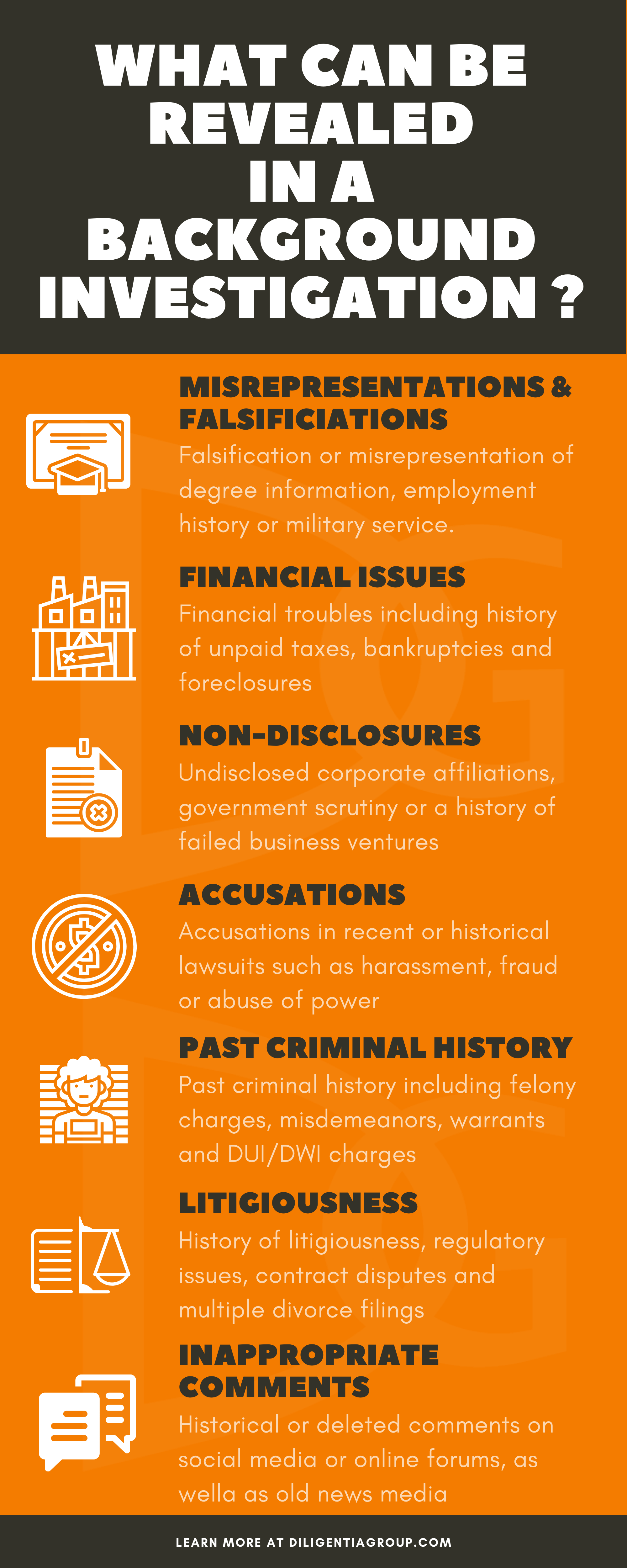
This is where you can identify much more nuanced information that can call a person’s character into question, like connections to unscrupulous organizations, a history of failed businesses, or questionable or inappropriate comments hidden deep in social media accounts.
This is also where financial issues, factual misrepresentations, lies, falsehoods, exaggerations, controversial remarks, contentious behavior, accusations, troublesome conduct, and problematic connections can be revealed; those revelations provide a broad-based picture of a person to help the client make a more informed decision.
For example, attorneys involved in high-stakes litigation may want to know more about a so-called expert or star witness; a private equity firm making a major acquisition may want to dive deep into their new president; the board of a public company may want to closely scrutinize the activities and representations of the incoming CEO/chairman of the board; a corporation may want to examine a competitor who has mysteriously come out of nowhere to steal some high-stakes accounts.
So, can a background investigation reveal whether or not you stole lunch money in the fourth grade, or whether you were jaywalking across Main Street or have a secret tattoo that nobody has ever seen?
Maybe, but I can promise you it’s going to be extraordinarily challenging, time-consuming, resource-intense, expensive, and not easy to find … unless you have some close friends in the FBI. ;)
https://diligentiagroup.com/wp-content/uploads/2020/09/What-Can-Be-Revealed-in-a-Background-Investigation_-1.png12602240Brian Willinghamhttps://diligentiagroup.com/wp-content/uploads/2021/01/DG_mainlogo-navy@2x.pngBrian Willingham2020-09-30 06:30:002020-09-17 17:11:41What Can Be Revealed in a Background Investigation?
In July, we received a call from Ruby, a middle-aged professional in Singapore who’d been in an online relationship with an American man for several months. As their relationship grew, so did her suspicions. Over the next 20 minutes, she told me a dizzying story about Rick Charles Moore, an American oil executive who had been detained in Norway for reasons unclear and needed financial support.
I know, this sounds like a typical romance scam, right?
But there were some interesting twists.
Someone on LinkedIn Viewed Your Profile
In December 2019, Rick Charles Moore invited Ruby to connect on LinkedIn. It was one of those innocuous requests that you get all the time if you’re a LinkedIn member. Although Ruby didn’t share any connections with Rick, his profile seemed legitimate enough. He was based in Kansas, had a degree from the University of Oklahoma, and worked as a project manager at BP. Rick had spent his career in the oil industry, working on oil rigs in the American Midwest before venturing abroad. He had several hundred connections, was active on LinkedIn, sharing photos and quotes, and had several endorsements from fellow LinkedIn members for his engineering and project management skills. Rick’s photo was of a middle-aged man — not too handsome and not too perfect. Just the kind of picture that nobody would think twice about.
The chatter started normally enough — friendly, but professional. After a few weeks, it got more interesting. Soon, Ruby and Rick began chatting on WhatsApp for several hours a day.
And then Rick’s problems began to unfurl.
When Rick and Ruby started messaging, he’d been based on an oil rig off the coast of Norway for a one-year project that paid him more than $240,000 — money he just couldn’t pass up. Also, Rick explained, he needed an extreme change of scenery. His wife had died in a car accident a few years before, and he wanted to explore the world and distract himself from his grief.
By mid-February, Rick was stuck on the rig. Incoming messages described an escalating crisis: After a serious battering by a winter storm, the damaged rig had started disgorging oil into the North Sea and was in “non-compliance.” Rick thought an evacuation was unneccessary, but the company did not concur. The crew was airlifted to shore by helicopter while an emergency team repaired the rig.
After a few weeks on dry land, Rick went back to the rig and spent the last weeks of his contract tying up loose ends and packing his things. His commitment was up in early March, after which he was headed back to the U.S.
In late February, Rick asked Ruby to access his bank account. He was unable to get online access from the rig, he explained.
This made no sense to Ruby, and little sense to me when she was telling the story. Why couldn’t he access the account himself? He was messaging her via the internet, wasn’t he? And who asks someone he’s never laid eyes on to access his banking information?
Rick’s request made Ruby uneasy, but she couldn’t quite put her finger on why. At this point, he hadn’t asked her for anything. All he wanted was for Ruby to access his bank account. That seemed harmless enough. Still, she demurred, and he didn’t mention it again.
An Invitation Is Waiting for Your Response
In early March, Rick was transferred to Edinburgh, Scotland. He told Ruby by phone that he was heading home via London, but before he could leave the country, he had to go to the Environment Agency of UK for some type of clearance.
Which is when things got interesting.
Rick told Ruby that his bank accounts had been “suspended” for some unknown reason, and he needed to come up with the “clearance” fine of £4,500. He only had £1,000 on him and asked Ruby to send the money to the Environment Agency in London. All of this seemed quite suspicious to her, save for the fact that Rick told her to send the money directly to the Environment Agency in London.
Ruby never said outright that she was suspicious. But she also didn’t wire the money. Instead, she hopped a plane to London, arriving on the morning of March 10th, and immediately called Rick, who was supposed to pick her up at Heathrow. The phone rang and rang. Ruby headed to the hotel and waited. She heard not a word from Rick for the next 28 hours.
Finally, a WhatsApp message appeared from Rick. He had been detained after reporting to the Environment Agency and was now being transported to Bergen, on the west coast of Norway. The reasons for his detention and removal to Norway were not totally clear.
The story was getting ever more convoluted and less believable. But for an instant, Ruby entertained an impulse to board a train for the 13-hour ride to Bergen.
And then she came to her senses, booked the next flight to Singapore, and went home.
That’s where the story should have ended.
But it didn’t.
Congratulate Rick for Starting a New Position
A week after Ruby flew home, an email from Rick’s attorney landed in her inbox. To be honest, this is the part of the story where I got a little bit lost. At this point, I was so certain that Rick was a complete fraud, which may have caused my mind to wander. But in short, the attorney told her that Rick was stuck in Norway because he couldn’t pay his fine. His bank account was still suspended, and the law firm needed Ruby’s help to transfer money between Rick’s accounts so that Rick could pay the fine from his own account.
Ruby obliged, transferring sums of $30,000 per day in various transactions, none of which came out of her own account.
I still can’t really figure out the end game here. Money laundering? Was this a trust building exercise? Or was Ruby involved in something much deeper that she didn’t want to admit to?
Nevertheless, by the beginning of July, Ruby was getting fed up. Rick was still being detained in Norway, for reasons that remained murky. She hadn’t been in direct touch with him for weeks. And the Pennsylvania attorney had chastised her by email, claiming that something she did had forced the bank to close Rick’s account. Ruby was frustrated and confused; all she’d done was follow the lawyer’s instructions.
And then Rick’s attorney asked Ruby to send the money in Bitcoin.
That’s when she contacted us.
Start a Conversation with Your New Connection
Despite the strange twists of Rick’s story and the attorney’s fishy request to send money in Bitcoin, Ruby sounded hopeful on the phone with me; some part of her still wanted to believe. She told me she’d hoped to go to Norway in person instead of sending the Bitcoin. To her mind, she had been cautious, and had done a lot of things right. She asked tons of questions. She kept documents, official-looking ones. She asked for intimate details and made careful notes.
Ruby struck me as a sensible, educated person with a good nose for the not-quite-right. If someone like her could get scammed, I figured, almost anyone could. She had logged months of mundane, hours-long chatter. She found Rick’s backstory and “perfect” American accent to be imminently believable. And in all, she was out a few thousand dollars in miscellaneous transfer fees. Rick never really got much from her.
Seemed like a lot of work for very little payoff.
The sheer volume of information that Ruby had collected about Rick made her think that he was legitimate. She had Rick’s birthdate, home address in the United States, Social Security number, U.S. phone numbers, and photos. She knew his grandmother’s name, the nursing home where Rick’s mother lived, his height and blood type. She even knew about his wife Karen’s fatal car accident on the first Friday of February, 2016. To her, all these details came together to create a robust fact infrastructure that looked like a real person’s life. And even the red flags didn’t point in any specific direction: Where was the big ask? Why hadn’t he disappeared when she refused to wire funds?
At this point, Ruby suspected that she was being scammed, but she wanted to know a few things: Was Rick a real person? Did this law firm exist?
Notifications
I get calls like this all the time. Usually, they tell a story similar to Ruby’s — and then comes a request like, “All I need to know is if Rick’s blood type is really O+” or “If you can determine that Rick’s mother is really not in that nursing home, I will walk away.” As if the blood type or nursing home lie were some final wound that would sever the fraying thread of trust for good and offer a clean break. It’s usually some ridiculous, arbitrary, and nearly impossible detail they want me to verify or disprove.
But Ruby was reasonable. She had tons of information and needed a simple answer: Was her relationship with Rick real or a sham? Had her confidence been betrayed?
Given the sheer amount of information Ruby had on Rick, I thought this would be pretty easy — which scared the hell out of me. Because I’ve seen this film enough to know that the easier the job seems at the outset, the more difficult it usually is.
I told Ruby that I would do a bit of digging on my end and get back to her with some recommendations.
I hung up the phone and couldn’t wait to dig in.
A Message About Your New Connection
Within 30 minutes, I’d done some preliminary research and set up a time to talk with Ruby again.
We spoke the next day.
Rick wasn’t real, I told her. Turns out that Rick’s web of lies wasn’t so easy to untangle.
There was no Rick Thomas Moore living at the address she had given me. It was a real house, but nobody by that name or surname ever lived at the address.
There was nobody by the name Rick Thomas Moore with the date of birth she gave me in the entire United States. And the Social Security number wasn’t real either.
The law firm was fake too. The domain name that the attorneys were using? It was set up the day before they emailed Ruby. And the attorney name she had didn’t exist either.
The final nail in the coffin were the photos of Rick. I put the photos she sent through some facial recognition tools, and what do you know? Rick was actually a Russian activist who had fled the country and was living in Spain. Every single one of the photos she sent me were on his Facebook profile.
Ruby took the news with equanimity. Her voice betrayed a mix of relief and disquiet: How could someone do this? And why? “There are many wicked people out there hurting others emotionally and financially,” she later wrote to me.
Ruby insisted on paying me, but I told her no. The only thing I wanted was for her to stop communicating with “Rick” and anyone affiliated with him.
She agreed to my terms.
Ruby also agreed to let me share her story, to help others who are navigating online relationships and wondering how much to trust, and how much to verify.
So here are some of my tips to protect yourself from master deceivers — or, at least, to mitigate the damage if you get caught up in a scam.
Scammers like to shower you with details that are tough to verify, like the fact that they ran a 4:10 mile in high school, or that they were the first person to ever eat a bowl of cereal in under 10 seconds. Random details like these “feel” true but prove nothing. Try getting data you can check out, like birthdates, copies of official documents, family names, etc.
Not only should you try to casually squeeze verifiable details out of the person, but you should write these details down — they have a funny way of changing over time. So things like: ✓ Date of birth. ✓ Social Security number. ✓ Addresses. ✓ Parents’ names. ✓ Siblings’ names. ✓Co-workers’ names.
Ruby was confident that Rick was an American because of his accent. But asking for a video call might have changed everything. Would the person on video have matched the photos he sent and the accent she knew from the phone calls? I seriously doubt it.
Don’t take photos someone sends you at face value. Typically, scammers keep a treasure trove of images they found online — it’s relatively easy to skim dozens or even hundreds of snapshots of someone from social media feeds or blogs. So first, I would suggest using one of the many tools to do reverse image searches, like Google Images, Bing Images or Yandex. Then, how about asking for a photo of your new friend at the location they claim to be messaging you from right now? Does the picture resemble your person? Does the background look like the west coast of Norway in February?
Talk to an independent third party and get their honest take. As Ruby told the story to me, she said out loud on a few occasions, “This sounds ridiculous.” Within a few minutes of talking to her, I was sure this was a scam, and I think talking to me helped her see that, too. I don’t think she’d ever told her story to anyone — in part, out of embarrassment. But when you hear yourself explain the whole story, it may sound crazy enough that it will help you change your mindset and admit the truth to yourself.
An argument I’ve heard again and again is: “But they never really asked for anything!” I’ve worked on dozens of these cases over the years. Sometimes the fraudster doesn’t want anything. Sometimes they are playing the long con, building it up for the big ask later on. Sometimes, it’s just about having some companionship, or the thrill of getting away with something. You really can’t imagine what motivates some people. All you can do is learn to protect yourself from getting hurt.
Remember that no one is immune, no matter their intelligence, education, or street-savvy. Anybody can get scammed, including billionaire investors, Nobel laureates, Harvard Law professors, and former U.S. Secretaries of State. Just knowing this can help inoculate you, to a degree, against the shame and denial that too often prevent people from taking timely action to defend themselves.
Self-awareness helps. What are your vulnerabilities, insecurities, or pressure points? Be brutally honest with yourself. Romance scammers are brilliant at exploiting desire: People want to feel lovable, attractive, generous, open-minded, compassionate, powerful, selfless or smart, so the scammer finds ways to fill that craving. But they can only fool you if you first lie to yourself.
I consider court records one of the most important and underutilized resources in an investigator’s arsenal. They are open source (anyone can access them), they are based on factual data, they can provide an intimate picture of an individual or a business and there are millions of data points (millions of cases are filed each year).
As recently as 15 years ago, the only way to search court records was by physically going to each court and searching the records either on a computer terminal or in bound books. Since the late 1990s, however, records have been computerized with increasing regularity, and the individual courts are putting their records on the Internet.
This is not true for every court, unfortunately. Many courts (probably most courts) in the United States cannot be publicly accessed on the Internet and, in some cases, still require a trip down to the court (yes, this is 2019).
This post is meant to give you a broad overview of how to do court research, but there are hundreds of exceptions here. With more than 4,000 state, local and federal courts in the United States, it’s just not possible to cover everything.
Before we get into the meat of the post, let’s discuss some general terms about what a civil lawsuit is, types of cases that are filed and some general terminology.
What Is a Civil Lawsuit?
In general terms, a civil lawsuit is a case in which an individual or a business files a dispute against another individual or business, seeking some form of damages or compensation.
Some common types of civil lawsuits are related to marital matters, personal injuries, contract disputes, discrimination, copyright infringement, medical malpractice, and evictions or unpaid rent, all of which are handled by the civil courts.
There are a number of specialized courts as well, such as the U.S. Tax Court, the U.S. Court of Claims and the U.S. Court of International Trade, which are separate entities and have their own rules regarding access.
There are two different kinds of courts in the United States — state courts and federal courts. In the most basic terms, federal courts handle cases involving a violation of federal laws (e.g., discrimination, copyright), the Constitution, cases involving the United States as a party or cases involving citizens of different states.
State courts involve cases concerning state or local laws. The most common cases are marital cases, personal injury cases or contract disputes.
For the most part, civil court cases are filed in the county or jurisdiction in which a person lives, works or conducts business (in the case of corporations).
It’s critical to understand which jurisdictions (specifically the counties) are relevant before you get started. If a person has lived and worked in Westchester County, New York, you need to make sure that you are searching state-level lawsuits in Westchester and federal-level lawsuits in New York.
While most cases are filed in the county or jurisdiction in which the plaintiff lived, worked or conducted business, there are always exceptions. For example, a person may be involved in a vehicle accident in a county neighboring where he or she always has lived. In large suburban areas like New York City, many people live outside the city in which they work.
In some instances, the case may be filed in the state in which a business was incorporated. For example, many large corporations are incorporated in tax-friendly states such as Delaware or Nevada; even if they do not conduct business in that particular state, a case may still be filed there.
Overview of State/County/Local Courts
Most state-level courts are split up by county. There is usually one “main” court in the county (typically called the Supreme, District, Circuit or Superior Court), with various smaller courts. In most instances, this main court will handle the more-significant cases, such as lawsuits involving more than $5,000.
If you are interested in being very thorough, you will need to make sure you cover both the main court and the smaller, outlying courts. In most cases, the smaller courts handle less-significant matters, such as small claims and eviction cases, which may not be all that relevant to what you are doing.
In many states, there are separate courts that handle matters such as family issues (e.g., divorce and child custody) as well as courts that handle probate matters such as wills and estates. In most cases, this requires a separate search because these courts are usually not directly wired to each other.
In summary, each county typically has one main court that handles the most-significant cases and many smaller courts for less-significant matters in terms of damages or other matters altogether.
Overview of Federal Courts
Federal courts are a little less complicated. In total, there are 94 U.S. district courts. Some states, such as Alaska, have a single judicial district, while others, such as California, have multiple judicial districts.
There are also appeals courts, where an unsuccessful party can file an appeal to have the decision reviewed. For the purposes of this post, we are discussing only originating cases, not cases on appeal.
How to Search Court Records
So now that you have a better understanding of the state and federal court systems, how do you go about searching court records?
Before conducting your search, there are few things you should keep in mind.
There is no central database.
There is no central database for searching all the courts. Despite the “millions” of records that you might find on some online site, I can assure you that they are neither complete nor comprehensive.
Databases can be quirky.
Searching databases can be quirky, so make sure you follow the directions. For example, in some instances, the full name and correct spelling are mandatory, while other databases will return names with similar spellings. Also, names may be misspelled or entered incorrectly, so be very wary of that.
In addition, some databases require you to enter a date range to search by, some have a preset date range and some will automatically search as far back as their records go. It is important to understand the scope of each online search. Sometimes a phone call to the court is necessary to confirm the scope of records available in the online database.
Last, many databases can be searched by plaintiff (the party filing the lawsuit) or defendant (the party who is being sued); make sure you search both.
Official repositories are always best.
If you are deciding which database to use, the “official repository” is always the best. Official repositories include state and federal government repositories where you can access information directly through the source — for example, PACER, the Cook County Circuit Court or the Palm Beach County Court.
The benefit, of course, is that you are using an official repository that is run by the state or federal government. It is important to remember that these repositories are only as good as the information they contain.
I can tell you with 100% certainty that all three of those sites are totally incomplete. Take my word for it.
Use multiple sources.
It is always recommended that you use multiple sources for searching records, even if you are using the “official” repository. After using one database, always try another — and don’t be surprised when you find different results.
Numerous times throughout my career, I have found records in one database and not another. Even “official” county-sanctioned databases have their issues.
The other nice thing about multiple sources is that you may be able to use more powerful searching capabilities. For example, PACER allows you to search only by first name and last name, while Bloomberg Law, LexisNexis and Westlaw allow you to search under name variations and allow you to search individual documents or docket sheets for references to someone’s name.
Civil cases don’t have identifying information.
Unlike criminal cases, which typically list some type of identifying information such as a date of birth or a middle name, civil cases do not. So, if you find a case filed against John Smith, it could be one of hundreds of John Smiths. While in some cases you may be able to determine within the court documents that the case is related to a specific person, the truth is that you may never know whether the case is related to that person.
That’s for another blog post, though.
Sources to Find State-Level Civil Cases
Online
For many counties, you can access the court records through the web. More often than not, those court records cover only the highest court in the county and not the smaller courts, but each county is different. Also, the depth of the information varies. Connecticut’s case lookup displays records for only 10 years, but at the local court, you can get records beyond that. (Insider tip: Court PC of Connecticut has been collecting records since the 1980s and is a fantastic source for historical records in Connecticut.)
Local retriever
There are thousands of local retrievers throughout the country who can search the local courts in person. They are a great source of information, too, as they know the ins and outs of their local court system. You can find a local retriever through the Public Record Retriever Network.
Third-party database aggregators
There are a number of third-party commercial database aggregators that have been collecting civil court case information for years, including LexisNexis, Westlaw, Bloomberg Law and CourtLink (which is owned by LexisNexis).
There are other third-party databases that collect information from a particular jurisdiction, such as Court PC of Connecticut , which collects Connecticut court records, and CourtTrax, which collects records from Washington and a number of other Western states.
Call the court
As a last resort, you can call the court directly (yes, using a telephone). In many small counties, you can actually call the court and they will do a search for you while you are on the phone. Or in some instances, they will ask you to submit a request by snail mail (yes, using the post office). Just a few weeks back, I spoke to a clerk in Hall County, Utah, who was able to look up a case for me while we were on the phone and email me the records.
Please don’t try calling the New York County Supreme Court, though; they will probably laugh in your face.
Or if you do call, don’t mention my name! ;-)
Sources to Find Federal-Level Civil Cases
PACER
PACER is a national locator index for federal district courts. The site is maintained by the Administrative Office of the U.S. Courts and is updated daily. You can search by party name, case number or nature of suit. You can search the entire database (nationwide), or you can search by a specific region or state.
Third-party database
Just like the state-level lawsuits, there are third-party commercial databases that also collect information on federal court cases, including LexisNexis, Westlaw and CourtLink.
Why is this recommended?
As described above, over the years, I have found many instances where cases showed up in one database and not in another for no explicable reason whatsoever. And for reasons that I cannot really explain, PACER has taken it upon themselves to remove loads of historical information.
Summary
I hope you have found this a useful guide on how to search court records. With over 17 million cases filed per year, that’s a lot of information to go through, but I hope that you now have a better sense as to how to find them.
Of course, if you have any questions or feedback, feel free to leave a comment below.
https://diligentiagroup.com/wp-content/uploads/2019/11/Guide-Search-Civil-Court-Cases.jpg522800Brian Willinghamhttps://diligentiagroup.com/wp-content/uploads/2021/01/DG_mainlogo-navy@2x.pngBrian Willingham2019-11-18 06:00:532023-05-12 16:41:05Guide to Search Civil Court Cases Like a Pro
2People who have absolutely no social network profiles (it’s 2019 people!)
3Insecure people
4People who describe himself or herself as “the only person to …” or “recognized as a world-class leader …” or “the first person to be awarded …” or “the youngest person ever to …” or “a pioneer in …”?
5People who likes to talk about themselves … endlessly
6People who don’t give you their real name
7Super-secretive people
8Those who have a “brilliant idea” every other week
9Anyone who posts anything on CraigsList
10Passive aggressive people
11People who don’t have a lot of friends (since they’ve likely pissed them all off)
12People who enjoy running
13Anyone who has tried to get you involved with something that sounds too good to be true
14Name droppers; especially the ones that drop names of people with little or no relevance to the topic at hand to impress others
15People who are constantly telling little white lies.
16People who are left-handed
17Anyone who has ever said, “Do you know who I am?”
18People who expect something in return for a good deed
19People who don’t listen
20That weird “friend” that “likes” everything you put on Facebook
21People who are desperate to be your friend
22People whose name is something like Jason Paul Smith, but goes by “Chip”
23People who constantly change their phone number
24People who don’t want you to see where they live
25Those who like to brag about themselves all the time
26Anyone who can’t hold a job for more than a few months at a time
https://diligentiagroup.com/wp-content/uploads/2021/01/DG_mainlogo-navy@2x.png00Brian Willinghamhttps://diligentiagroup.com/wp-content/uploads/2021/01/DG_mainlogo-navy@2x.pngBrian Willingham2019-11-14 08:00:412019-11-14 08:13:4027 Signs You are Dealing with A Shady Character (in GIFs)