


I’ve always been skeptical about commercially available “investigative” database websites like TruthFinder, Spokeo, BeenVerified and Intelius. These services get a bit of a bad rap for overselling their information, charging customers in perpetuity and providing inaccurate information. I wasn’t really sure how the accuracy of any of these services could compare to that of investigative databases like TLO, IDI, IRB, Tracers and Delvepoint, which can be accessed only by professionals. So I’ve sort of dismissed sites like TruthFinder as ineffective.
Recently, however, I spoke to a private investigator who “swore by” TruthFinder, noting that it was nearly as good as professional investigative databases, especially for social media data. In fact, the investigator said that he preferred TruthFinder over some of the paid investigative databases that you need a private investigator license to access.
Frankly, it shocked me.
Is it possible that commercially available websites that anyone can access with a credit card are just as good as the professional investigative databases we pay thousands of dollars for monthly and need to jump through hoops to sign up for?
When I reached out to said investigator, he noted that “swear by” is a “little strong.” Still, the investigator found it “very useful” for its flat monthly fee and its social media data, which is better than that of one of the leading professional investigative databases that focus on social media.
Then I got a call from a journalist who was writing a book, and he asked if we could help track down a former professional wrestler. I told him I felt we weren’t a great fit for this, as we usually take on more complex projects, and there was an issue with the permissions required for our databases. I explained that we must have a permissible purpose for accessing professional private investigator databases. In short, federal privacy laws protect certain types of information from being released. Nearly all commercial database providers require that you declare a permissible use, and journalistic reasons don’t fall under that category.
We tested some commercially available databases a few years back, comparing Intelius to Spokeo and BeenVerified specifically for background check reports. This time, I wanted to test the data to see how good it was, specifically phone numbers, address history, social media data and criminal records. The results of our research on Intelius, Spokeo and BeenVerified were a bit of a mixed bag, but I could see the value they provide for some.
Disclosure: If this is not abundantly clear, I was not paid to write this article and do not earn a cent by using or referencing any of these services. We paid out of our pocket to run all the searches described below, and we spent about 30 hours of research time working on this.
I wanted to do this research for a few reasons.
For one, we frequently get questions about the effectiveness of these online services. While I generally presume that the data is of far lower quality than the regulated data we have access to, I wanted to see for myself.
Also, there might be a time and a place where one of these services could be helpful, for example if we just wanted to find an old neighbor’s contact information, wanted to contact a potential business lead or had some other reason that didn’t require permission.
I was interested in a few specific areas that are extraordinarily valuable for a private investigator:
- Current telephone number
- Current address
- Social media accounts
- Criminal records
All these areas are critical for private investigators and amateur sleuths alike:
- An accurate, up-to-date phone number is crucial for interviews and identifying social media or other accounts.
- There is no simple way of identifying social media accounts. Even in 2022, it’s still a manual process, but any quick links to social media data can provide a valuable way to dig into someone’s personal life.
- Current addresses are extraordinarily valuable for process service. Additionally, identifying a person’s whereabouts and present jurisdiction is critical for conducting things like criminal record searches and litigation research.
- Last, criminal records are sort of the lifeblood of conducting investigations of individuals.
To accomplish this, we did a few things:
- For phone numbers, we found some recent telephone interviews we conducted and matched the known phone numbers to the data in TruthFinder to see if their database had the phone number at all.
- We compared the social media results on TruthFinder to those of a leading professional investigative database and also compared the results to our manual efforts.
- We picked ten addresses of known individuals we have recently investigated, as well as a mixture of friends and family members, for whom we have 100% certainty on mailing address.
- Last, we found six individuals with known criminal histories and checked TruthFinder’s records to see if they were accurate.
A Word of Caution
During our research, we found several individuals we researched were not in the TruthFinder database. We suspect this is because these individuals have decided to opt out of the database so that their information could not be viewed publicly. Everyone can remove themselves from these databases; there are websites dedicated to just that.
TruthFinder versus Professional Private Investigator Database Analysis
A couple of notes before we begin. This exercise is not a professional research project; as you can see, there are some small and varied sample sizes here. This is meant for informational purposes only and is purely anecdotal.
Telephone Numbers
We researched the accuracy of information from professional investigative databases and that of TruthFinder. To that end, we checked 50 telephone numbers that are known to be current phone numbers. When I say “known” and “current” phone numbers, these are numbers that we have confirmed with 100% certainty, where we have either personally interviewed these individuals or have confirmed that they answer the phone.
Of those 50 actual phone numbers, we ran a TruthFinder background report and compared the numbers identified by TruthFinder to those we had confirmed.
Out of the 50 numbers, TruthFinder could identify only 29 (58%) accurately.
For a professional who relies on getting accurate information, it’s not ideal, but for a member of the public trying to contact a friend or relative or even a journalist looking to reach a potential interview subject, it might get the job done.

Social Media
Next, we tested the accuracy of TruthFinder’s ability to identify an individual’s social media accounts. For the purposes of this research, we focused on only a few of the most popular social media platforms: Facebook, Instagram, LinkedIn and Twitter.
For this test, we used ten individuals for whom we recently conducted in-depth social media research. Of those ten individuals, we identified 36 separate social media accounts on the social media platforms mentioned above. In some cases, individuals had multiple accounts on the same platform, and in other cases, no social media accounts were identified for a person on a particular platform.
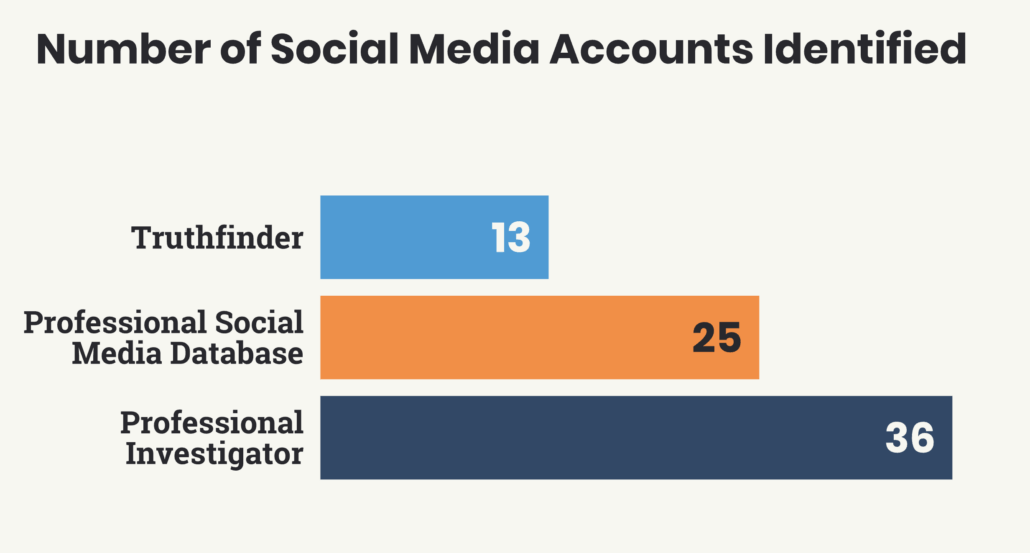
Out of the 36 total accounts we were personally able to identify on these various platforms, TruthFinder could identify only 13 (36%) accurately, which is not a great hit rate.
Our professional social media database found 25 of the 36 platforms (70%). Although it’s not perfect, this database does provide beneficial information (i.e., usernames or profile pictures), which can be very helpful in identifying additional accounts.
Still, the professional investigator won here, which goes to show that social media research still requires some human touch.
Addresses
We also explored the accuracy of identifying an individual’s current mailing address. To do this, we used information from 25 different individuals for whom we had accurately confirmed current addresses. These individuals were a combination of people we personally know and those from investigations we have recently completed.
For those 25 known addresses, we ran a TruthFinder background report and compared the addresses identified by TruthFinder to our known information.
TruthFinder fared much better with identifying addresses. Out of the 25 tested, TruthFinder was able to accurately identify 18 (72%) as current addresses for the people we used in our research.
This could prove most useful for a process server looking to serve a potential litigant or witness.

Criminal History
Finally, we researched TruthFinder’s ability to provide accurate criminal background information on an individual.
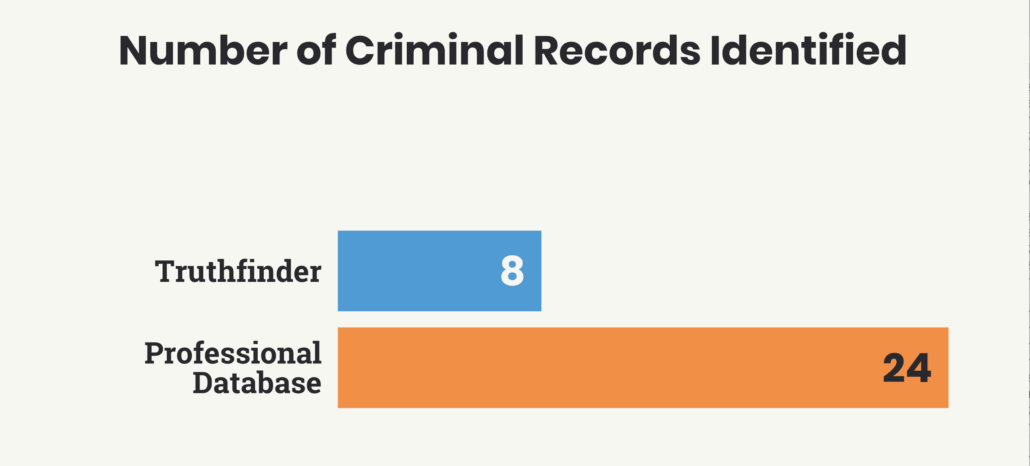
In this case, we utilized six individuals with a known criminal history, people who collectively had 24 criminal charges that were pretty serious in nature, including battery, burglary and willful child cruelty.
Four of the individuals had a collective 14 criminal offenses that we had previously identified using professional investigative databases and our own research of court documents and records. Of the 14 offenses, TruthFinder accurately identified eight. The ones that TruthFinder missed were all committed before 2000, but they were pretty serious charges, including felony drug charges and misdemeanor assault charges.
For the two remaining individuals, TruthFinder had no record at all. Although it’s not entirely clear why they weren’t in the database, given their extensive criminal histories, these individuals may have opted out of the TruthFinder database. These two individuals had some pretty significant charges of petty larceny, burglary and felony battery, so it makes sense that they might want to have themselves removed from these public databases.
These individuals were not, however, removed from our professional databases. While it is possible to have your information scrubbed from investigative databases or even have court records expunged/sealed, those are much more rigorous processes that require legitimate reasons.
Also, certain states—such as New York, where you have to shell out nearly $100 to do a criminal search through the New York State Office of Court Administration—have almost zero coverage of criminal histories in these online databases.
In Summary
If you’re looking for a cheap way to (possibly) identify some personal (but incomplete) information, TruthFinder may not be a bad option.
But if you are interested in getting reliable and comprehensive information more than half the time and from reputable sources, you might want to look to a professional.
After publishing the post, the investigator reached out to add the following comment: “I’m not surprised by your results, nor did I or have I claimed Truthfinder was as good. What I still believe is it is “good enough” for. And by that I mean, TLO/Accurint reports, while not expensive, are not cheap either and it’s often a cost not recoverable, i.e. overhead. The question is, in many situations, I’m looking for some information, enough, and often I get it via TruthFinder and a few other fixed fee subscriptions. The bottom line, I know what I’m getting, but a lot of times that’s all I want to pay for.”








A very thorough review of databases! All databases have their limitations. I use professional databases but I also use a number of the online databases. From my experience some of them are better than others. Occasionally, I find a nugget of information in a few of these online databases that does not appear in the professional databases. My advice is to use all the databases you can and compare information.
What a great article that shows how a consumer, non-regulated database stands up against fully credentialed level access sites such as IDI that make you complete an application process including a site visit in order to get access. While my view may be biased from the database world, I also come from a PI background and honestly would use any site that would get me the best information regardless of cost. My advise to all is to stack your sources and to build your best mousetrap. Thanks to Brian for writing such an interesting and real-life story that plays in todays intelligence community.