Posts

The George Santos fiasco provides a glimpse into the biggest background investigation failure I have ever seen. It was a failure on so many levels, but from the prospective of someone who does a lot of this kind of work, the “background investigation” conducted by the Democratic Congressional Campaign Committee (DCCC) had some huge mistakes.

For those who haven’t been following closely, back in November 2022, the members of his district on Long Island, New York elected George Santos to serve in Congress. He ran as a “seasoned Wall Street financier and investor,” as a graduate of Baruch College and NYU with a stellar GPA, and as someone who had worked for the likes of Goldman Sachs and Citigroup and owned a real estate portfolio of 13 properties worth millions of dollars.

After his election, it was revealed that he lied about:

He also has a criminal history, has used multiple aliases and even lied about HIS MOTHER’S DEATH! Who does that?

There have been reports that some people in his own party knew about some of this before he was elected, which is mind-boggling.

For now, I will focus on the background investigation conducted by the DCCC, which published an 87-page “research memo” (or “research book”). It’s a bit of semantics, but I will call this a background investigation. In political lingo, this is called opposition research (or oppo research), which is the practice of collecting anything and everything that may destroy the opponent’s campaign.

Before I get into the issues with the DCCC report, a few positives:

  • The author did an amazing job of sourcing the information. There are links to tweets, articles and even screenshots from databases showing political contributions. Personally, I am a big fan of sourcing the work.
  • It’s clear that they scoured news media and social media—like every single tweet and Facebook post. Doing this is time-consuming and resource intense, and so these searches are often skipped over because of that.
  • I also appreciate the fact that they put in a caveat that “this is preliminary research, and further research will be necessary on George Santos.” As someone who does this work for a living, there are always limitations, and it’s important to note it (although they could have done a better job of making that more prominent).

So, here are the biggest mistakes that came out of the 87-page background investigation of George Santos:

1)  Failure to Act

Background investigations don’t exist in a vacuum; one needs to act on the information for them to have any value.

To whoever wrote this report: I feel for you. I too have worked on cases where there was a clear need to dig further or act on the information provided. But, despite our best efforts, the people in control must make the decision to act.  

2)  Too Much Information

The average reader would have needed 3.5 hours to read the 26,000-word, 87-page report. 

87. Pages. Is. Too. Long.

[END]

3)  Long-Winded “Significant Findings” Summary

The 87-page report contains an 10-page executive summary, which included that “Santos’s website had an issues page as of January 2021, but it was later taken down” and “Santos filed a Personal Financial Disclosure covering calendar year 2020.”

An executive summary should be a snapshot of the information, with the critical points clearly laid out concisely. Whoever reads this can get a pretty good idea of what they are about without spending 3.5 hours reading the whole thing.

Not 10 pages of mostly insignificant findings.

Get. To. The. Point.

10-Pages of “Significant Findings”

4)  Lack of Analysis

Put the pieces together. There was a lot of cutting and pasting of significant portions of news articles, but there was a lack of actual analysis.

For example, the facts that Santos had multiple evictions for a few thousand dollars and unpaid credit card bills for a few thousand dollars are not particularly earth-shattering.

But when you couple them with the fact that he claimed to be running his family firm with more than $80 million in assets, and he ran on a platform as a “seasoned Wall Street financier and investor,” that adds a little weight to the evictions and unpaid credit card bills. 

5)  Reliance on Personal Statements

I see this often. A person makes a personal statement about his or her own work history, education history or fantastic accomplishment, and it’s repeated as a fact.

One of my favorite examples of this was the fraudster Mouli Cohen, a self-described billionaire who claimed that President George H.W. Bush granted him “Millionaire Residency” status, the first such honor ever bestowed.

It was repeated everywhere, but it was total nonsense.

Repetition makes lies sound true.

6)  Lack of Depth

The report indicated that Santos’ education included an undergraduate degree from Baruch and an MBA from NYU.

Page 12 of the DCCC Research Memo

Santos earned neither.

Degree verification typically requires a signed release, which the DCCC didn’t have, so it’s hard to argue that they should have caught this. But don’t just regurgitate what Santos has said in public statements.

If someone was paying attention, however, he or she would have noticed that in some places Santos indicated earning a degree from Baruch, while in other places he said he earned degrees from both Baruch and NYU.

It should have been a sign to dig further or at least raised a yellow flag. 

7)  Thin Public Records Searches

The report did well referencing sources and links, even in the public record database area. But they were too reliant on commercial databases and didn’t go directly to the sources.

The public record research was really thin, and where they really messed up was the criminal record section.

From the report:

“Santos appeared to have no criminal record.

NOTE: Further research [is] necessary to determine whether Santos has a criminal record.”

Page 82 of the DCCC Research Memo

Wait, what?

Where did they search? Did they search the fictional nationwide criminal database? And which is it? Does he have a record? Or is “further research” necessary?

I’ve talked about this endlessly before. Criminal records are misunderstood, so it’s best to be pretty specific about what was searched. Because it might bite you in the a$$.

Oh yeah, he did have a criminal record — in Brazil. Which I am guessing wasn’t part of their mythical criminal database.

8)  Understand the Scope

Santos ran on a platform as a “seasoned Wall Street financier and investor” who had worked for the likes of Goldman Sachs and Citigroup, and he reportedly ran his “family’s firm” that managed $80 million in assets, including multiple properties.

None of that is true.

If the whole reason he is there is because of this, one would think that this is something that you would want to check the veracity of.

But they never bothered to check regulatory records to see if he worked at Goldman Sachs or Citigroup, and they never bothered to check whether the “$80 million” family firm had any public-facing assets. If they did, there would have been some more yellow flags.

Avoiding Mistakes in the Future

This might be the last “George Santos” we see for a while in terms of pulling the wool over people’s eyes in such a public way.

But don’t be fooled; charlatans like George Santos are everywhere.

And this fiasco could have been easily avoided with a more intentional approach to the background investigation.

Enjoyed What You Read?

Join 2,000+ others to get insider tips and tricks delivered to your inbox from what has been voted the best blog in the investigative industry!

Newly elected congressman George Santos is probably the biggest public-facing background investigation failure that the world has seen, and it’s a good reminder for the private equity community about investment due diligence and background investigations.

In case you don’t know the whole story, George Santos was elected to Congress from his district on Long Island back in November 2022. He ran as a “seasoned Wall Street financier and investor” who had worked for the likes of Goldman Sachs and Citigroup and owned a real estate portfolio of 13 properties. Santos purportedly received an undergraduate degree from Baruch College and at one point claimed to have received a degree from NYU as well. His firm, Devolder, was reportedly his “family’s firm” that managed $80 million in assets, including multiple properties.

After his election, the New York Times revealed that much of his personal and professional history was a figment of his imagination:

  • Baruch College had no record of Santos’s attendance or degree.
  • NYU had no record of Santos’s attendance or degree. Interestingly, it appears that he stuck with his story of graduating from Baruch, save for one instance where he indicated that he also went to NYU.
  • Citigroup had no record of Santos working for them.
  • Goldman Sachs had no record of Santos working for them.
  • Santos was evicted twice for a few thousand dollars in rent, despite being a “seasoned Wall Street financier.”
  • His “$80 million” family firm had no “public-facing assets.”

Oh, and to top it off, Santos also had a pending criminal case in Brazil for check fraud!

Subsequently, other questions have been raised about his Jewish heritage and sexual orientation, and he even lied about the death of his own mother.

Frankly, the question is whether or not he has been truthful about anything. But I digress.

Nevertheless, Santos ultimately confessed that he “never worked directly” with Goldman Sachs and Citigroup, stating a “poor choice of words.” He also never graduated from any “institution of higher learning” despite claiming to do so in multiple places. 

It’s rare to see such a pathological liar to be uncovered in such a public forum. Especially with politicians, in part because there is so much at stake in politics and ridiculous amounts of money involved, so there is plenty of motivation for various parties to dig up dirt on the opposing side and feed that information to the media.

But something clearly was amiss here.

How did everyone miss this? After all, the opposition had published an 87-page report on Santos. 

Could this have happened in a private equity investment? After closing on a transaction, would it be possible that the head of the new company was an outright liar?

Probably not. There are quite a number of protections in place during the due diligence process to not let that happen.

But there are certainly a few lessons that one can extract from this epic failure. 

Avoid Your Biases

I think it’s relatively safe to say that if any of these various embellishments, outright lies or criminal activity had come up prior to the election, it probably would have changed the outcome.

At least I hope so.

And if this had come up during the due diligence process in a private equity transaction, one would hope that it would have at least altered the deal, or possibly have killed the deal altogether. I mean, imagine if the new CEO of the company that a private equity firm was purchasing for millions of dollars was an outright liar?

Of course, if zero background investigation occurred, maybe it would have been missed. But let’s just assume that some background investigation would have been conducted.

In my experience, I have seen plenty of deals go through because of what I will call conservatism bias.

Conservatism bias is the process in which people maintain their past views at the cost of recognizing new information. In the case of private equity transactions, conducting a background investigation on the key principals is typically one of the final pieces of the due diligence process. By that time, the firm has invested months of time and tons of resources into their due diligence and investment decision process.

For example, suppose in the final weeks of a lengthy due diligence process a background investigation reveals that the founder and key future employee has a history of serious financial issues, misrepresented some details of their life and has had a bit of a messy personal life. But because the firm is so invested in the process and doesn’t want to rock the boat, they cling to their prior views that the founder is a good person, so they don’t address the issues and instead continue with the investment.

I’ve seen it happen dozens of times, where firms either ignore some pretty significant red flags or underreact to the new information, all for the sake of getting the deal done.

Sometimes it works out, but sometimes it doesn’t.

Gather Data => Summarize into Intelligence => Act on Intelligence

In the case of George Santos, the Democrats had done quite a bit of opposition research.

It wasn’t for lack of information. The Democrats had published an 87-page report on Santos. For the two people that had actually read the lengthy document, there were hordes of information on his political views, and it did reference the evictions, but it didn’t get into his degree (or lack thereof), his work history, the lack of assets for his family’s firm or his criminal history in Brazil. And someone clearly spent dozens of hours scouring through every tweet he has ever made.

But there were a couple of major failures here.

Anyone can gather data, but that data does no good if it’s not turned into succinct intelligence that is acted upon.

Clearly, few people read the 87-page report in much detail, or even the 10-page-long executive summary, which included minute details such as “Santos’s [sic] website had an issues page as of January 2021, but it was later taken down” and “Santos filed a Personal Financial Disclosure covering calendar year 2020.”

It’s just too much information, if you ask me.

How about if the first few lines of the executive summary read:

  • Santos claims to have worked for Goldman Sachs and Citigroup, but we have found no information to suggest that he has ever worked at either company. Similarly, we have been unable to find any information to support his degree at Baruch College or New York University, and we have found conflicting self-reported biographies about his attendance at the schools. We have been unable to verify his degree without a signed consent form.
  • Despite running his family firm with more than $80 million in assets, including multiple properties, property record databases have not shown any documents or deeds associated with him, immediate family members or his “family run” company, the Devolder Organization.
  • In 2015 and 2017, Santos was the subject of two eviction proceedings in Queens County for a few thousand dollars, yet over the last few years he appears to have run into significant wealth, reportedly earning $750,000 a year from his company along with dividends in the $1 million to $5 million range, according to financial disclosures. 

Would that have caught someone’s attention? My guess is probably yes.

So the first failure was the inability to succinctly turn that data into intelligence.

And the second failure was the failure to act on the data.

This happens in the investment space pretty often.

A few years back, we worked with a small family office on an investment opportunity. Concerned about their reputation, the family office told us that we should contact them immediately on the first sight of any possible issues.

So when we found some criminal issues, some pretty significant professional history discrepancies and some politically sensitive social media posts, we thought the deal would be over.

But it wasn’t.

We never got any insight into why the deal ultimately went through, and we are not privy to every conversation that happens. But if I were a betting man, I would guess that this deal will eventually go sideways.

Get Permission, Obtain Forms and Address Issues Head-On

In a private equity transaction, almost certainly a situation like George Santos could have been avoided with a simple signed release and a background investigation form requiring an individual to disclose their personal and professional history and any known civil litigation and criminal history.

Not all firms require this, which in my belief is a major oversight (and a topic for another day).

In the case of Santos, he claimed to have worked for Goldman Sachs and Citigroup, and at points that he had graduated from Baruch College and New York University, although he reportedly never furnished any dates to substantiate the claims of his professional and educational history. (The missing dates should have been a clue!)

The New York Times was able to determine that Santos never went to Baruch College or New York University and never worked at Goldman Sachs or Citigroup by reaching out to the schools and companies to seek comment.

Sidebar: Most schools won’t publicly verify degree information without a signed release, but I suspect the reporter was able to get the school to comment due to the weight of the New York Times and the story. Technically, degree details are considered directory information and are available publicly. But you can only access the information through National Student Clearinghouse, which has a monopoly on this information; the website requires permission from the student. I’ve vehemently argued with the schools and National Student Clearinghouse about this topic, and it enrages me that we can no longer get this information! (This too is a topic for another day.)

The 87-page report relied on Santos’ public statements in referencing his professional work history; they didn’t even bother trying to verify this information. They obviously didn’t have his permission, but even without his permission, a little digging in regulatory filings would have probably raised a red flag.

In the background investigation process for a private equity transaction, there are certain crucial steps, one of which is verifying that the person is who they say they are. Some basic steps in this process are things like verifying their name, date of birth and Social Security number and that they are, in fact, an actual human being.

Among those steps would be to verify work and education history. It can be a pretty simple, straightforward way of determining if the person is actually who they say they are. Like, did the incoming CFO really go to that Ivy League school and work for one of the Big 4 accounting firms?

To verify employment and education history, you need a list of the person’s professional and education history. In most cases, however, verifying employment and education requires a signed release.

Best practices call for getting a signed authorization and a good background investigation disclosure form, which can gather all the relevant details in one place.

And while you are at it, it’s also a good practice to have the person self-disclose any criminal history, litigation history or other history that you might be interested in knowing more about. It gives them an opportunity to openly disclose the issues. You might be surprised by how many people don’t self-disclose information, which, in my view, can be pretty revealing about a person’s character.

And to further avoid any issues, a good practice is to address the issues head-on with the subject of the background investigation.

So, for example, if they failed to disclose certain issues, misrepresented themselves or have a history of litigiousness that needs some additional color, talk it through with the person.

Was it an oversight? A misunderstanding? Or did some additional context clarify things?

Or is there something more nefarious going on? A lack of clarity, deflection of blame or outright denial may lead you down a different path. 

In Conclusion

On the biggest public stage, George Santos, with everyone watching and an enormous amount at stake, was able to literally make up his entire life and get voted into Congress. The greatest trick he pulled was to convince the world that George Santos was someone that he wasn’t.

Even in this age of information, with so much available at our fingertips, don’t think for a second that there isn’t another George Santos out there, trying to convince the world he is someone he isn’t.

Enjoyed What You Read?

Join 2,000+ others to get insider tips and tricks delivered to your inbox from what has been voted the best blog in the investigative industry!

I’ve always been skeptical about commercially available “investigative” database websites like TruthFinder, Spokeo, BeenVerified and Intelius. These services get a bit of a bad rap for overselling their information, charging customers in perpetuity and providing inaccurate information. I wasn’t really sure how the accuracy of any of these services could compare to that of investigative databases like TLO, IDI, IRB, Tracers and Delvepoint, which can be accessed only by professionals. So I’ve sort of dismissed sites like TruthFinder as ineffective.

Recently, however, I spoke to a private investigator who “swore by” TruthFinder, noting that it was nearly as good as professional investigative databases, especially for social media data. In fact, the investigator said that he preferred TruthFinder over some of the paid investigative databases that you need a private investigator license to access.

Frankly, it shocked me.

Is it possible that commercially available websites that anyone can access with a credit card are just as good as the professional investigative databases we pay thousands of dollars for monthly and need to jump through hoops to sign up for?

When I reached out to said investigator, he noted that “swear by” is a “little strong.” Still, the investigator found it “very useful” for its flat monthly fee and its social media data, which is better than that of one of the leading professional investigative databases that focus on social media.

Then I got a call from a journalist who was writing a book, and he asked if we could help track down a former professional wrestler. I told him I felt we weren’t a great fit for this, as we usually take on more complex projects, and there was an issue with the permissions required for our databases. I explained that we must have a permissible purpose for accessing professional private investigator databases. In short, federal privacy laws protect certain types of information from being released. Nearly all commercial database providers require that you declare a permissible use, and journalistic reasons don’t fall under that category.

We tested some commercially available databases a few years back, comparing Intelius to Spokeo and BeenVerified specifically for background check reports. This time, I wanted to test the data to see how good it was, specifically phone numbers, address history, social media data and criminal records. The results of our research on Intelius, Spokeo and BeenVerified were a bit of a mixed bag, but I could see the value they provide for some.

Disclosure: If this is not abundantly clear, I was not paid to write this article and do not earn a cent by using or referencing any of these services. We paid out of our pocket to run all the searches described below, and we spent about 30 hours of research time working on this.

I wanted to do this research for a few reasons.

For one, we frequently get questions about the effectiveness of these online services. While I generally presume that the data is of far lower quality than the regulated data we have access to, I wanted to see for myself.

Also, there might be a time and a place where one of these services could be helpful, for example if we just wanted to find an old neighbor’s contact information, wanted to contact a potential business lead or had some other reason that didn’t require permission.

I was interested in a few specific areas that are extraordinarily valuable for a private investigator:

  • Current telephone number
  • Current address
  • Social media accounts
  • Criminal records

All these areas are critical for private investigators and amateur sleuths alike:

  • An accurate, up-to-date phone number is crucial for interviews and identifying social media or other accounts.
  • There is no simple way of identifying social media accounts. Even in 2022, it’s still a manual process, but any quick links to social media data can provide a valuable way to dig into someone’s personal life.
  • Current addresses are extraordinarily valuable for process service. Additionally, identifying a person’s whereabouts and present jurisdiction is critical for conducting things like criminal record searches and litigation research.
  • Last, criminal records are sort of the lifeblood of conducting investigations of individuals.

To accomplish this, we did a few things:

  • For phone numbers, we found some recent telephone interviews we conducted and matched the known phone numbers to the data in TruthFinder to see if their database had the phone number at all.
  • We compared the social media results on TruthFinder to those of a leading professional investigative database and also compared the results to our manual efforts.
  • We picked ten addresses of known individuals we have recently investigated, as well as a mixture of friends and family members, for whom we have 100% certainty on mailing address.
  • Last, we found six individuals with known criminal histories and checked TruthFinder’s records to see if they were accurate.

A Word of Caution

During our research, we found several individuals we researched were not in the TruthFinder database. We suspect this is because these individuals have decided to opt out of the database so that their information could not be viewed publicly. Everyone can remove themselves from these databases; there are websites dedicated to just that.

TruthFinder versus Professional Private Investigator Database Analysis

A couple of notes before we begin. This exercise is not a professional research project; as you can see, there are some small and varied sample sizes here. This is meant for informational purposes only and is purely anecdotal.

Telephone Numbers

We researched the accuracy of information from professional investigative databases and that of TruthFinder. To that end, we checked 50 telephone numbers that are known to be current phone numbers. When I say “known” and “current” phone numbers, these are numbers that we have confirmed with 100% certainty, where we have either personally interviewed these individuals or have confirmed that they answer the phone.

Of those 50 actual phone numbers, we ran a TruthFinder background report and compared the numbers identified by TruthFinder to those we had confirmed.

Out of the 50 numbers, TruthFinder could identify only 29 (58%) accurately.

For a professional who relies on getting accurate information, it’s not ideal, but for a member of the public trying to contact a friend or relative or even a journalist looking to reach a potential interview subject, it might get the job done.

Social Media

Next, we tested the accuracy of TruthFinder’s ability to identify an individual’s social media accounts. For the purposes of this research, we focused on only a few of the most popular social media platforms: Facebook, Instagram, LinkedIn and Twitter.

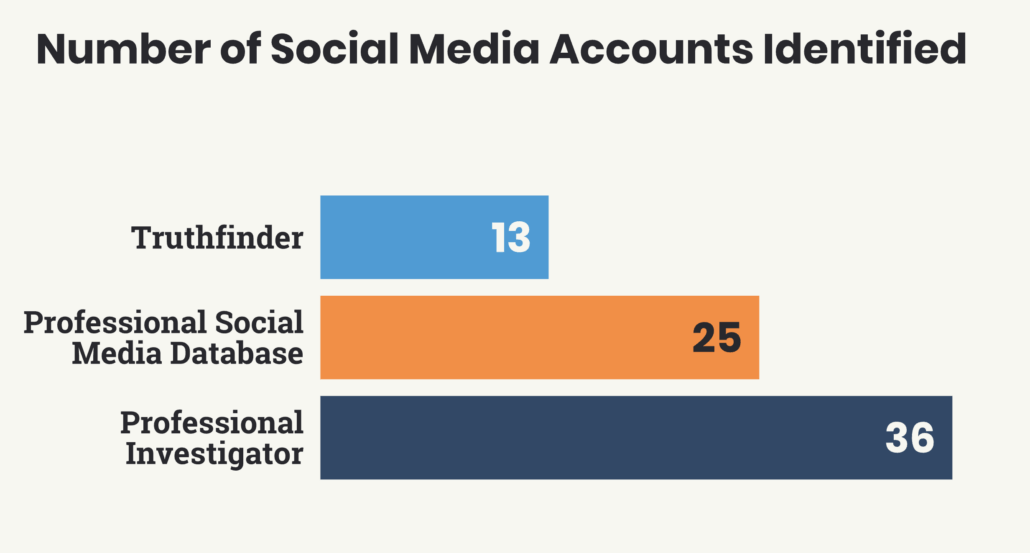
For this test, we used ten individuals for whom we recently conducted in-depth social media research. Of those ten individuals, we identified 36 separate social media accounts on the social media platforms mentioned above. In some cases, individuals had multiple accounts on the same platform, and in other cases, no social media accounts were identified for a person on a particular platform.

Out of the 36 total accounts we were personally able to identify on these various platforms, TruthFinder could identify only 13 (36%) accurately, which is not a great hit rate.

Our professional social media database found 25 of the 36 platforms (70%). Although it’s not perfect, this database does provide beneficial information (i.e., usernames or profile pictures), which can be very helpful in identifying additional accounts.

Still, the professional investigator won here, which goes to show that social media research still requires some human touch.

Addresses

We also explored the accuracy of identifying an individual’s current mailing address. To do this, we used information from 25 different individuals for whom we had accurately confirmed current addresses. These individuals were a combination of people we personally know and those from investigations we have recently completed.

For those 25 known addresses, we ran a TruthFinder background report and compared the addresses identified by TruthFinder to our known information.

TruthFinder fared much better with identifying addresses. Out of the 25 tested, TruthFinder was able to accurately identify 18 (72%) as current addresses for the people we used in our research.

This could prove most useful for a process server looking to serve a potential litigant or witness.

Criminal History

Finally, we researched TruthFinder’s ability to provide accurate criminal background information on an individual.

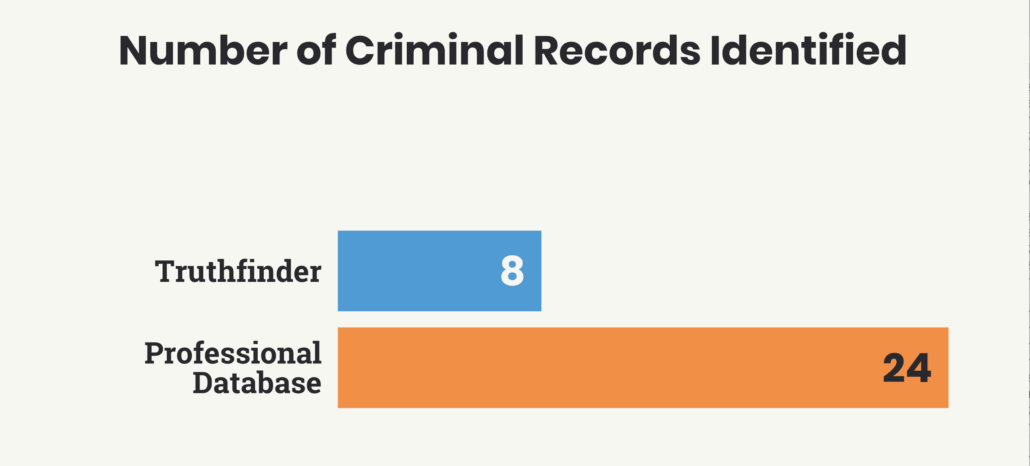
In this case, we utilized six individuals with a known criminal history, people who collectively had 24 criminal charges that were pretty serious in nature, including battery, burglary and willful child cruelty.

Four of the individuals had a collective 14 criminal offenses that we had previously identified using professional investigative databases and our own research of court documents and records. Of the 14 offenses, TruthFinder accurately identified eight. The ones that TruthFinder missed were all committed before 2000, but they were pretty serious charges, including felony drug charges and misdemeanor assault charges. 

For the two remaining individuals, TruthFinder had no record at all. Although it’s not entirely clear why they weren’t in the database, given their extensive criminal histories, these individuals may have opted out of the TruthFinder database. These two individuals had some pretty significant charges of petty larceny, burglary and felony battery, so it makes sense that they might want to have themselves removed from these public databases.

These individuals were not, however, removed from our professional databases. While it is possible to have your information scrubbed from investigative databases or even have court records expunged/sealed, those are much more rigorous processes that require legitimate reasons.

Also, certain states—such as New York, where you have to shell out nearly $100 to do a criminal search through the New York State Office of Court Administration—have almost zero coverage of criminal histories in these online databases.

In Summary

If you’re looking for a cheap way to (possibly) identify some personal (but incomplete) information, TruthFinder may not be a bad option.

But if you are interested in getting reliable and comprehensive information more than half the time and from reputable sources, you might want to look to a professional.

After publishing the post, the investigator reached out to add the following comment: “I’m not surprised by your results, nor did I or have I claimed Truthfinder was as good.  What I still believe is it is “good enough” for. And by that I mean, TLO/Accurint reports, while not expensive, are not cheap either and it’s often a cost not recoverable, i.e. overhead. The question is, in many situations, I’m looking for some information, enough, and often I get it via TruthFinder and a few other fixed fee subscriptions.  The bottom line, I know what I’m getting, but a lot of times that’s all I want to pay for.”

Enjoyed What You Read?

Join 2,000+ others to get insider tips and tricks delivered to your inbox from what has been voted the best blog in the investigative industry!

Recently, I was having a discussion with a fellow private investigator about a background investigation report that was produced by another private investigation firm. The report has some glaring holes and a lack of depth, and the vast majority of the report was a cut-and-paste job from various investigative databases.

Some of these so-called holes and what I consider big issues may have an explanation, but the background investigation report was on THE key witness in a case with major implications and a lot of money at stake. I understand that there are times when you need to cut some corners, but this was not one of them.

This happens quite often in our line of business. I’ve seen private investigators send a $15 “comprehensive report” from the investigative database provider TLOxp (owned by Transunion) to an attorney, charge them $500, and call it a background investigation.

Note to anyone who does that: attorneys can get access to TLO too.

I am here to tell you that sending a comprehensive database report to an attorney and charging them multiple times what the report actually costs is not a background investigation. It’s doing no service to anyone.

Raw data + zero analysis = no value-add.

So, here are what I see as some glaring holes in background investigations.

1) Relying on Databases With Limited Access

Background investigations rely on both public and private databases for information. These databases get information from a variety of public data (e.g., criminal records, property records, voter registration records) as well as private data (e.g., phone information, credit header information). But a database is only as good as the information contained in the database itself.

So, for example, each database has its own set of phone information, driver’s license records and criminal records, some of which are more complete than others.

But NONE of them covers everything. ALL criminal record databases have major holes; even the FBI’s national criminal database (NCIC) has some huge holes.

2) Failing to Note the Limitations

Digging deep into someone’s background takes time and effort. Sometimes clients just don’t want to pay for that time and effort, which is understandable. A client may not want to spend thousands of dollars in order to learn “everything” about someone.

If you need to go back only five or 10 years in criminal history searches because you didn’t have the budget to do criminal history searches in 14 jurisdictions, say that in your report.

If you were only looking for derogatory or controversial social media posts because you didn’t have the time to analyze 82,000 tweets, say that. 

Just please don’t say, “We searched his criminal history and found nothing.”

Because that literally means nothing.

3) Not Multisourcing

As stated earlier, databases are only as good as the information that they contain. Each database provider offers different sources of information. Some are good for some things, while others are better than others. Any good background investigation will search multiple sources of information even if they overlap. For example, PACER is a great tool for federal, civil, criminal and bankruptcy cases. But its search capabilities are absolutely archaic. And PACER will only search for plaintiffs and defendants. That’s it.

Free services like RECAP or paid services like Bloomberg Law, Westlaw and Lexis Nexis allow you to use more advanced searches to find name variations and also includes searches of the docket sheets, which can show you if someone has filed an affidavit, testified or been a witness in a case. And the paid services allow you to search the actual court filings, so you may be able to find a hidden gem of when someone was involved in a case but not named as a party.

4) Cutting and Pasting

Just the other day, a new client reached out looking for some information on her daughter’s ex-husband. The potential client told me that the last investigator had been a waste of money because that investigator had “merely cut and pasted information from PACER.”

In the age of the internet, potential clients are smart and savvy.

Don’t cut and paste information from sources that can be easily found via a few Google searches.

Leave the cutting and pasting for the kids.

5) Not Vetting Information Through Reliable Sources

I’ve spent a good portion of this post talking about investigative databases. The ones private investigators use include TracersInfo, TLOxp, DelvePoint, IDI and Accurint. In vetting other public records and news sources, sites like Westlaw, Factiva, ProQuest, LexisNexis and Bloomberg Law are extraordinarily valuable as well.

All these services have their benefits, but the one limitation that they all have is that they rely on information from elsewhere. So, for example, one of these services may report some criminal history, but in order to rely on the information, getting the information from the actual source or local court is critical. Databases get information wrong, so vetting the information from the original source is critical. 

And before you ask, all of these databases have their benefits, but none of them is the “best.”

6) Lacking Analysis

I often see background investigation reports regurgitating database information with a lack of analysis. The prime example of that would be bankruptcy and litigation records. It’s obviously useful to know that a bankruptcy is filed, but an analysis of the bankruptcy petition, which lists assets, loans, income, retirement, children, corporation interests and other valuable information would be a bit more telling. Did the person have hundreds of thousands of dollars in credit card debt? Or did they get laid off and fall on hard times?

Litigation documents can be telling as well. Do the records suggest that it’s more of a course-of-business collection case, or is there some deeper issue of abuse, threats or harassment?

Similarly, knowing that a criminal case exists is one thing, but knowing the intimate details of the filings is another.

All of this adds some contextual information, not just a data dump.

7) Including Opinions

I read a background investigation report produced where the investigator wrote that they were “very moved by his social media presence,” he appeared to be an “encourager and uplifter,” and it was “evident by his presence that he had worked very hard to reform his life and become a shining example for men like him.”

I’m not making this up.

There are so many things wrong with this I don’t know where to even start.

But, clearly, this investigator never watched “Dragnet.”

Just. The. Facts.

8) Not Researching Name Variations

One of the first steps I teach investigators is to confirm a person’s name. Seems silly, but it’s a critical piece.

Why? Well did you know that the actor John Wayne was born Marion Robert Morrison? Or that Michael Keaton is really Michael John Douglas? Or Brad Pitt is William Bradley Pitt?

Researching records on these guys would be a nightmare. Think of all the name variations that you would need to conduct searches under. Remember, computers aren’t smart enough to know that Brad Pitt and William Pitt are the same person. For example, most court records or official documents would include the real full name, while references in other places might include their stage name.

There are also married names to contend with. Like actress Jada Pinkett Smith, wife of Will Smith. She might have records under Jada Pinkett, Jada Smith, Jada Pinkett Smith or Jada Pinkett-Smith.

Conducting a background investigation under name variations is critical to providing a complete, accurate background investigation.

9) Lacking Clarity

Last, but not least, the biggest mistake I see is that a private investigator lacks the clarity of what the client is looking for.

A few months ago, I was speaking with an attorney who wanted to find “anything and everything” on several individuals involved in a multimillion-dollar lawsuit. When it came down to it, however, the client was convinced these guys were lifelong fraudsters and was really only trying to see whether they had any significant issues in their past to confirm suspicions.

Those are two very different things.

So, does your client want to make sure that the person is not a convicted felon, wanted by the FBI and on the terrorist watch list?

Is the client on a dirt-digging exercise to find “anything” that may impugn a person’s character?

Are you trying to find holes in a person’s history to challenge their credibility?

Or are you working for an investment firm that just wants to check a box to make sure that the person is legitimate?

Each of these requires a whole different approach.

Enjoyed What You Read?

Join 2,000+ others to get insider tips and tricks delivered to your inbox from what has been voted the best blog in the investigative industry!

Screen capture tools for saving social media pages and web pages is a topic that comes up frequently for private investigators. There are tons of tools out there, ranging from the simple snipping tools to complex screen capture software that “captures” metadata, timestamps and links.

There are some companies that offer really expensive tools for collecting evidence on a mass enterprise scale, like PageFreezer, X1 Social Discovery and the like. These services can cost thousands of dollars and are designed for big-data collection.

While those are amazing tools for massive cases, that’s not what most of us small investigation shops do.

More often than not, my typical use case would be when I need to:

  1. Screen capture something to add into a report;
  2. Save an entire web page to include as an attachment to a report or collecting “evidence” (I am using that term pretty loosely here); or
  3. Capture some critical piece of information that may disappear from the Interwebs (that’s a technical term).

While most of the work that I do as a private investigator does not end up in court, I constantly have an eye toward how the information is collected in case it ever does end up in court.

So, for example, if I am conducting a sensitive interview, I might want to record the interview (with permission depending on the state you are in), have a second witness with me to validate the conversation or draft a summary of the interview immediately after, and have the person sign an affidavit or declaration. That way, in case the person misremembers something or changes his or her mind, I’ve got some good backup.

Similarly, if I ever need to authenticate any of our background investigation research, I can refer to the court document, news article or corporate filings where we found the information. If needed, I can get certified copies of court documents of government filings to present in court.

More frequently, information for the vast majority of our casework is being collected via the Internet, especially social media. Since that type of information can be deleted or altered at any moment, simply including a link to a web page in our report may not be enough, since by the time it comes up, it may not be there anymore.

The more sensitive the case, the more cautious you need to be.

Warning

Before I get into the meat of this post, I am not a legal expert and don’t pretend to be. If you are doing some serious evidence collection with a lot at stake, you should first consult an expert and/or an attorney.

Don’t rely on what I tell you.

That being said, after years of collecting information, this is the process that I typically go through.

Screen Capture for Quick, Everyday Use

Built-in screenshot applications on Mac and the snipping tool on Windows computers are good if you need to capture something quickly to share. They can easily be stored on your computer and dropped into an email or report, and offer a great visual.

I also use the built-in features of Google Chrome’s “Save as a PDF” to capture an entire web page. These are typically pieces of information that are particularly interesting that I may want to refer to. What I like about this form of data collection over simply just taking a screenshot is that the text is searchable, so I can recall the information by simply searching my computer without much of a problem.

In terms of preserving evidence, neither of these ways is particularly good. Screenshots are just photos and can be easily altered; the same goes for PDFs. It doesn’t take much to alter those, either. 

I’ve got some pretty rudimentary Photoshop skills from 20+ years ago, but I am pretty sure I can alter a screenshot to make it look legit enough that nobody would be able to tell it is a fake.

Not that I would ever do that.

So, even if the initial manner in which you preserve the evidence isn’t the best, it might be important to capture something quickly, because it might be taken down.

Screen Capture for Good-Looking Screenshots, with Extra Protection

As described above, most web browsers give you the option to save as a PDF, which includes the URL and date/time of capture; most of these built-in features give you a jumbled-looking, ugly PDF.

There are several Firefox and Chrome add-ons that make the page look a lot prettier. Fireshot and GoFullPage are two of the most popular (although as of the date of this post, Fireshot for Chrome is not working). I strongly recommend the paid versions of these; they have features like adding a date and full URL.

There are a number of built-in features to make screenshots pretty by using “smart” PDF page splitting, and include the URL and timestamp on the page.

While this is similar to saving a page to a PDF, it makes it look so much better. It will look exactly like the web page as you see it, so it’s familiar to everyone. What you see is what you get; WYSIWYG for you nerds out there.

(Note: GoFullPage looks like they have a “legal” version in the works for legal professionals that seems interesting.)

So, if you need a pain-free way of collecting a web page exactly as you see it, to attach to a report or court filing, this may be a good choice.

Secure Collection

For cases that I think may end up in court or involve scenarios in which authenticity may be challenged, I turn to Hunchly.

This is where things start getting nerdy. But in short, if you need to collect evidence that may be ultimately challenged and attacked in court or elsewhere, you need to start thinking about collecting evidence to be preserved accurately and minimizing the risk of tampering.

For this, I use Hunchly, a lightweight Chrome extension that captures web pages in MHTML format, and that includes a timestamp and maintains links and metadata. What Hunchly captures is automatically timestamped, hashed and stored on your computer hard drive. So, while you are scrolling around the Internet, Hunchly is working in the background saving everything that you are doing in a secure way.

What’s great about this is that you can always go back and search Hunchly for something that you captured, meaning you don’t have to worry about recalling the exact web page of some little nugget of information that you found weeks ago.

All of the data is stored on your computer, where it can be saved for eternity.

I don’t use this in every case I work, but there are cases in which I will. In other cases, I might save a few web pages into Hunchly if they are important. This way, I’ve always got a record of them, in case it ever comes up again. 

Hunchly is not perfect. It doesn’t do a great job with scrolling web pages, like a Facebook or Twitter timeline. It also doesn’t always produce the prettiest looking pages that, for example, I can attach to a court filing.

So what do I typically do?

For sensitive cases, I will capture them through Hunchly; then, to preserve them and capture them, I will use GoFullPage to include in a report or affidavit. This way, I have the secured collection of Hunchly, with the lovely PDF that GoFullPage will produce.

(I spoke to Justin Seitz, founder of Hunchly, and he says that Version 3.0 of Hunchly is going to handle some things much better.)

Hunchly costs $130 per year and it is worth every penny for the peace of mind it affords.

For Secure, Court-Ready Critical Web Pages

The last recommendation is Page Vault. I have been using this company’s product for several years. What I like about Page Vault is that it is designed specifically for legal professionals, so they are speaking the same language as the attorneys I work with.

The captures from Page Vault look great and include all the metadata and secure hashing. But what separates this from other services I mentioned is that it keeps investigators out of the chain of custody of evidence and outsources the technical issues to an outside firm. So if there is a question about the authenticity of the documents, professionals at Page Vault can issue an affidavit about the screen capture process, and Page Vault can serve as an expert witness to describe the technology and storage process behind it.

I am pretty good at some things, but explaining the technology behind the capture process and technical jargon is not one of them.

So, my use case for this would be a one-off situation in which there were a few critical web pages that needed to be authenticated and saved and that may come into question down the road.

Page Vault starts at $100 per page capture, so it can get pricey depending on what you are doing.

Bonus Tools

One thing to consider when archiving web pages is saving the data to Archive.org, Archive.today or another third-party archiving site. As most of you know, Archive.org is the largest repository of historical web pages on the planet. It’s an incredible resource for so many things.

One thing you may not know, though, is that both Archive.org and Archive.today have ways that you can submit a URL to be archived onto their site. I use the Chrome extensions (Archive.org Chrome extension; Archive.today Chrome extension), where you can archive a specific page while you are on it.

I like this method because it’s permanently saved through a third party whose credibility is widely known. Having said that, you have to be careful what you are saving for these services, but you get the point.

Thanks to Steve Mason for starting up this conversation.

Enjoyed What You Read?

Join 2,000+ others to get insider tips and tricks delivered to your inbox from what has been voted the best blog in the investigative industry!

Even in their most basic form, nearly all background investigations will include some form of identity verification, some criminal history (the depths of which may vary), and watch list research, but there are varying levels of background investigations where you can find information, from a $19.95 online service to a several-hundred-thousand-dollar background investigation such as one done by the FBI.

And there are quite a few in between.

In general, however, background investigations are designed to reveal information in a person’s history that may call their character into question.

On one end of the spectrum is the basic online background investigation. In most cases, online background checks should be able to do a good job of verifying a person’s identity, finding any serious criminal offenses, exposing significant jail time, and identifying registered sex offenders and international terrorists.

In the simplest terms, these types of background investigations should be used to identify the terrorist, the ax-murderer, or the sex offender you wouldn’t allow within three miles of your residence.

While this has been completely oversimplified, this end of the spectrum is what you would typically find in an employment background check, where the main focus is identify verification, criminal records, terrorist watch lists, and sex offender registries. These checks may also confirm the individual’s reported degree and employment history.

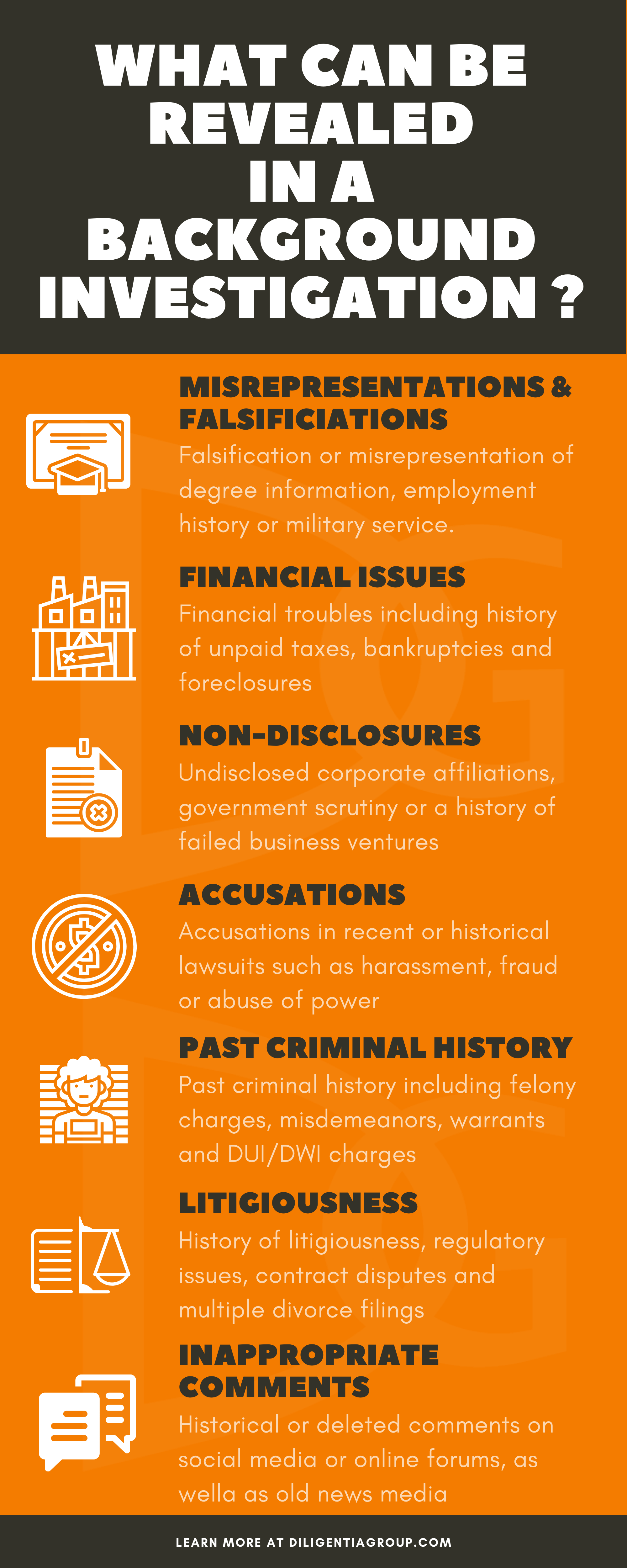
What Can Be Revealed in a Background Investigation?

At the other end of the spectrum is the FBI background investigation, where every moment from the time a person is born is scrutinized, vetted, examined, cross-checked, and investigated.

While this kind of deep vetting is saved for extraordinary circumstances like investigating people in high-ranking political positions or people involved in extremely high-stakes litigation, it is between these two extremes that background investigations can be really revealing.

This is where you can identify much more nuanced information that can call a person’s character into question, like connections to unscrupulous organizations, a history of failed businesses, or questionable or inappropriate comments hidden deep in social media accounts.

This is also where financial issues, factual misrepresentations, lies, falsehoods, exaggerations, controversial remarks, contentious behavior, accusations, troublesome conduct, and problematic connections can be revealed; those revelations provide a broad-based picture of a person to help the client make a more informed decision.

For example, attorneys involved in high-stakes litigation may want to know more about a so-called expert or star witness; a private equity firm making a major acquisition may want to dive deep into their new president; the board of a public company may want to closely scrutinize the activities and representations of the incoming CEO/chairman of the board; a corporation may want to examine a competitor who has mysteriously come out of nowhere to steal some high-stakes accounts.

So, can a background investigation reveal whether or not you stole lunch money in the fourth grade, or whether you were jaywalking across Main Street or have a secret tattoo that nobody has ever seen?

Maybe, but I can promise you it’s going to be extraordinarily challenging, time-consuming, resource-intense, expensive, and not easy to find … unless you have some close friends in the FBI. ;)

Enjoyed What You Read?

Join 2,000+ others to get insider tips and tricks delivered to your inbox from what has been voted the best blog in the investigative industry!

So, what really is a background investigation?

A background investigation takes on many shapes, forms and sizes, and is dependent on how far you want to dig into a person’s past, how much you are willing to pay for the investigation and the type of access authorized within the law.

Definition of a Background Investigation

A background investigation is the process of obtaining and collecting data from public, proprietary and other sources to determine: 1) if the person is who they say they are, 2) if the person has any adverse history and 3) the authenticity of the person’s qualifications and character.

A background investigation can take on numerous forms and the level of the information included in the background investigation is largely dependent on 1) access to information, 2) how much you are willing to pay for the information and 3) how far you want to dig into a person’s past.

Let’s break this down a little further.

Three Basic Questions in a Background Investigation

Is the person who they say they are?

A critical first step is to verify the basic details pertaining to an individual, such as a person’s name, date of birth, Social Security number and address history. Additionally, confirming that the person is not on any government watch lists, a convicted sex offender or really a wanted terrorist.

Is there any adverse history?

In addition to reviewing state and federal criminal histories, adverse history searches can include a review of any civil litigation history, bankruptcy records, judgments, and liens as well as any derogatory news media articles. It may also include reviewing social media sites for references to this person.

Can we authenticate their qualifications and character?

This would include verifying the authenticity of professional details such as employment history, education history and professional licensing history, as well as uncovering any sanctions, disputes or complaints. This may also include interviews with colleagues, business partners or adversaries to develop information outside of the public domain.

Factors To Consider

The background investigation can take on several forms, depending on several factors.

If someone working in the federal government is doing a background investigation for security clearance purposes, he or she has to have access to certain nonpublic information. The FBI background check on Steve Jobs, however, is an example of the need to access public information as well.

Dig Deeper: How to Conduct a Background Check Like the FBI

Similarly, when you purchase a gun, your name gets run through the National Instant Criminal Background Check System, or NICS, which is a nationwide criminal record repository that is also not publicly available.

For an investigator or any background screening firm, information in a background investigation is gathered from public and proprietary sources. While it may also include a review of a person’s credit history or personal financial details, this data can only be obtained with specific consent.

How Far Do You Want to Dig Into a Person’s Past?

There is a big difference between a background check and a background investigation. While we will dedicate some more time to this in a future post, in general, a background check is typically a quick way to quickly verify the integrity of a person by inputting their name into one or more databases and passing the raw data along to the end user.

Typically the information in a background check is not vetted or verified. Information in these databases can be incomplete, incorrect or stale. More troubling, the databases are usually not what they say they are, especially with regard to key areas such as criminal records.

Dig Deeper: Warning: Online Background Check Services Are Not What You Think

A background investigation is much more thorough and complete, and it includes scouring various public and proprietary databases, and analyzing and vetting the information for misrepresentations, inconsistencies, omissions, sanctions and false statements.

How Much Are You Willing to Pay?

I am sure you have seen various online services offering free or low-cost background checks. The reality is that most of the online criminal check databases and online background checks provide little more than a false sense of security.

A background investigation provides a much more thorough and accurate picture of an individual. Of course, with thoroughness, accuracy and depth, you are going to pay more.

This post is part of a series of posts titled Background Investigations 101 – What You Need To Know

Enjoyed What You Read?

Join 2,000+ others to get insider tips and tricks delivered to your inbox from what has been voted the best blog in the investigative industry!

Background investigations and background checks are all the rage now.

You can read news almost every day about background checks for gun purchases, background checks for employment purposes, federal government background checks for security clearance purposes, and nanny background checks.

There is even a school in the Chicago suburbs that conducts a “criminal background” check via a “national database” for every visitor to the school.

The confusing part is that each one of the “background checks” described above is something completely different!

What’s even more confusing is that a background check and a background investigation, although technically similar, are really completely different.

Needless to say, it’s a confusing mess.

Have no fear … we are here to help.

We have created a series of posts to explain some of the areas of background investigation and background checks.

Among the topics we will explore in this series include:

Sound interesting?

If you don’t want to miss anything, sign up for free email updates.

Guide to Hiring a Private Investigator

Enjoyed What You Read?

Join 2,000+ others to get insider tips and tricks delivered to your inbox from what has been voted the best blog in the investigative industry!